

 dyton mupawaenda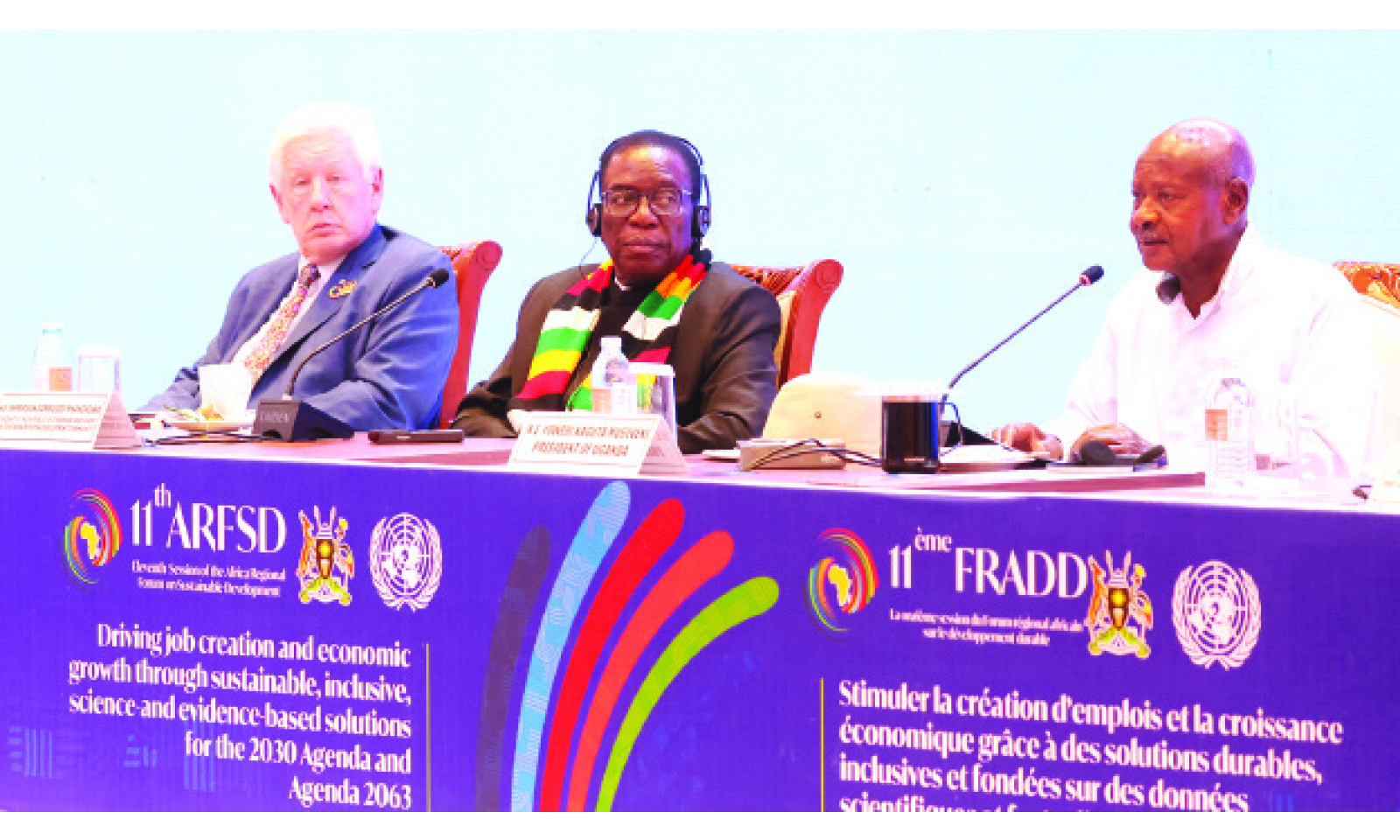
Wallace Ruzvidzo in KAMPALA, Uganda
AFRICA must produce its own food, clothing and essential goods, taking advantage of the abundant natural resources and rich heritage, President Mnangagwa has said.
The President made these remarks during a Presidential Dialogue at the 11th Africa Regional Forum on Sustainable Development here yesterday.
President Mnangagwa, who is also the chairman of SADC, said the African continent must seize control of its development and future as “Africa’s transformation will not occur by chance”.
“Let us remain steadfast in advancing the implementation of both the 2030 Sustainable Development Agenda and Agenda 2063. That responsibility lies with us, the leaders and people of this great continent.
“As Africa, we must take charge of our development and our destiny. Let us, therefore, re-commit ourselves to the guiding objectives of inclusive development, strengthening human capacities and eradicating poverty, in all its forms.
“These must remain at the centre of our shared aspirations for a prosperous and peaceful Africa,” he said.
Going forward, President Mnangagwa said Africa must jointly explore emerging technologies, as the continent stood a better chance of sustained development by maintaining a united front rather than as individuals.
“These should include harnessing Artificial Intelligence and the Internet of Things to drive productivity, build globally competitive economies, and to boost intra-Africa Trade,” he said.
On its part, the President said, SADC remained committed to the attainment of regional, continental and global goals.
“In the context of the implementation of the 2030 Agenda for Sustainable Development and Agenda 2063: ‘The Africa We Want’, the collective experiences of our countries are invaluable in nurturing evidence-based leadership, as we reflect, learn and co-create solutions towards a better tomorrow. In Southern Africa, our resolve in this regard, is firmly grounded in the SADC Treaty.
“Primarily our objective is to promote sustainable and equitable socio-economic development as well as the eradication of poverty through regional integration,” said the SADC Chair.
President Mnangagwa said the SADC Vision 2050 places inclusive development at the heart of the region’s long-term aspirations.
“We, thus, continue to strengthen institutions, broaden partnerships and entrench governance models that are responsive to current challenges and emerging opportunities,” he said.
The President said the region’s abundant natural resources offered a unique comparative advantage that must be fully leveraged to create decent jobs, sustainable enterprises and economic development through sustainable value chains, especially in commodity sectors.
“In this regard, through the SADC Industrialisation Strategy and Roadmap, the region has identified priority value chains in agriculture and mining.
“Focus is on scaling up industrialisation, diversifying industrial sectors, infrastructure development, tourism, and ICTs among others, to ultimately stimulate intra-regional trade,” said President Mnangagwa.
He said youth employability and skills development remained top regional priorities.
“Riding on the demographic dividend, SADC Member States are undertaking various education sector reforms to make education institutions Centres of Excellence for innovation, entrepreneurship and skills.
“The goal is to ensure that our young people are equipped with the appropriate knowledge and skills for ‘jobs of the future’,” President Mnangagwa said.
Additionally, he said, the region was scaling up investments in Technical, Vocational Education and Training, with a renewed emphasis on practical and digital skills to help young people and women to benefit from the ongoing technological and green transitions.
“Solutions and new products related to agri-tech, fin-tech, digital health and climate technologies, among others, have the potential to propel modernisation and industrialisation of the continent,” the President said.
In the case of Zimbabwe, President Mnangagwa said the Second Republic was leveraging on the energy, creativity and innovativeness of the youth and has thus, established Innovation Hubs which are helping to spur inclusive development.
“In 2024, my Government passed the Science Technology and Innovation Start-Up Bill, creating a legal framework for tax incentives, infrastructure access and public procurement reforms that favour youth led enterprises,” he said.
The President said key to Zimbabwe’s development success milestones towards the realisation of SDGs and Agenda 2063, was Government’s adoption of the Whole-of-Government Monitoring and Evaluation System.
“This allows the real-time tracking and performance of national programmes across sectors, enabling data-driven and people-centred governance, improved transparency, accountability and more agile institutional responses.
“At regional level, efforts by SADC Member States are also reinforced by the region’s commitment to peace, security and good governance.
“We recognise that political stability, the rule of law and peace within our borders, regionally and globally, are foundational to inclusive development and job creation,” he said.
SADC is implementing adaptation and mitigation strategies, which include climate-smart agriculture practices and the promotion of traditional crops.
To accomplish this, the SADC Chair said the establishment of irrigation infrastructure was being scaled up.
“In the case of Zimbabwe, the provision of inputs to smallholder farmers that are specific to the respective climatic regions, along with the drilling of boreholes and establishment of nutritional gardens are having positive impacts on incomes as well as food and nutrition security, at the household level.
“This transformational model is in-turn accelerating rural industrialisation, as well as the adoption of relevant technologies, which are backed by our strong traditional knowledge systems, all resulting in job creation at the community level, leaving no one and no place behind,” said President Mnangagwa.
He said the SADC Regional Indicative Strategic Development Plan 2020-2030 and the SADC Industrialisation Strategy and Roadmap 2015-2063 were the main frameworks adopted to actualise Agenda 2063 and will go a long way in achieving SDGs.
“This includes in particular, Goal Number 8, on decent work and economic growth. Employment creation and empowerment have been deemed central objectives in national development plans while the mainstreaming of these key cogs, across macroeconomic and sectoral policies, is also a priority.
“In other words, we are of the view that our fiscal and monetary policies should simultaneously promote economic stability and job creation,” said the President.
As climate change remains one of the greatest threats to developmental aspirations, President Mnangagwa said addressing its risks requires global solidarity, synergy, partnerships and investments.
“Calls for increased climate financing and technology transfer to Africa and the global south towards strengthening resilience and adaptation should remain pronounced. In our pursuit of inclusive growth, renewable energy has emerged as a vital enabler.
“Through the adoption of an energy mix that best suits our realities, our continent must see more of our communities, particularly those in rural areas, having increased access to affordable and clean energy,” said the President.
He said energy transition therefore, presented immense possibilities for green jobs for Africa’s youth and women.
“The need for infrastructure financing, while being cautious of the risk of debt burden requires us to embrace innovative financing models to leapfrog sustainable development and economic growth,” President Mnangagwa said.
“Regional collaboration in financing large-scale infrastructure projects is essential to drive connectivity and economic integration for shared modernisation, industrialisation and prosperity”.
Speaking to journalists upon arrival at the Robert Mugabe International Airport in Harare yesterday, President Mnangagwa said SADC and the East Africa Community (EAC) came together in Uganda to map a way forward towards sustainable development.
“So, in the meeting we held with the President of Uganda, we were able to discuss all these issues. Yes, other Heads of State were represented by their Foreign Ministers, but we were happy that it was a robust debate. And we were happy that both SADC and the East Africa Community were all represented in terms of respective countries from those two regions.
“And we resolved to pursue our goals as the two regions. Fortunately, from SADC, the chairman, and from the eastern region, the chairman was there. So, the two chairpersons were present. President (Yoweri) Museveni is our elder, so whenever we meet him we pay attention and learn from him. We were able to discuss issues facing our two regions. We are happy with the co-operation that is existing between the two countries,” said the President.
During deliberations in Uganda, President Museveni said Africa had the solutions to ensure sustained development.
Deputy Secretary-General of the United Nations, Ms Amina Mohammed, said Africa must confront the hard truths and ensure bold solutions are cultivated for the continent’s continued development.
The Forum brought together Heads of State, former Presidents, Prime Ministers and Ministers, among other delegates.
President Mnangagwa was accompanied by Foreign Affairs and International Trade Minister Professor Amon Murwira, Finance, Economic Development and Investment Promotion Minister Professor Mthuli Ncube and Presidential spokesperson Mr George Charamba.
The President was received at the airport by his deputies Vice Presidents Constantino Chiwenga and Kembo Mohadi, the Minister of Defence Oppah Muchinguri Kashiri, Cabinet Ministers, service chiefs and senior Government officials.



 Online Reporter