admin
admin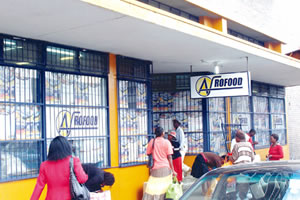
application filed by Golden Fruit 97 (Proprietary) Ltd, who had supplied beverages to Afrofood but had not been paid for the supplies.
The provisional liquidation was granted on September 12 by Justice Zhou.
According to Golden Fruit’s application, which cited Afrofood as the first respondent and the Master of the High Court as the second respondent, the retailer had breached the supply agreement with outstanding payments due to Golden Fruit accumulating to nearly US$70 000.
The applicant said it had became evident that Afrofood, once the fastest-growing supermarket chain when the country the adopted multi-currency system, was indebted to several creditors, with some having already attached most of the company’s movable assets.
It said most, if not all, of the premises where Afrofood used to operate had closed down and it was clear the business was “struggling”.
Stocks have been heavily depleted while the remaining assets were outstripped by the company’s huge debts.
“Based on the above, I believe that it is just and equitable that first respondent (Afrofood) be wound up, so that the remaining assets of the company can be liquidated to provide for some equitable distribution to creditors in an orderly way,” read part of the High Court application filed by Golden Fruit 97.
Some of the Afrofood’s assets, including vehicles and groceries, have already been auctioned.
Circumstances that may lead a company into liquidation are set out in terms of Section 206 of the Companies Act (Chapter 24:03).
These include instances where a company has, by special resolution, resolved that its operation be wound up by the court.
A special resolution is a unique declaration passed by at least 75 percent of the shareholders of a company.
It can also take place if default occurs in lodging a statutory report or holding statutory meetings.
Statutory reports may refer to annual returns lodged with the office of the Registrar of Companies while statutory meetings include AGM.
If 75 percent of paid-up share capital of the company has been lost or has become useless for the business of the company, the company can be liquidated.
For instance, if a company with US$2 000 issued share capital realises cumulative losses of US$1 500 or whose assets underpinning the business are impaired to the extent of US$1 500, it is liable for liquidation.
If a company has committed an act of insolvency that results in its inability to pay its debts, it can be liquidated. The High Court has the powers to determine whether it would be just and equitable to wind up the operations of the troubled company.


 Online Reporter