Online Reporter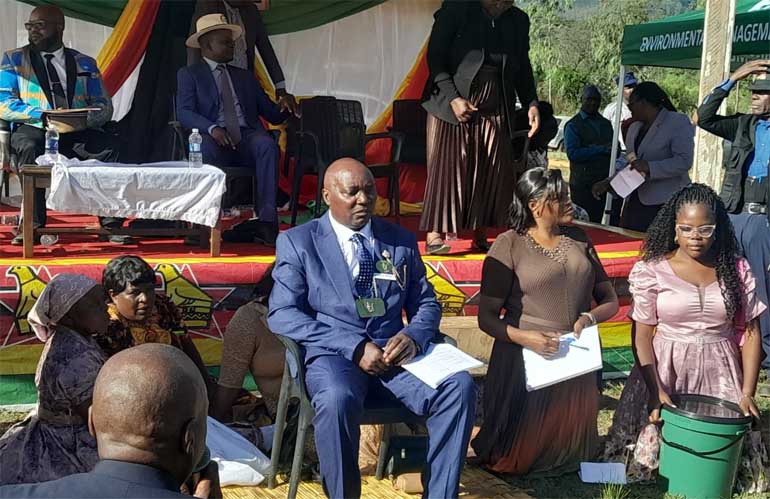
Tendai Gukutikwa
Post Reporter
FOR 74 years, the Muchena headmanship lived only in whispers.
Elders spoke of it by firelight. Family members argued over it in quiet homesteads. Politicians filed application after application for its restoration, only to watch the years slip by.
Last Friday, under a wide sky at St George’s Muchena Primary School, memory turned to flesh and bone. The drum of history, long muted, beat once more for the Muchena people.
Mr Itai Muchena (65), stepped forward and was ceremonially installed as Headman Muchena, ending a dispute that had outlived generations.
The air was thick with emotion. Some wept. Others watched, fascinated, as a chapter closed and another opened.
Yet it was not the restoration alone that held the crowd. It was the manner of it. Those who have witnessed headmanship ceremonies in Mutasa expected the familiar thunder of Shumba totem traditions – the rolling chants, sharp, symbolic songs of the vazvare, the passing of knobkerries and heirlooms – the ritual artefacts that have ushered leaders into office for centuries. None of that came. The installation moved like a held breath – quiet and solemn! Almost matrimonial in its stillness. No chants rose. No spears were exchanged.
Guests from beyond Mutasa shifted, puzzled, as the expected pageantry gave way to something older, subtler, and deeply personal.
Why so different?
The answer, Chief Mutasa later explained, lies not in omission, but in origin.
The Muchena headmanship does not spring from the direct Mutasa royal bloodline, but traces back, generations deep, to a son-in-law who married into the Mutasa dynasty.
That lineage, bound by marriage rather than blood, carries its own customs — gentler, reserved, and shaped by a history that walks a parallel path to the Shumba throne.
And so, last Friday, tradition did not roar. It whispered.
After 74 years, the Muchena name was restored, not with clamour, but with the quiet dignity of homecoming.
“The Muchena family are sons-in-law of the Mutasa Clan. Way back, Abraham Muchena married a daughter of Chief Mutasa. The late Chief Tendai Chifambausiku’s policy was to ensure that all sons-in-law had proper upkeep to take care of his royal daughters – he did not want to see his daughter or grandchildren suffering. If a son-in-law could not take care of a Mutasa daughter, the Mutasa Clan would chip in and ended up taking care of both our daughter and that son-in-law. We do that up to now, we cannot stand to see our sisters and daughters suffering out there. We take care of our mukuwasha (son-in-law),” said Chief Mutasa.
Unlike most headmanships in the area, which belong to the Shumba (lion) totem, the Muchena family belongs to the Mhofu (eland) totem.
That distinction, Chief Mutasa said, meant the family follows its own customs and traditions, even when installing their traditional leader, despite being under the Mutasa chieftaincy.
“We do not impose the Mutasa traditions and customs when performing rituals for a son-in-law’s family. Our role is to officiate as we are the chiefs of the land, but we let them perform their own rituals according to their traditions and customs. So in this case, the Muchena family are performing their own rituals, however, different they might be to ours,” said Chief Mutasa.
The ceremony reflected exactly that – the new headman did not walk into the arena on his own feet.
Instead, he arrived carried on the back of a relative, his face completely hidden beneath a white veil, like a new bride.
He was put on a reed mat, where he sat besides his wife, also covered beneath the same cloth. The reed mat had been carefully laid in the middle of the ground for all to see the revealing of their new leader.
Flanking them were Headman Muchena’s sisters, seated uncovered on either side like silent guardians of the sacred process.
Across from them and on the same ground, sat members of the Muchena family with bowed heads – a gesture of reverence and submission to the authority being ushered into existence before them.
The atmosphere was tense, but respectful. Then came the defining moment.
Chief Mutasa rose, and before he instructed the new headman’s sisters to carefully remove the white cloth covering him and his wife, he chastised them on whether they were clean or not.
“You cannot be seating on that reed mat with your brother if you were intimate with your husbands or lovers last night. Also you should not be playing with black magic to be on that mat. You need to be clean, otherwise, you will spoil this headmanship,” he said.
Once the sisters agreed that they were ‘clean’, Chief Mutasa instructed them to unveil the couple.
As the veil lifted, ululations erupted from the crowd, especially from the family members that sat across them on the ground. They celebrated peacefully, no loud chants and no profanities sung as they saw their new traditional leader unveiled for the first time. The moment resembled the lifting of a bride’s veil at a wedding ceremony.
Unlike other installations in the area, there were no traditional weapons, no knobkerries, no ancestral artefacts and no heirlooms presented before the new headman. To outsiders, the omissions may have appeared unusual.
However, to the Muchena family, the ceremony was complete.
Family elders insisted those were the customs handed down through generations.
In an interview, Mr Nathan Muchena said that is how they perform their ceremonies within the Muchena family.
“This is how we are unique as a family. Our customs differ from those of the next headmanship even though we are under the same Chief,” he said.
The ceremony also marked the end of years of disputes surrounding the headmanship.
Chief Mutasa acknowledged that confusion and contestation had plagued the position after its abolition decades ago.
“As the new headman, you should know that this headmanship had been abolished, but now we have restored it. There had been confusion where everyone wanted to be crowned headman. As a result, we ended up looking for a fitting and proper family member to become the headman. Be organised as a family. This headmanship is not for you to fight over,” he said, also warning outsiders against interfering in the Muchena family affairs.
The restoration of the headmanship was welcomed by Minister of State for Manicaland Provincial Affairs and Devolution, Advocate Misheck Mugadza, who described the development as a victory for cultural identity and rural development.
He thanked President Emmerson Mnangagwa for approving the restoration of the headmanship, which was abolished in 1952.
Minister Mugadza traced the origins of the dispute to historical divisions within the Muchena lineage dating back to the 18th century.
“Within the Muchena family, there are two houses of Chitombo and Zvomoyo, and it is within those two families that a headman is supposed to be chosen from. The new headman is of the Chitombo house. When the headmanship was abolished in 1952, many Muchena villagers were resettled in Chiadzwa, Tonhorai and Nyamajura (Mutare District), leaving the land for settlers. The headmanship is back now. It has been many years since people started applying for the resuscitation process,” he said.
Minister Mugadza paid tribute to several political and community figures, he said played critical roles in pushing for the restoration, including Cde Didymus Mutasa, Cde Oppah Muchinguri-Kashiri, the late Cdes Edgar Tekere, and Movern Mahachi.
Minister Mugadza also said restoring traditional leadership structures is essential for development.
“As Government, we are elated by this restoration because areas without traditional leadership often lag behind in development. The new headman must ensure peace, development and proper administration in his area,” he said.
He reminded Headman Muchena of his responsibilities under the Traditional Leaders Act, including assisting the chief, maintaining peace and reporting criminal matters to the police.
The newly installed headman was born in 1961. He attended St Mary’s Mafara Primary School, and later Jombe Secondary School, before training as a police officer in 1979.
He joined the Criminal Investigation Department (CID), where he served as a detective until 2005 when he retired.
Minister Mugadza said his policing background makes him well suited to preside over community disputes and traditional courts.
The headman, who has one wife and seven children, pledged to serve his people fairly and preserve the dignity of the restored institution.
“I accept this responsibility with humility. This is not a victory for one individual, but for the entire Muchena family and community.
“I will work to unite our people, preserve our traditions and ensure peace and development in this area,” said Headman Muchena.
ENDS