Online Reporter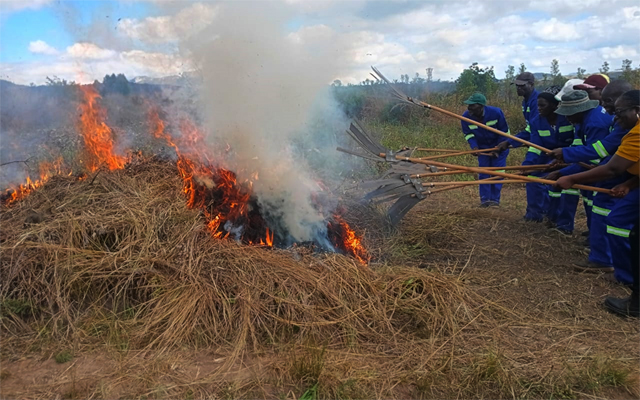
Lovemore Kadzura
Post Reporter
THE once-thriving commercial timber empire of Manicaland, nestled in the pine-clad mountains of the Eastern Highlands, is bleeding away hectares of forest as a toxic cocktail of raging veld fires, rampant illegal gold panning, sprawling settlements, and crippling seed shortages strangles production.
Industry experts warn that the relentless onslaught has hollowed out Zimbabwe’s timber reserves so severely that companies are now forced to truck in logs from Mozambique and South Africa just to keep sawmills and furniture factories running.
The crisis is most acute in Nyanga, Mutasa, Mutare, Chimanimani, and Chipinge, where fire seasons have for years reduced thousands of hectares of prime pine, eucalyptus, and wattle to ash.
Flames are only part of the devastation as illegal gold panners gouge out plantation soils, leaving scars of erosion, while unauthorised settlements steadily carve into forest estates, transforming once-verdant landscapes into wastelands of stumps and dust.
Timber Producers Federation chief executive officer, Mr Darlington Duwa, said the sector is fighting back despite punishing setbacks.
He noted that the industry is “holding the line” by planting an average of 8 000 hectares of trees every year.
To survive, producers are importing seed from South Africa to plug crippling local shortages, investing millions in state-of-the-art fire-fighting equipment, and lobbying Government and law enforcement agencies to evict illegal miners and settlers from gazetted plantations.
A raft of emergency measures is being rolled out to salvage the sector, which underpins thousands of jobs and anchors Zimbabwe’s construction, paper, and export industries.
“Veld fires affect the timber industry, especially the resource base. Right now, there is a huge shortage of timber on the market due to veld fires. Around 2007, the industry lost some 10 000 hectares, and significant areas are being lost every year. Timber takes some time to mature and that gap has not yet been closed by the replanted trees. We are now importing timber and prices have gone up due to the shortage.
“The industry has been planting extensively for the past eight years. The target is to plant at least 8 000 hectares per year and achievements vary between 5 000 and 7 000 hectares per year. We have intensified planting despite the shortage of germplasm, sourcing seed from South Africa as the Forestry Commission is not adequately supplying the industry. The industry has invested heavily in fire-fighting equipment, especially fire trucks, and is also conducting staff training so that employees are competent in combating fire outbreaks. We are also working with communities, including traditional leaders, to raise awareness so that they do not cause fires. We have fire committees that focus on fire suppression activities, campaigns and other initiatives.
“Illegal gold panning is a major challenge for us, contributing to the shortage of the resource. Forests such as Tarka in Chimanimani are almost gone – there are many illegal settlers and panners in the plantation. The panners leave huge open pits, making access and harvesting impossible. At times, they are also hostile and chase away our workers. We have our own security guards and also rely on the Zimbabwe Republic Police (ZRP) to remove the illegal occupants, but they keep coming back. We have engaged the Ministry of Mines and Mining Development so that it does not issue permits for gold mining in our plantations,” said Mr Duwa.
Speaking at the Provincial Fire Week launch held at Domborutinhira Secondary School in Mutasa Central last Wednesday, the Environmental Management Agency (EMA) Manicaland provincial manager, Mr Rambwayi Mapako, revealed that last year veld fire incidents dropped by half compared to 2024, attributing it to awareness campaigns by the agency and other stakeholders and buy-in from communities.
“In 2025, a total of 2 997 veld fire incidents were recorded, and 985 314,73 hectares were lost across the whole country. These veld fires destroyed property valued at approximately US$7 217 202, and resulted in three veld fire-related deaths being recorded. Coming down to Manicaland, the province lost 37 400ha of land due to veld fires in 2025 compared to 74 083ha in 2024, translating to a 49,52 percent decrease in hectarage burnt by veld fires.
“The most affected were Makoni and Nyanga districts, with records showing that the Nyanga National Park area experienced the worst fires and the largest areas lost. Veld fires have become one of the greatest environmental challenges of our time and an issue of national concern given their wanton destructive nature to the natural resources, property and human life.
“Manicaland has not been spared from the destructive effects of veld fires. The province is rich in both timber and non-timber forest products, which play an important role in supporting livelihoods, employment and economic development in the district,” said Mr Mapako.
Minister of State for Manicaland Provincial Affairs and Devolution, Advocate Misheck Mugadza, who was represented by the deputy director provincial coordination, Mr Past-tense Tarondwa, called upon the people to jealously guard the environment as it is key in promoting tourism, food security and climate resilience.
“Section 73 of the Constitution of Zimbabwe guarantees every citizen the right to an environment that is not harmful to their health and well-being and obliges us to protect the environment for the benefit of present and future generations. “Protecting our environment from veld fires is therefore, not only a moral duty, but also a constitutional obligation. Veld fires are not merely an environmental issue; they are a major development challenge. They threaten biodiversity, food security, tourism, climate resilience, human safety, infrastructure and rural livelihoods. Each uncontrolled fire destroys valuable natural resources, undermines economic activity and reverses hard-won development goals. Manicaland is richly endowed with some of the most spectacular natural resources in the country. From the majestic Eastern Highlands to the breathtaking landscapes of Nyanga and Chimanimani National Parks and the Bvumba Mountains, our province is home to indigenous forests, wetlands and vital water catchment areas that sustain both people and nature,” said Minister Mugadza.