Online Reporter
Ray Bande
Senior Reporter
THE Government is intensifying efforts to improve safety standards in Zimbabwe’s artisanal and small-scale mining sector, with plans to harness modern technologies, including artificial intelligence, surveillance systems and internet connectivity, to reduce fatal accidents and protect miners.
ZANU PF national spokesperson, Cde Chris Mutsvangwa, said President Mnangagwa is committed to transform Zimbabwe into a leader in mining safety on the continent.
Addressing thousands of party supporters at the Constitutional Amendment Act No. 3 Thank You Rally in Mutare last Sunday, Cde Mutsvangwa said the President has prioritised the wellbeing of artisanal miners, whose contribution to the country’s economy continues to grow.
“The President told me that we are going to create the safest mining environment in Africa. If it means deploying Starlink, cameras and artificial intelligence in mining shafts, then so be it.
“There should no longer be anxiety among mothers and wives whenever their sons or husbands go underground in search of gold. President Mnangagwa is deeply concerned about the safety of our miners because this sector has become one of the country’s major sources of foreign currency,” said Cde Mutsvangwa.
Zimbabwe’s artisanal and small-scale miners have emerged as key contributors to gold production in recent years, accounting for a significant share of national deliveries to Fidelity Gold Refinery.
Cde Mutsvangwa said the country’s development agenda under President Mnangagwa is anchored on long-term infrastructure investments designed to sustain economic growth.
He urged Zimbabweans to remain patient as the Government continues implementing major projects across the country.
“Through the constitutional amendments that you supported, President Mnangagwa is focusing on building infrastructure that will sustain the country’s growth. Roads, railways, dams and other strategic projects require time and resources. These are not overnight achievements,” he said.
“By 2030, Zimbabweans will witness significant transformation in infrastructure development across the country,” he said.
Turning to agriculture, Cde Mutsvangwa expressed confidence that tobacco prices will recover following the Government engagement with international markets and tobacco buyers.
His remarks come after the close of the 2026 tobacco marketing season, during which growers delivered more tobacco than in the previous year, despite a decline in earnings and average prices.
According to Tobacco Industry and Marketing Board statistics, farmers sold 353,8 million kilogrammes of tobacco during the 2026 marketing season, compared to 347,3 million kilogrammes in 2025.
However, total revenue declined by 24 percent to US$882,5 million, down from US$1,1 billion recorded last year. The average price also dropped from US$3,33 per kilogramme in 2025 to US$2,49 per kilogramme this season.
Despite the downturn, Cde Mutsvangwa said the Government is working to improve returns for growers.
“Tobacco production has grown from about 20 000 tonnes around 2008 to nearly 400 000 tonnes today. This growth is a result of deliberate policies introduced under President Mnangagwa.
“Our President is engaging trading partners and tobacco-buying countries to ensure that prices return to more favourable levels. Cabinet is also seized with the matter,” he said.
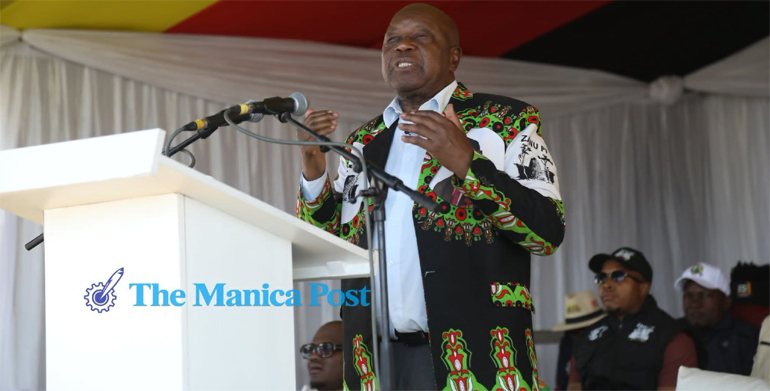
Speaking at the same event, Minister of State for Manicaland Provincial Affairs and Devolution, Advocate Misheck Mugadza, said attention is now firmly focused on accelerating development projects across the province.
He said Government is prioritising investment, industrialisation and job creation following the enactment of Constitutional Amendment Act No. 3.
“From the Government’s perspective, this matter is now settled. It is done and dusted. Our focus is on development, development and more development.
“We appreciate His Excellency, President Mnangagwa for signing the Bill into law. What we now want is to ensure that development reaches every corner of Manicaland,” said Minister Mugadza.
He highlighted several strategic projects underway in the province, including upgrades at Forbes Border Post and construction of the Christmas Pass Bypass Road.
Minister Mugadza also pointed to growing industrial activity in the province, saying value-addition projects are creating employment opportunities and strengthening the local economy.
“Tanganda Tea Company is now investing in avocado processing, while Wattle Company is expanding into pulp value addition. In Dorowa, fertiliser production initiatives will reduce the country’s reliance on imports.
“So many positive developments are taking place in Manicaland, and these projects are creating employment opportunities for our people,” he said.
He added that research conducted by provincial authorities indicated that Manicaland currently has about 4 200 job opportunities across various sectors, and urged industries to consider returning Zimbabweans when recruiting workers.
“We have many compatriots returning from neighbouring countries, including South Africa. As we create jobs, we must ensure that returning citizens are also integrated into our growing economy,” he said.