Chronicle Editor
Nqobile Tshili, [email protected]
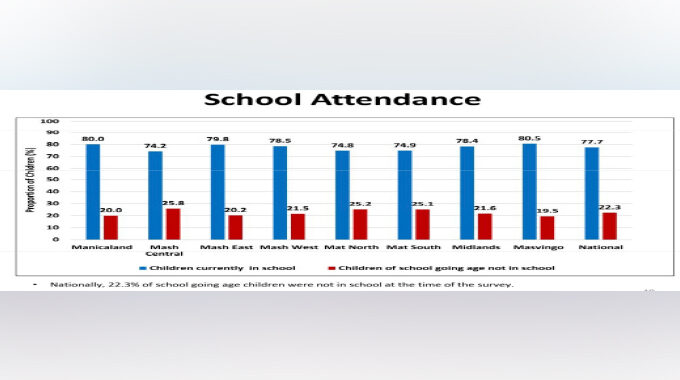
MATABELELAND North and South provinces have a significant 25 percent of children of school-going age not attending school with the alarming dropout rate being attributed primarily to early marriages and poverty, among other challenges.
According to the Zimbabwe Livelihoods Assessment Committee (ZimLAC) Rural Livelihoods Assessment (RLA), financial challenges, children considered too young, pregnancy and early marriages, illness, and the need to care for other household members are some of the factors behind the drop-outs.
Other contributing factors noted in the report include a general lack of interest in education and long distances to school.
The report is produced by an inter-government agency and coordinated by the Food and Nutrition Council, a department in the Office of the President and Cabinet. The report covers the country’s eight rural provinces.
The report shows that the “out-of-school children” in the two provinces were above the national percentage of 22 percent.
“Nationally, 22,3 percent of school-going age children were not in school at the time of the survey. Financial challenges (10,3 percent) were reported to be the main reason why children were out of school,” reads the report.
Educationists said there is a need for a comprehensive approach to tackle the crisis. Lupane State University (LSU), which has been making interventions to reduce zero pass rates in primary schools in Matabeleland North said poverty is the main factor contributing to non-attendance of school by the school-going age groups.
LSU’s acting Dean of Humanities and Social Sciences, Dr Mbulisi Ndlovu, said there is a relationship between poverty and access to education.
“Matabeleland North is one of the poorest provinces in the country, and parents can’t afford the cost of education. Being a poor province means that the standard of living in the province is low, and the schools that are there are poorly resourced and can’t attract or retain learners in schools,” said Dr Ndlovu.
He said Matabeleland North ranks second in the country after Manicaland in terms of early marriages, which also contributes to children dropping out of school. Dr Ndlovu said some parents do not value education and encourage their girl children to marry early for little financial benefits.
Early marriages disrupt the education of many young girls, forcing them to abandon their studies to assume domestic responsibilities. The practice not only curtails their educational opportunities but also perpetuates the cycle of poverty, as these young girls often lack the skills and qualifications needed for better employment opportunities.
Dr Ndlovu said the issue of access to national documents has also contributed to depriving some pupils of access to education.
“Lack of registration documents like birth certificates, parents — most of them teenage parents — migrate to neighbouring countries leaving their children without birth certificates hence they can’t be enrolled in schools,” he said.
“Government has since mandated the civil registry department to make sure that measures are put in place to help such children get documents. The issues of long distances to schools have also seen an increase in the number of children dropping out of school.”
Dr Ndlovu said locals should also play a role in changing the narrative as far as education is concerned.
“While the Government has a lot to do in improving the learning situation in Matabeleland North, locals have to take it upon themselves to rewrite the education story in their province. There is an urgent need for change in perception of education and its values in the development of a society,” he said.
Zimbabwe Teachers Association (Zimta) chief executive officer Dr Sifiso Ndlovu said poverty is one of the driving factors pushing pupils away from schools.
“This report shows that we have a long way to go in terms of ensuring that all the children have access to education. There could be so many factors that come to play, with one of them being poverty,” he said.
“With such high statistics, between 50 to 70 percent of the children need support from the Basic Education Assistance Module. But in reality, BEAM has not been forthcoming for all the learners.”
BEAM assists vulnerable learners so that they access education.However, despite this programme, a high number of school-going children are still out of school.
Dr Ndlovu said a shortage of teachers also contributes to some of the pupils dropping out of school
“Also, the teaching of learners in languages that they are not conversant with, especially in Early Childhood Development, can discourage an interest in education. So Matabeleland region has lost in human resources development as there are teachers who don’t speak local languages,” he said.
Dr Ndlovu said the Government should also ensure that the school feeding programme reaches all the schools as there is evidence that feeding learners in school helps retain pupils.
Dr Ndlovu said while the country’s educational policy supports that pupils who fall pregnant can return to class, conditions in schools are still not so accommodative for young mothers to continue with their education.
Faculty of Science and Technology Education Executive Dean at the National University of Science and Technology (Nust) Professor Lwazi Sibanda said poverty is one of the major hindrances to access to education.
She said in some rural areas, children may not have enough resources that enable them to access education.
“Some of them live with elderly grandparents and it becomes a challenge for them to access education. They will not have the requisite financial resources.
“Poverty becomes a major barrier to access to education and when they are uneducated it becomes difficult to break the poverty cycle,” she said.
Prof Sibanda said to break the poverty cycle, there is a need to target those children for skills development.
“Skills development will ensure that even those who are not formally educated have a survival skill so that they manipulate resources within their community to develop themselves. They will get entrepreneurial skills as some of them would have passed the stage of formal education. —@nqotshili



 Online Reporter