admin
admin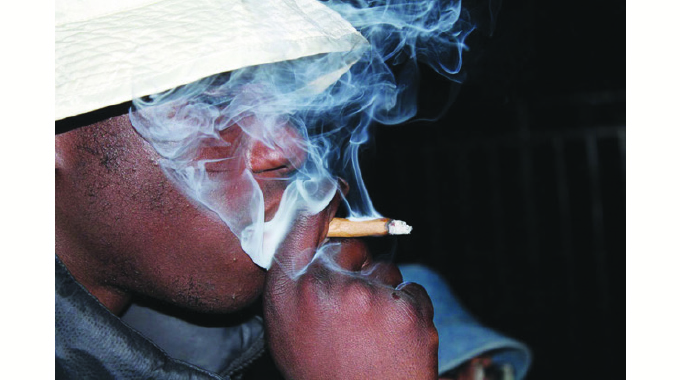
Paidamoyo Mutsvairo-Correspondent
Abuse of substances and drugs has become rampant among global nations, and Zimbabwe has not been spared.
It is saddening that, worldwide, adults, young adults and school learners, including pupils as young as 10 years are involved in drug abuse.
Abuse of drugs by learners has negatively impacted on schools pass rates.
Also, in Zimbabwe, the rate of school dropouts has previously increased due to many factors, and chief among them drug and substance abuse.
Apart from affecting school work, drugs are a major threat to people’s health. Most people who abuse drugs suffer from chronic diseases, including lung failure.
The future of Zimbabwe is premised on today’s youth, who would be entrusted with the responsibility of carrying the country economically, politically, socially, and culturally.
Thus more should be done to minimise or arrest the issue of drugs and substance abuse.
Locally, drugs such as Broncleer cough syrup, marijuana (mbanje), crystal methamphetamine (mutoriro/dombo/guka) and jelly substances from diapers are taken by many young adults as they attempt to get charged.
Most of these drug abusers go for several days or weeks without eating food.
They believe that because of these drugs, there will not be any need for food and thus they can only survive on water.
Also, some of the drug abusers spend about one to two weeks without sleeping. However, some school of thought say the issue of drug abuse is somehow linked to Satanism.
This is because those that become part of the substance abusers are usually initiated into drugs by friends, just like what happens in Satanism.
Usually in schools, pupils join drug abusers through peer pressure.
It is worrisome that the gospel against drug abuse has been, and is always being preached against in churches, schools, work places, communities and social media platforms.
It is also unfortunate that the gospel seems to be falling on deaf ears, as most of the drug abusers pay no attention to it.
Instead of having reduced cases, the numbers of substance abusers continue to surge by each day.
What bothers most is that the areas where these drugs are sold in high density suburbs such as Mbare, Glen Norah, Glen View and Highfield, are known.
They usually refer to the places as bases.
Some of the people who also sell these substances are known, and it is up to the law enforcement agents to move in and arrest them.
At times, police raid the places to curb the malpractice and this should be intensified.
Yet, raiding the bases alone is not enough. Thus, there is need by policymakers and the law enforcement agencies to put in place tough measures on those who smuggle, distribute, sell and consume drugs.
It is high time that the police or the law treat all drug abusers as criminals and not victims.
For instance, in January this year, Dominican Convent School in Harare expelled eight girls who were abusing drugs.
However, expelling the girls from the school will not end their journey of abusing drugs.
The pupils may continue taking the substances even after their expulsion. In that regard, there is need for policy reforms on the issue of drug abuse.
Citizens should always report drug dealers and their accomplices to law enforcement agents.
Recently, the police launched an anti-drug and substance abuse campaign dubbed, “No to Dangerous Drugs and Illicit Substances,” in an effort to end drug abuses by citizens.
According to a non-profit organisation, Shanduko Foundation, approximately 60 percent of patients admitted to mental health institutions suffer from drug related problems.
As such, community-based co-ordination and advocacy platforms such as the Concerned Citizens Against Drugs (CCAD), whose goal is to end drug and substance abuse in Zimbabwe, through non-confrontational advocacy, should continue with efforts to minimise illegal drug uptake by residents.
Likewise, educational campaigns on the dangers of drugs and substance abuse should be held continuously in schools, residential suburbs and public places.
This could also contribute towards reducing the rate of substance abuse.
Moreover, there is need by the Ministry of Health and Child Care (MoHCC) and the Ministry of Finance and Economic Development to consider funding of investments in drug and substance abuse.
This will also support the implementation of the drug and substance abuse treatment, rehabilitation and road map policies.
In addition, Government should also consider establishing more drug rehabilitation centres. Thus, rehabilitation centres have a major role to play in bringing the addicted persons back to life.
For instance, drug rehabilitation centres should provide professional support for those suffering from different drug addiction issues.
They must offer various treatment therapies depending on the substance of abuse.
Fighting the abuse of drugs and substance abuse should only be left to Government or affected parents. Rather, stakeholders should get together and find solutions to this national challenge.
There is need for the Government, civil society organisations (CSOs), the private sector and other concerned stakeholders to unite against the issue of drug abuse.



 Online Reporter