admin
admin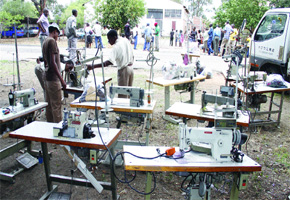
Ascot Clothing, which employs about 105 workers, has also been dogged by liquidity problems, which has seen it failing to remit pension contributions and paying its creditors on time.
Recently, the Clothing Industry Pension Fund (CIPF), attached the company’s machinery demanding an estimated $55 000 owed to it since 2009.
When a Chronicle news crew visited Belmor Manufacturers in Belmont, the place was a hive of activity as workers scrambled to buy machinery and other usable company property on offer.
Among the auctioned items were electric sewing machines, furniture, sewing threads, unused fabrics, computers and accessories.
While some workers were in the queue inside the factory waiting to buy, others were busy helping each other to remove the machinery they bought from the company premises.
Some were milling around waiting for their turn to be ushered in by the security guards who manned the gate.
Others could be seen loading their machines onto vehicles that were parked outside the gate. Each worker was allowed to buy one machine.
The auction continues today where members of the public would also be allowed to buy the remaining stock.
In separate interviews, the workers said they were happy that they did not leave the company empty handed.
“It is sad that we lost our jobs but we are grateful for what the company has done. Our colleagues in other firms went home with nothing. We have been given our packages and now have the privilege to buy machines at cheap price,” said a worker who identified himself as Mr Mpofu.
The workers said the machines were sold for between $100 and $150 while furniture such as chairs was sold for as little as $5.
Asked about their next move after retrenchment, some workers said they were planning to pool resources together and find a place to start their own business.
“We can pool resources together and approach Government for funding. The problem is that we do not have space. We are willing to do something but we are not capacitated,” said another worker.
Others, however, said they were going to sell the machines at a higher price while some hoped to get jobs elsewhere.
The workers accused the Government of failing to stop company closures in the city.
“We are very bitter about the Government’s slow response to the challenge of de-industrialisation facing the city. Our leaders only attempt to intervene when it is too late. If they had come here on time, this company would not have closed,” said another worker.
A majority of the workers who earned about $180 per month last week pocketed between $1 000 and $2 000 in retrenchment packages.
The money was deposited in their bank accounts.
Each worker was paid a retrenchment package commensurate with the number of years served.
The company announced its decision to close shop two months ago citing viability problems and its management held meetings with workers to discuss their retrenchment packages.
More than 85 firms have closed shop in Bulawayo in the past decade leaving thousands of people jobless.
Workers’ unions have expressed concern over lack of funding to bail out distressed firms.
Experts have however, said the level of de-industrialisation, in percentage terms, was the same countrywide.



 Online Reporter