Online Reporter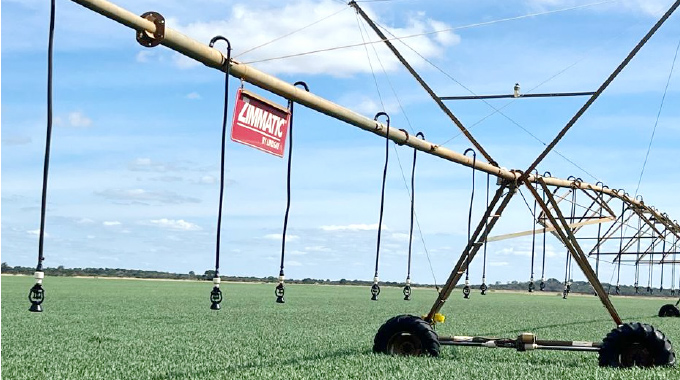
Sukulwenkosi Dube-Matutu, [email protected]
THE Antelope Irrigation Scheme in Maphisa, Matabeleland South, is fast becoming one of Zimbabwe’s key success stories in winter wheat production, offering hope for improved food security as planting gathers momentum across the country.
At the heart of the province’s farming efforts, the scheme has already planted 525 hectares of wheat against a target of 678 hectares, contributing to Matabeleland South’s broader goal of 4 500 hectares this season.
The 1 000-hectare estate, owned by the Agricultural and Rural Development Authority (Arda) and leased to farmer Deane Leroux under a public-private partnership established in 2013, has steadily grown into a model of large-scale commercial farming.
It is now widely seen as a vital pillar in the Government’s push to strengthen food security and drive Zimbabwe towards its Vision 2030 goal of becoming an upper-middle-income economy.
Speaking during a tour of the estate on Thursday by Deputy Minister of Agriculture, Mechanisation and Water Resources Development, Davis Marapira, Leroux said planting was progressing well, despite early setbacks.
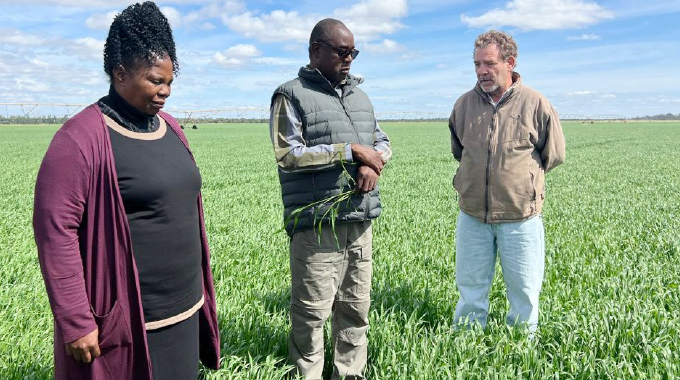
“We started planting our wheat crop on 3 May and we now have 525 ha out of a targeted 678. The crop is at various stages. We were slightly delayed in planting our crop because of heavy rains,” he said.
Although this year’s planted area is slightly lower than last season’s 718 hectares, the reduction has been largely attributed to prolonged rains, which delayed maize harvesting and limited available land.
However, the same rains have brought an unexpected advantage.
Leroux said that the unusually high rainfall — around 1 000mm compared to the normal 300mm — has left soils heavily saturated. As a result, the scheme will require far less irrigation water this winter.
Instead of the usual 600mm of irrigation, only about 380mm will be needed, significantly reducing both water usage and electricity costs.
Across the province, progress remains slow, with only 1 500 hectares planted so far — about 33 percent of the 4 500-hectare target. Even so, officials remain optimistic.
Marapira acknowledged the challenges caused by the rains but expressed confidence that the target could still be met, noting that farmers have until mid-June to complete planting.
He said Government has put in place a number of measures to support farmers and ensure the country meets its winter wheat goals.
“The crop I’m seeing here is a good crop with a targeted yield of eight tonnes to 8,5 tonnes. This is the kind of level of production which we need as a country if we are going to meet are winter wheat target and achieve food sufficiency as a nation,” said Marapira.
He added that the Ministry of Agriculture is closely monitoring progress across all provinces, with teams deployed from provincial level down to villages to ensure targets are met. Agricultural experts have also pointed to the benefits of the recent rains, particularly in improving soil moisture.
Matabeleland South Agricultural Development and Advisory Services director, Shupikai Sibanda, said farmers are in a favourable position if they manage water use carefully.
“The fact that we received a lot of rainfall up to around the end of April means that the amount of moisture that is retained in the soil is enough to sustain the next crop to maturity. Farmers, however, need to take care of the requirements of every crop so that they just top up a little water. For example, here in Maphisa, the farmer will just top up around 300mm of water, which is economically viable.”
Sibanda said while progress in the province has been slow, efforts are being intensified to close the gap.
She highlighted Arda Ingwizi as another key contributor, where 525 hectares of wheat have already been planted out of a planned 700 hectares.
“The estate is one of the major contributors to the provincial target. A lot of work is still ahead under the wheat plant as the province is at 33 percent. The province is working tirelessly to reach its target,” she said.
Nationally, Zimbabwe is aiming to plant 125 000 hectares of wheat this season, slightly up from the 122 142 hectares planted in 2025.
Last year, the country recorded a strong harvest of 642 000 tonnes — well above the annual national requirement of between 350 000 and 450 000 tonnes.
This year’s production target is even higher at 662 000 tonnes, supported by 256 958 hectares of functional irrigated land.
For years, Zimbabwe relied heavily on wheat imports to meet local demand. However, improvements in irrigation systems, increased mechanisation, and continued Government support have helped transform the sector.
As planting continues, schemes such as Antelope Irrigation Scheme are proving that with the right support and conditions, Zimbabwe can not only meet its own wheat needs but build a more secure agricultural future. — @DubeMatutu