

 admin
admin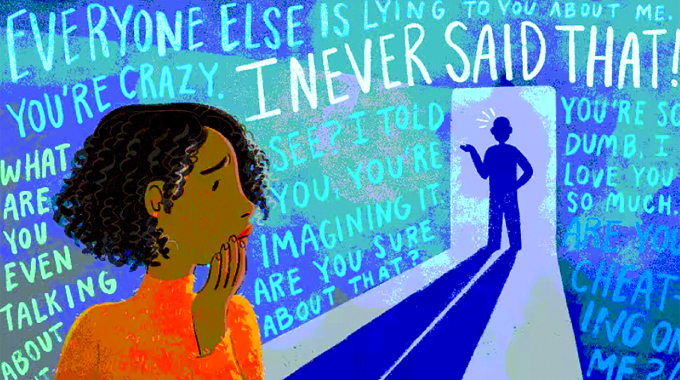
Laina Makuzha
Love by Design
A healthy relationship is one that is supportive and growth oriented. In order to foster this emotional growth, both partners must have genuine respect for each other. When this mutual respect exists, both partners are vested in pro-relationship behaviours such as acceptance, forgiveness, and a commitment to working through conflict in ways that show honour for each partner’s feelings.
However, there are some behaviours in relationships, that if left unchecked, can cause tremendous hurt and misery for the one on the receiving end. One such trait is gaslighting.
Understanding gaslighting
Gaslighting is widely identified as a form of emotional and psychological abuse wherein a person uses verbal and behavioural tricks to convince another person they are losing their mind or — at the very least — to doubt their own judgment. Why? To gain control.
When a partner repeatedly undermines and trivialises your thoughts, views and feelings and drills such negativity about you that you doubt your sanity, these may be red flags of gaslighting. You might hear common phrases like ‘you’re being too sensitive’, ‘you’re overreacting’ or even ‘this is all your fault’. If someone you care about or love deeply keeps undermining you in this way, you’re very likely to start believing them.
How to Spot a gaslighter
Says Susan McQuillan on Psycom.net: “Gaslighters need control and power. In a relationship, they need to be in charge, and they need to be right about everything, routinely imposing their judgments on you. A gaslighter’s tactics — constantly criticising, blaming, making verbally abusive statements, intimidation, denial of responsibility, minimising abusive behaviour, and proclaiming dissatisfaction with a relationship — may be subtle at first.
“The goal is always to weaken resistance, break spirits, appear blameless, and create chaos and confusion in the mind of the ‘gaslight-tee.’ Gaslighting isn’t an isolated or occasional event. It’s an insidious and persistent pattern of behaviour that keeps you questioning yourself and those around you while slowly eroding your self-esteem and even your identity. You may not sense something is deeply wrong until you find yourself existing in a never-ending state of confusion and self-doubt. Gaslighters are blamers, using lines like, “You made me do it” or “I did it because you wouldn’t listen to me.” They may accuse you of having issues or needs that they actually have, such as suggesting you’re not being honest with yourself. They may find ways to take credit for your accomplishments. When a gaslighter gives a compliment or apology, it is often backhanded: “You look almost as good as you did when I first met you” or “I’m sorry you feel that way.”
Why the name ‘gaslighting’?
Reference to “gaslighting” as a term, was coined from the British play Gas Light and the subsequent 1944 movie Gaslight, a mystery-thriller in which a man slowly tricks and manipulates his wife into doubting her own perceptions and coming to believe she is losing her mind; his goal is to have her committed to a mental institution so that he can gain power of attorney over her.
There are many ways that a gaslighting partner might try to achieve their goal of controlling the other person, for instance they might insult you or demean you in front of others or when the two of you are alone. They might use unpleasant humour as a weapon and tease you or mock you under the guise of “just kidding.” The examples are countless.
Being in a relationship with someone who gaslights is a form of mental abuse, and it is important to recognise the signs so you can stop it or just not fall for it. In the same vein, you may also recognise these traits in yourself and work towards stopping the destructive behaviour and treating your partner better. Where there’s a will there’s a way. We can all do better.While you may not be experiencing the level of abuse shown in the movie, it is important to know how to deal with gaslighting abuse as it tends to get worse with time.
Award-winning writer, Stacey Colino, who specialises in health, fitness, and psychological issues, and an ACE-certified health coach puts it this way:
“They can make you doubt your own memory or perceptions by saying things like “I never said that,” or “You said you’d pay that bill,” or “I wasn’t flirting with that woman — you’re paranoid!” Although every relationship is unique, there are some common telltale signs that can be revealed by asking yourself the questions, such as: Is my partner always putting boundaries or rules around what I am allowed to think, say, or do? Are my partner’s comments about me consistently negative and harsh? Am I blamed for every conflict or problem?
Those who gaslight their partners regularly put down, demean, and harshly criticise their victims. Regardless of the origin of the gaslighting behaviours, the outcome is always negative.
Gaslighters play dangerous mind games to gain control over others while subtly traumatising the other person. Understanding what triggers your gaslighter can be one of the first steps in stopping the gaslighting and taking control of your own life. Let’s keep the conversation going. Is anything shared here familiar to you? Let’s discuss practical solutions and tips that build stronger, healthier relationships.More on this subject in the next edition.
Feedback +263719102572
Email:[email protected]
Twitter:@Ledisoul



 Online Reporter