Online Reporter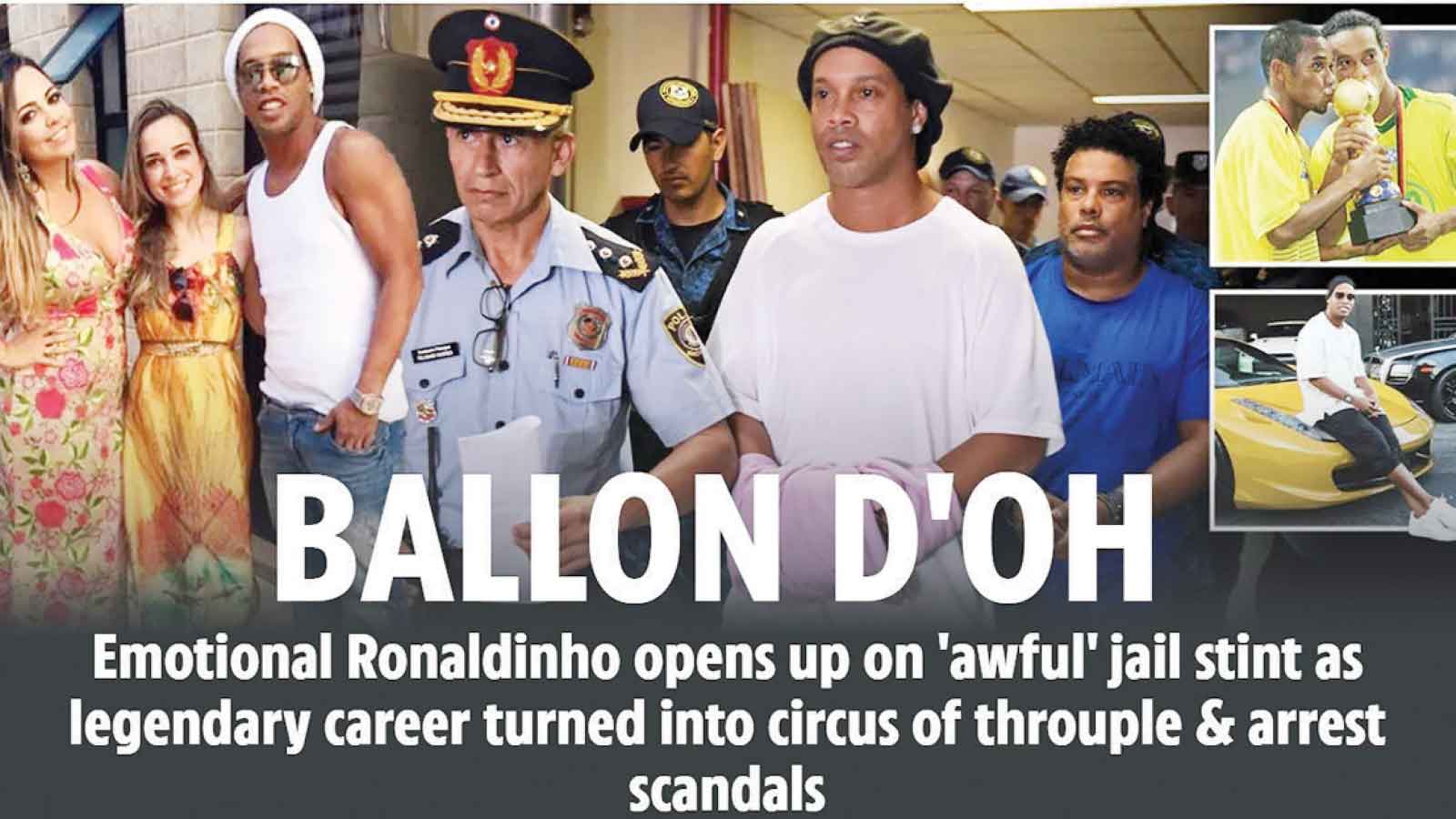
WITH a World Cup and Ballon d’Or under his belt, Ronaldinho had well and truly conquered the sport of football.
So beloved and admired was the Brazilian that Real Madrid fans once even stood up to applaud him after he led Barcelona to a crushing 3-0 victory in the El Clásico back in 2005.
But just three years after officially retiring from the sport, the 46-year-old would end up spending his 40th birthday behind bars in Paraguay.
Along with his brother and agent, Roberto de Assis Moreira, they had been accused of using forged identity documents, including false passports.
Following their 2020 arrest, the pair would spend a month in prison, followed by another four months on bail under house arrest in a hotel in the country’s capital of Asuncion.
“Being arrested in Paraguay was the worst moment, without a doubt,” said Ronaldinho in a new Netflix documentary.“Why did I have the passport? It was given to me. That person came to my house to hand it over.
“You’re stuck in a situation despite having done nothing wrong. It’s awful.”
Ronaldinho and his brother maintained their innocence.
But it was a bizarre situation, without easy explanation. After all, Ronaldinho – who had represented Brazil in numerous international tournaments —was one of the most recognisable people in the world, and was definitely not from Paraguay.To top it off, Brazilians didn’t even need a passport to travel to the neighbouring South American country thanks to a trade agreement.
When questioned, the pair said they thought the identity documents were a courtesy gesture, and that they had been tricked. Eventually they were released without charge — but not before paying £153,000 in damages. “It was an important trip, and everything happened so fast,” said his brother Assis. “You trust someone, and they don’t keep their word.
“What happened was insane. We never imagined going through something like that, living in a situation like that.”But as dire as things were while in prison, Ronaldinho — a player beloved as much for his infectious positive energy as for his magical touch—still managed to find the positives.
He joined in futsal matches and a tournament while behind bars, playing with fellow prisoners and guards.
Unsurprisingly, he wiped the floor with them and led his side to an 11-2 victory. The prize for the winning team was a piglet.
“I did make friends,” he said as he reflected on his time in prison. “It was a way to forget what I was going through.”Born in a poor neighbourhood in the city of Porto Alegre in the south of Brazil, Ronaldinho grew up in a close-knit family — his mum, dad, older brother, and older sister.
“All my childhood memories revolve around playing football,” he said.
“My mum would send me to the bar to tell my dad that dinner was ready. On the way there, I’d try to get there without letting the ball drop.”
He idolised his older brother, who at age 17 was signed professionally to the local club Gremio.
They were able to move into a luxury villa in an affluent part of town. The club was their life— his brother would take him along to training, and Ronaldinho practically grew up in the team’s locker room. But when he was just eight years old, tragedy struck.
His dad had a heart attack in the pool of their home. After two days in a coma, he died, aged 42. Ronaldinho’s brother, whose career was to be cut short by injury, stepped in.
“My brother became both brother and father at the same time,” he said.
By now, though, it was clear that the young Ronaldinho was gifted with something truly special. His rise is rapid – winning the under-17 World Cup with Brazil, and carrying Gremio to victory in the State Championships.
It wasn’t long before his magical ability with the ball was bringing him to the attention of some of the biggest clubs in the world, and in 2001 he joined French side PSG.Come 2002, and he was part of the sensational Brazil team that won the World Cup. He was ready to leave PSG — and despite interest from Manchester United, joined Barcelona, for €30million. Such a stir was there at his Camp Nou debut that a local observatory reportedly detected seismic activity
The Catalonian club had been facing a trophy drought but thanks to Ronaldinho they won the league back to back, and the Champions League.
“His debut at Barca was incredible,” said Messi. As a young player on the team, Ronaldinho had acted almost as a father figure, delivering assists and even carrying him on his shoulders to celebrate.
Named Ballon d’Or winner and two-time winner of the Fifa Player of the Year award, everyone was ready to see him lead Brazil to victory again in the 2006 World Cup—but they were eliminated. Ronaldinho had always had a reputation for being a party animal. It had always been tolerated —but when Barcelona’s results started to suffer, he became a target. Eventually, he left for AC Milan.“I saw him suffer, and it wasn’t fair, because he made Barcelona great again, so to speak,” Messi said.
But there would be shock and disappointment when he was left out of the Brazil squad for the 2010 World Cup – and some wondered if it was the end of an era.
With six months left on his contract at AC Milan, he decided it was time to return to his home country – and though he was expected to join his boyhood club Gremio, he ended up with Flamengo. But questions and criticism over his partying habits continue to follow him. In 2011, he lost a £500,000-a-year contract with Coca-Cola after he was caught drinking Pepsi at a press conference.His final triumph came with Atletico Mineiro, leading them to their first major title since 1971.
Now a free agent, he was even offered a contract with non-league side Basingstoke Town – though this was unsurprisingly turned down. He briefly joined a team in Mexico, but by now his focus was elsewhere.
The icon allegedly once had two girlfriends at once, Priscilla Coelho and Beatriz Souza, living with them both in a Rio de Janeiro mansion. But Priscilla’s mum, Maria, wasn’t happy.
“He had his bedroom for him and Priscilla, and another bedroom for him and Beatriz,” she said.
“He gave both of them the same amount of spending money every month and he would give them exactly the same gifts. He once gave them both a Rolex watch,” she added in an interview with Glam, Set & Match —though Ronaldinho denied reports he was planning on marrying them both.
Ronaldinho also had a son, João Mendes, born in 2005 to dancer Janaina Mendes. He is also now a grandfather.
“What I regret the most is not being there the day my son was born. It was playing, it was match day,” he said.
His son, himself a footballer for Hull City, also appeared in the documentary and revealed that they now have a strong relationship.
“Birthdays were the hardest. We always wanted to be together, but he’d often be traveling abroad, or had a match, or a training camp,” he said.
“Knowing who my father is, it was never going to be that normal. Our relationship now, besides father and son, is also a friendship.”
In 2018, he and his brother also received a £2million fine for building a pier in an environmental protection area without permission. When they refused to pay, authorities seized 57 properties, and their passports, and he faced allegations of bankruptcy.
Tragedy stuck when, in 2021, his beloved mum died from Covid. But today, he’s busier than ever, jetting around the world, and always with a smile on his face.
“My life is just crazy. They call me the kind of unexpected adventures, because everywhere in the world, people invite me to do all sorts of stuff.
“Today, nothing holds me back.” —Sun