Oliver Kazunga-Senior Reporter
FOREIGN currency bank deposits in Zimbabwe have surged to US$5,5 billion, signalling a sharp rebound in public confidence in a financial sector once shunned by depositors in years of hyperinflation and cash shortages.
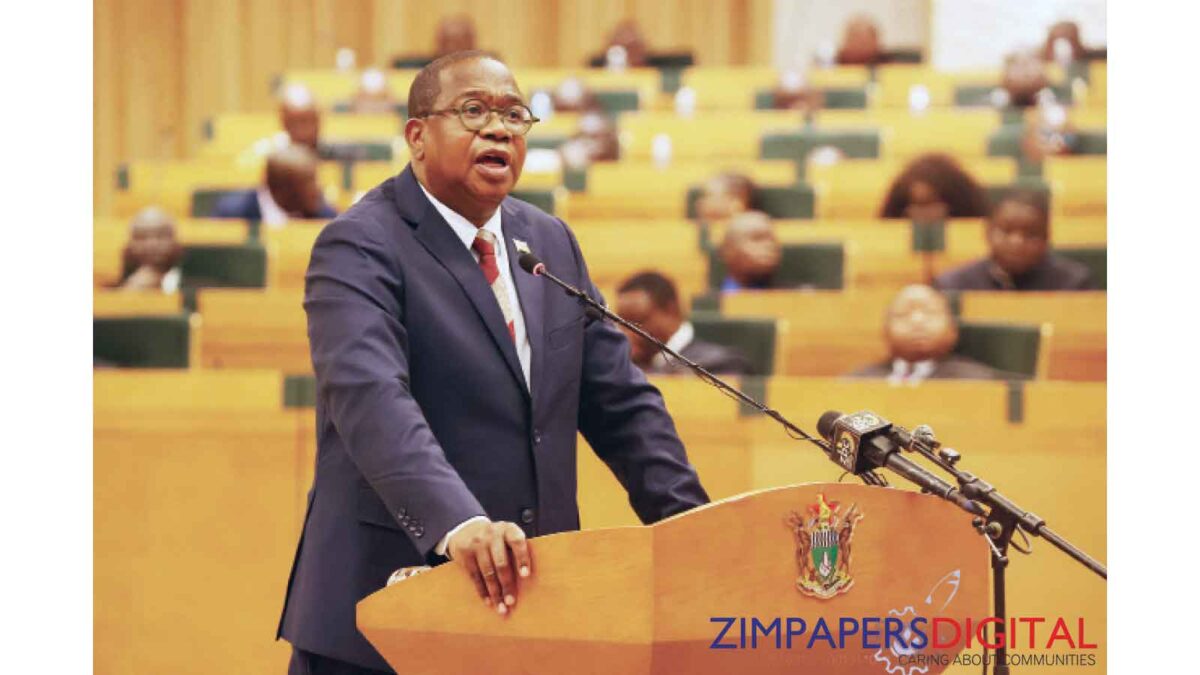
Presenting the 2027 National Budget at Parliament in Mt Hampden yesterday, Finance Minister Professor Mthuli Ncube said the expansion — up from US$0,7 billion in 2018 — reflected sustained price, currency and exchange-rate stability under the Second Republic.
“The financial sector is safe and sound, on the back of sustained price, currency and exchange-rate stability. The foreign currency account bank deposits have increased from US$0,7 billion in 2018 to US$5,5 billion in 2026. Financial intermediation growth continues to support economic activities,” he said.

Speaker of Parliament Advocate Jacob Mudenda addresses the August House before the Budget presentation at New Parliament Building in Mt Hampden yesterday. — Picture: Believe Nyakudjara.
While the majority of funds remain concentrated in short-term and demand accounts —constraining long-term lending for infrastructure, industry and housing — Prof Ncube noted that banks remain well capitalised with healthy loan books.
“The banking sector is adequately capitalised, with non-performing loans to total loans at three percent, well below the international benchmark threshold of five percent,” said Prof Ncube.
The surge caps a steady multi-year recovery since the separation of Real Time Gross Settlement (RTGS) and nostro foreign currency accounts (FCAs) in 2019, when nostro balances stood at roughly US$600 million before climbing to US$1,6 billion by September 2023 and US$2,64 billion by October 2024.
The return of larger balances follows repeated assurances from monetary and fiscal authorities that hard currency savings are safe.
Reserve Bank of Zimbabwe (RBZ) Governor Dr John Mushayavanhu has maintained that the eventual transition to a mono-currency —guided by conditions precedent under the National Development Strategy 2 (NDS2) — will be market-driven rather than date-based, and will not result in the forced conversion of foreign currency accounts or existing contracts.

Ministers Tatenda Mavetera, Kazembe Kazembe, Frederick Shava, Anxious Masuka and Daniel Garwe, alongside other guests, stand to welcome President Mnangagwa as he enters Parliament. — Picture: Believe Nyakudjara.
Prof Ncube added that domestic capital markets remain resilient, citing strong performances on the Zimbabwe Stock Exchange (ZSE) and the Victoria Falls Stock Exchange (VFEX), alongside the launch of the Zimbabwe Entrepreneurship Exchange (ZEEX) in July 2026.
“The stock market, namely the Zimbabwe Stock Exchange and the Victoria Falls Stock Exchange, continues to perform well, safeguarding the investments,” he said.
“The Zimbabwe Entrepreneurship Exchange (ZEEX), launched in July 2026, focusing on SMEs, has great potential to support the sector with capital raising.”
Housed under ZSE Holdings and licensed by the Securities and Exchange Commission of Zimbabwe, ZEEX operates as a regulated digital platform designed to help small and medium enterprises raise growth capital.