admin
admin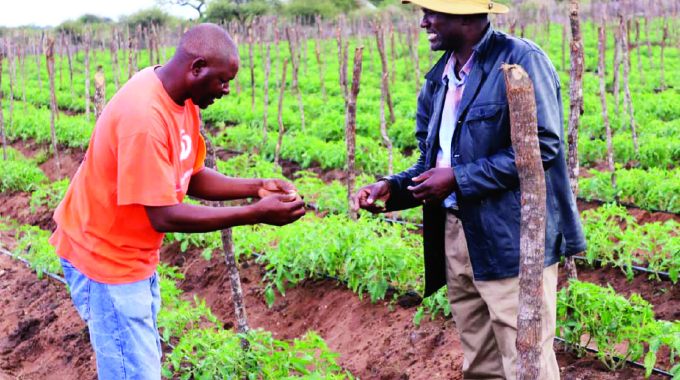
Thupeyo Muleya Beitbridge Bureau
In the last three decades, farmers in the Lowveld, especially Beitbridge have been struggling to grow cash crops under the normal rainfall patterns due to the semi-arid conditions which favoured mostly livestock rearing.
Of late, the situation has been compounded by climate change with the country going through three successive droughts in a row, in the last five years.
Communal and resettled farmers have been the hardest hit, with some having to watch in despair their crops wilting or being swept away by floods.
In essence, seasons have been altered, resulting in low rainfall totals, especially in the southern region, which has crippled agriculture output.
Human activity such as greenhouse gas emissions is one of the factors behind climate change.
As a result, the government has been promoting the use of climate-smart methods to ramp up production and enhance food and nutrition security nationally.
Commercial farmers and most A2 farmers who are highly mechanised have been doing well in adapting to the effects of climate change.
From around 2018, A1 farmers (resettled) and communal farmers have been gradually responding positively to the government’s call.
According to Beitbridge East legislator, Cde Albert Nguluvhe, more than 50 communal farmers have changed the farming landscape through the use of solar energy and drip irrigation to grow cash crops.
“As local leaders, we have since 2018 been encouraging people to make use of underground water and solar energy which is in abundance here to grow cash crops,” he said.
“If you look across the Limpopo River in South Africa, there is good agriculture production throughout the year. So, the thinking is that if we have the same weather patterns how can we fail to grow crops just like them.
“We have been telling our people to adopt smart agriculture methods and increase production considering that we have good soils and the water table is very close. So, people are now seeing the value in adopting climate-smart agriculture techniques to ramp up production.”
Cde Nguluvhe said it was critical for every homestead in rural Beitbridge to have a small horticulture plot to address food security and to create alternative revenue streams at the household level.
He said the use of drip irrigation powered by solar energy should be the game-changer in terms of climate change adaptation in the agricultural sectors.
Mr Joseph Ndou of the Tshapfuche area, in Ward 5, said the market for farm produce, mainly tomatoes, cucumbers, butternuts, green papers, beetroot, carrots, and onions was growing on the local market.
“I have three fields where I am using electricity to pump water to irrigate the crops,” he said. “The long-term plan is to set up a solar plant to power the project.
“I have 13 permanent employees and hire 26 women as seasonal workers when it’s harvesting time and I hope the number will grow as we introduce more cash crops and the farmland.
“Through the use of drip irrigation, one can grow crops throughout the year, practicing the correct rotation methods with the help of agriculture extension workers.”
Mr Ndou said more and more people in his area had started seeing value in the use of small pieces of land to produce for themselves and commercial markets.
“Using drip irrigation has also helped me to increase yields and to control weeds compared to the other irrigation methods,” said Mr Ndou. “Setting up a drip irrigation system is a seamless process, you only need the right expertise and source of water.”
Mr Suta Sibanda, a communal farmer of Khololombe in Ward 3, said the use of solar energy and drip irrigation system had helped to reduce labour costs and increased his yields.
He said he started using the system on a 1-hectare piece of land on a maize crop and harvested five tonnes.
Mr Sibanda said he was planning on putting two more hectares under drip irrigation in August this year.
“At the moment I have sugar beans crop under drip on one hectare, whereas the sunflower covering one and a half hectare was dry planted,” he said. “The target market for sugar beans is NGOs, schools, and the Beitbridge community. The maize and sunflower are raw materials for making pen fattening meal for my feedlot.”
A farm manager at the 60 hectares Royal Cooper Estate (in Ward 14), Mr Samuel Karonga, said recently they started using drip irrigation in 2016 and that since then their market share was growing across the country.
Mr Energy Muzamani of the Goda area in Ward 15 said he was using water from a communal borehole to turn around the lives of many people in Beitbridge East who get fresh vegetables for resale around the area. He has been growing tomatoes, green pepper and cabbages on his three-hectare plot since 2016, with the aid of drip irrigation.
A climate expert in the Ministry of Lands, Agriculture, Fisheries, Water and Rural Development (Department of Climate Change), Mr Lawrence Mashungu, said water efficiency was one key component that farmers needed to employ in the agriculture sector.
“This means we have to look at precision agriculture where the water goes directly to the plant through drip irrigation that is planned, usually at night,” he said. “We might need to be efficient on water harvesting techniques so that we harness the water that comes our way for present and future use.
“It is also important that the farmers grow plants with shorter maturity time frames and can use the little water that is available.
“Adaptation means, we are now able to live under the current conditions where we have little rainfall. We also need to look at recycling water for agriculture purposes.”
Beitbridge District Agritex officer, Mr Masauso Mawocha, said it was important for farmers to adopt the use of the drip irrigation method, which often produced better yields.
“The other methods in use include the Pfumvudza/Intwasa, which promotes the use of planting stations and mulch to conserve moisture,” he said. “Here, soil disturbance is very minimal.
“Some are employing water harvesting techniques, where farmers are using infiltration pits, potholes, and tied ridges. All these are meant to harvest water and conserve soil moisture.
“We are also encouraging them to grow drought-tolerant traditional grains and cowpeas and in some cases, the farmers are growing lab-lab, velvet beans, forage sorghum, bana grass, lucerne, Katambora Rhodes grass, and star grass among other crops.”
Mr Mawocha said the communal farmers were producing their own open-pollinated crop variety seed like babadla and red cock which can do well under the current climate conditions in the region.
On livestock, he said people were now commercialising small stock (goats, sheep & chickens), which can survive even in severe droughts.
He said the use of agro-ecology practices such as organic fertilisers more than inorganic fertilisers, was user friendly and helped to protect the environment.



 Online Reporter