Chronicle Editor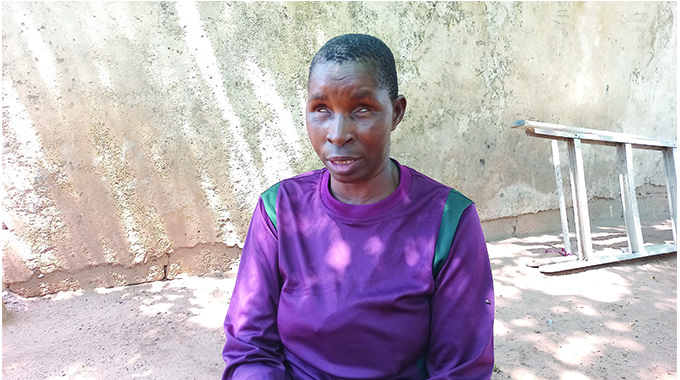
Bongani Ndlovu in Binga
SHE was born blind, lives alone, is unemployed, illiterate but has to find her own food, fetch her own water and firewood.
Ms Saliah Tshuma (48), a single mother of two, from Binga Urban has to overcome an array of challenges every day to keep body and soul together.
She and hundreds of other villagers, who had been getting US$12 a month from the recently stopped Emergency Social Cash Transfer (ESCT), which was implemented by Unicef and the Ministry of Public Service, Labour and Social Welfare and World Vision with financial support from the Government of Germany through KfW Development Bank since 2021, are pinning their hopes on the Government Harmonised Social Cash Transfer Programme for continued support.
The Government programme is taking over from the ESCT and will soon be operational. It is part of the main programme, which is the Harmonised Social Cash Transfer.
The ESCT targeted urban domains and was piloted in two districts Gutu and Highfields during the Covid-19 pandemic and was later spread to six districts, Beitbridge Urban, Bulawayo Metropolitan, Lupane Urban, Binga Urban, Mufakose Urban and groups and households that had lost their source of income.
For Ms Tshuma, looking for food is a daily exercise that becomes a cause for celebration when she finds the firewood and water to cook it. She lives in a two-roomed house, which is part of a compound for persons with disabilities, owned by the Binga Rural District Council.
The compound does not have running water and electricity. Ms Tshuma has to fetch water about 500 metres away at a Roman Catholic church and find firewood in the bush. In 2021 she got some relief from the ESCT that provided vulnerable households in Zimbabwe with monthly payments through cash transfers and complementary child protection services.
This week, the ministry in collaboration with Unicef held a three-day media tour to Matabeleland North in the urban parts of Lupane and Binga Districts to familiarise members of the fourth estate with the impact the ESCT had on beneficiaries.
There are 637 households in Binga and 394 households in Lupane that benefit from ESCT, where a household has a maximum of four people.
Every month since then Ms Tshuma would receive US$12 and with that she could buy the basic commodities such as mealie -meal and cooking oil.
“When I started receiving the US$12 it came as a relief to me. I was able to buy food, which was hard to find during the Covid-19 pandemic, as we had restrictions to move around,” said Ms Tshuma.
She said as a visually impaired person she could not receive the money directly as she has no cellphone or mobile line to receive the money.
Ms Tshuma had Ms Catherine Mwembe to thank for receiving the money on her behalf. However, like a devastating blow to her existence, the cash transfer was stopped this year.
Luckily for her and hundreds of others, the beneficiaries of the ESCT are being transitioned to the Government Harmonised Social Cash Transfer Programme.
Ms Tshuma did not attend school because in rural Pashu, her birth place, there was no learning institution that could accommodate her. She has two children, a son and a daughter who are now grown up and she last interacted with them years ago, when they abandoned her to get married.
At the same compound, Mrs Catherine Mwembe (52), who walks with a crutch, the situation is slightly better.
She teamed up with Mr Raphael Mudenda (43) to set up a chicken rearing project that is helping them survive.
“We started the chicken project after realising that we could save some money from the US$12 we were getting. We started with 10 chicks and we now have over 100,” said Mrs Mwembe.
Mr Mudenda said he was happy that the Government Harmonised Social Cash Transfer Programme will be taking up the slack from the ESCT because: “It is next to impossible to get by without the regular cash injection.”
In Lupane District there are households that benefited from ESCT.
Ms Percy Ngwenya (36), a widow who has four children, used to receive US$42 from the programme.
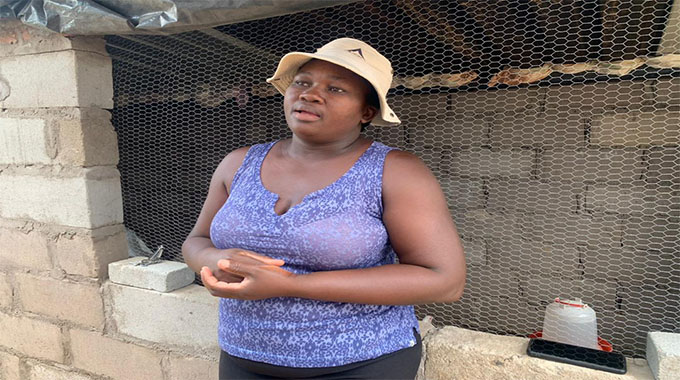
Ms Percy Ngwenya
With the funds she and four other women contributed US$20 to a money club and from that she bought 25 day-old chicks and feed. She is now running a successful business supplying chicken.
“The market is good as some come and they buy at times 50 at once. It’s mostly restaurants like Take Me Out and caravans. These are just the few who buy my chickens,” said Ms Ngwenya.
She said when her husband died, he left her with a two-roomed house.
Ms Ngwenya said in a short space of time she has managed to build four more rooms.
An elderly couple, Mr Dazzy Dube and Ms Margaret Thwala (both 76 years of age) have turned to brick-making to take care of their four grandchildren.
“The stress we have everyday is how do we feed these children? Their parents are all dead and we are now taking care of them'” said Mr Dube.
Perhaps someone who epitomizes the real impact of the programme is Mrs Magaret Tshuma in Binga who at the moment does not know where she will get relish for her evening meal. She now relies on handouts from people and appeals to authorities to speedily resume the programme.
“At least with the US$12, I knew what I was going to eat for the whole month. Now since it has stopped I have gone back to begging and people here and there come to help me with food. As we speak I have mealie-meal but I don’t have relish for the evening meal.”
May they quickly start the harmonised programme as the cash helped me a lot,” said Ms Tshuma.
Deputy Director Family and Social Protection, in the Ministry of Public Service, Labour and Social Welfare Mr Joseph Tirivavi gave a background of the Emergency Social Cash Transfer.
“It targets vulnerable households which are food-poor (having 1 meal or no decent meal per day). It also covers labour constrained households – these are households with no person aged 19 to 59 years of age who is able-bodied to do productive work so as to fend for the household.
“Labour constraint categories include child-headed households, elderly-headed households, households with chronically ill members and households with disabled members,” said Mr Tirivavi.
He said there is also a component known as the CASH PLUS component – these are additional services to cash for example the nutrition component cushioning pregnant women, lactating mothers and children under two years provided they are in vulnerable households.


 Online Reporter