Chronicle Editor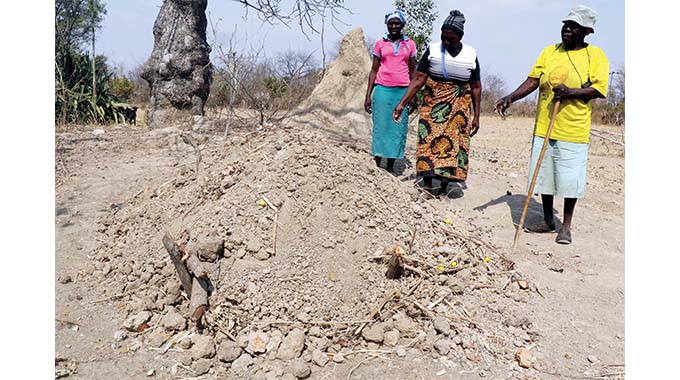
Raymond Jaravaza in Nkayi, [email protected]
THE sight of a blood stained rural kitchen hut floor where her daughter was allegedly murdered by her husband will forever remain entrenched in the memory of Nessy Mpofu for the rest of her life.
Pools of blood covered with sand greeted Mpofu the first time she walked into a hut in rural Plumtree the day she came face to face with reality that her daughter had breathed her last allegedly at the hands of a man who was supposed to be a protector and source of love.
“Till death do us apart” is a vow to love and protect one’s spouse but for the late Sibonakaliso Fuzane, her death literally came in the hands of the father of her children – the same man she should have counted on for protection.
Fuzane’s body was found across the border in Botswana with multiple stab wounds allegedly inflicted by her husband (name withheld), who confessed the murder to both families – his and that of the deceased.
The murder was committed on August 31 in Botswana, barely a kilometre from the Zimbabwean border, where the body was discovered by law enforcement authorities in the neighbouring country.
Today, the man who confessed to the murder still walks free in rural Plumtree and Fuzane’s family is seething with anger while demanding answers and justice for their late daughter.
The late Fuzane hailed from Nkayi, in the Nkuba area and was married to the husband from Maitengwe in Plumtree. The two, together with their children, lived in the Maitengwe border line in Plumtree until her death.
Fuzane is buried in Nkuba where the Saturday Chronicle spoke to her family surrounding the circumstances of her death and the family’s demands for justice.
The two had been fighting over the sale of the family livestock by the husband, without the consent of Fuzane, according to her mother.
“My daughter had told me over the phone that her husband sold their donkeys and goats without her knowledge and she was not going to allow the buyer to collect the livestock. On the day that she was killed, she had gone with her husband to his sister’s homestead for them to resolve the issue.
“They talked about the issue and resolved that her husband would give the buyer back his money and they decided to sleep at the sister’s home since it was late to walk back to their home. The sister says she heard them arguing at night and that my daughter was screaming, pleading with her husband to stop beating her. She says after a while the fighting stopped so she assumed they had gone to bed and that was the last she saw my daughter alive.
“The following morning, around 3am, the husband woke up his sister saying that he had done something horrible and wanted to kill himself. He phoned his brother saying he had killed my daughter and that the body was on the Botswana side. We still don’t buy the story that she was killed in Botswana, he killed her in that kitchen and simply dragged the body across the border to cover up the crime,” said Mpofu.
The grieving mother said the circumstances of her daughter’s death, according to the son-in-law, just don’t make sense.
“He told my family that they fought before going to bed and that my daughter wanted to walk back to her home in the middle of the night and he tried to stop her. He says she was adamant about leaving and stormed out of the kitchen where they were sleeping, he followed her and they started fighting again in the middle of the night and somehow they ended up across the border and that’s where he lost control and stabbed her.
“None of this makes sense. My daughter died in that kitchen. The amount of blood which had been covered with sand in the kitchen was too much for her to have survived and still walked over five kilometres,” added Mpofu.
When the body was discovered by police in Botswana, the alleged killer was detained by the local headman’s aides since he had confessed to the crime.
The family rushed to Plumtree from Nkayi upon news of their daughter’s demise and started the process to repatriate her body from Botswana. With the assistance of local police from Plumtree, the family was given the body by Botswana authorities for burial.
The family say they expected the alleged murderer to be handed over to the police since he had confessed to a crime, although he was adamant that he stabbed her numerous times on the Botswana border and not in Plumtree.
The husband did not attend the funeral in Nkayi.
“We expected the police to arrest him and charge him with murder but they said the crime was committed in another country so their hands are tied. As we speak, he is walking free. I have so many unanswered questions about why and how my daughter died. She did not deserve to be killed like an animal and dumped like that,” said Mpofu.
Matabeleland South spokesperson Loveness Mangena said no case of murder in the Maitengwe area had been recorded around the time that Fuzane died.
A retired police prosecutor, Gibbs Makhulu, who now runs a private security company in Bulawayo explained that since the murder is alleged to have been committed in Botswana, police from the neighbouring country can ask for their counterparts in Zimbabwe to arrest the husband and extradite him to face murder charges.
The alleged killer’s brother Bruce Moyo told the Saturday Chronicle by telephone that his brother had crossed the border to Botswana in search of work and that they didn’t expect him back at least for another two weeks.
“He is looking for piece jobs in Botswana, he has kids to look after so he must look for work. We are truly sorry for what happened to our daughter-in-law, our family is really upset about how she died,” said Moyo.
In March 2022, the Extradition Treaty of criminal suspects between Zimbabwe and Botswana came into force. Under the Treaty, each country commits to extradite to the other those found in its territory and wanted by the other country for trial on criminal charges or to serve their sentence if they had already been tried and convicted.
Under the Treaty, extraditable offences are those that are punishable under the laws of both countries by imprisonment or other deprivation of liberty for a minimum period of at least one year, or by a more severe penalty.
“Where the request for extradition relates to a person who is wanted for the enforcement of a sentence of imprisonment or other deprivation of liberty imposed for such an offence, extradition shall be granted only if a period of at least six months of such sentence remains to be served,” reads the Statutory Instrument.
In determining whether an offence is punishable under the laws of both parties, it shall not matter whether either country places the accused’s conduct within the different category or legal terminology. However, both countries have the right to refuse to grant extradition if the offence for which extradition is requested is regarded by the other as an offence of a political nature.
“If the requested party has substantial grounds for believing that the request for extradition has been made for the purpose of prosecuting or punishing a person on account of that person’s race, religion, nationality, ethnic origin, political opinions, sex or status, or that that person’s position may be prejudiced for any of those reasons,” reads the legal instrument.
Suspected criminals may also not be extradited if the offence for which extradition is requested is an offence under military law, which is not also an offence under ordinary criminal law, and if there has been final judgment rendered against the person in the requested party in respect of the offence for which the person’s extradition is requested.
Other reasons for refusing to grant extradition is if the accused person would be subjected to torture or cruel, inhuman or degrading treatment or punishment or if that person has not received or would not receive the minimum guarantees in criminal proceedings, as contained in the laws of the requested party.


 Online Reporter