Chronicle Editor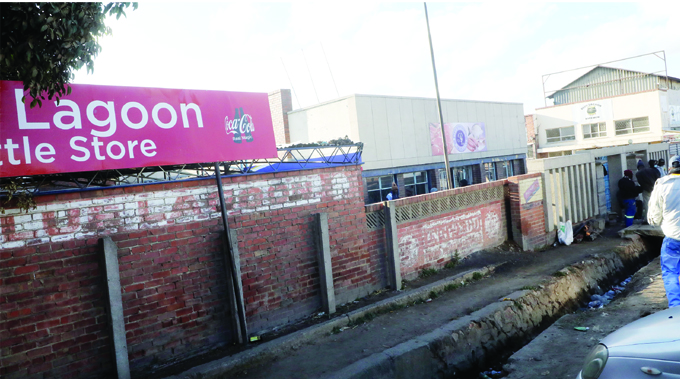
Mashudu Netsianda, Senior Reporter
THE famous Blue Lagoon, situated at Renkini Bus Terminus in Bulawayo’s Makokoba suburb is a culmination of the late Vice-President Dr Joshua Mqabuko Nkomo’s dream to assist the local community.
The idea emanated from political meetings, which he held with fellow freedom fighters from neighbouring countries at the beginning of his political career.
Dr Nkomo would meet the likes of the late former South African President Nelson Mandela, Botswana’s founding President Seretse Khama and Zambia’s founding President Dr Kenneth Kaunda, among other nationalists such as Cdes Enoch Dumbutshena and Herbert Chitepo, in a restaurant in Johannesburg which was called the Blue Lagoon.
During that period, they were students.
According to a poster mounted at Blue Lagoon offices, Dr Nkomo would meet Khama and Mandela at the Blue Lagoon Restaurant in Johannesburg during which he began attending rallies organised by the African National Congress (ANC). At the time, Dr Nkomo was a student at Jan Hofmeyr School of Social Science in Johannesburg. The institution had no student hostels hence he rented a room at the Bantu Social Centre, which was reserved mainly for visiting students.
The centre did not serve meals and Dr Nkomo would therefore go to the Blue Lagoon Restaurant to buy meals.
In an interview yesterday, Dr Nkomo’s only surviving son, Mr Michael Sibangilizwe Nkomo, the owner of Blue Lagoon, said his father brought the idea from South Africa.
“After completing Standard Six at Tsholotsho Industrial School in the early 1940s, my father went to South Africa for further studies. While there he met up with the likes of Seretse Khama, Nelson Mandela and others who brought up the ideology of freedom and Pan Africanism,” he said.
“They loved meeting at a restaurant called Blue Lagoon in Johannesburg. It was one of few eateries for blacks during apartheid South Africa.”
Mr Nkomo said over the years during the late veteran’s period in the struggle for freedom, the restaurant evoked good memories culminating in the idea to open a similar place back home with a similar name.
“Umdala got ideas from ANC leaders during those meetings at Blue Lagoon and he then decided to bring the ideas back home. In 1952, Dr Nkomo was elected president of the African National Congress of Southern Rhodesia,” he said.
“He took advantage of his Railways Pass to travel throughout the country mobilising people.”
The same year Dr Nkomo accepted an invitation from Sir Godfrey Huggins, the Prime Minister of Southern Rhodesia to represent African opinion at the London Conference on the proposed Federation of the two Rhodesians and Nyasaland. Dr Kaunda and Dr Hastings Kamuzu Banda represented Northern Rhodesia and Nyasaland respectively.
“Joshua Nkomo returned home bitterly opposed to the proposals, but could make no impression in the face of overwhelming European support for the concept,” said Mr Nkomo.
In 1955, Dr Nkomo became the president of the African Workers’ Unions and inevitably propelled into national politics.
In December 1954 an All-African People’s Congress was held in Ghana during which Dr Nkomo interacted with other liberation movements around the world. Dr Nkomo and other nationalists accepted the armed struggle as an alternative means of attaining Independence.
In 1959, authorities in Southern Rhodesia declared the first State of Emergency, banned ANC and detained 500 of its members.
Dr Nkomo escaped because he was in Egypt at that time.
“At the advice of Egyptian friends, he opened an external office in London. For 18 months Dr Nkomo travelled widely from his London base,” said Mr Nkomo.
In 1960 a new party, the National Democratic Party (NDP) was formed with Dr Nkomo as president with the late Cdes Leopold Takawira, Morton Malianga, Ndabaningi Sithole and Robert Mugabe as executive members.
The NDP rejected Sir Edgar’s franchise and representation plans and Nkomo led the boycott against the elections emanating from that Constitution. The resultant escalation of civil unrest and tension between the NDP and the government led to the party’s ban in December.
Dr Nkomo responded by launching the Zimbabwe African People’s Union (Zapu) headed by himself as president and the NDP executives retaining their posts in the new organisation.
Zapu was banned and most of its leaders and members were restricted to their rural places of birth for three months. Dr Nkomo, who was in Zambia at the time Zapu was banned, considered establishing a government-in-exile to bring pressure on the Organisation of African Unity, the United Nations and other sympathetic bodies to effect political change at home.
In April 1964 Dr Nkomo was arrested and restricted to Gonakudzingwa Camp and for the next 10 years he was confined at various other places including Gwelo Prison and Buffalo Range near Chiredzi.
“My father spent 10 years at Gonakudzingwa Detention Camp among other prisons. Upon his release he went to war where he consolidated Zapu and formed its military wing, Zipra,” he said.
Mr Nkomo said after independence, his father had a lot of ideas generated over a period from the time he was in South Africa and travelling around the world.
“Zapu ended up buying farms and properties as part of empowering its members and all that was as a result of the Blue Lagoon Restaurant meetings in Johannesburg. In 1980, he started building his own Blue Lagoon, a culmination of a dream of over 40 years,” he said.
“It had always been his dream of building a place called Blue Lagoon. That is how this Blue Lagoon idea came into being from an idea started in South Africa.”
Mr Nkomo said it took his father three years to finish the first phase of the project before it was disrupted by the post-independence political disturbances known as Gukurahundi.
“Work resumed after the signing of the Unity Accord between PF Zapu and Zanu-PF in 1987. The Blue Lagoon was built in stages starting with a supermarket, a cocktail bar, administration offices, bakery, butchery and then the restaurant,” he said.
Mr Nkomo said Dr Nkomo’s vision for Blue Lagoon included putting up a motel to cater for stranded travellers.
“At Blue Lagoon, there was a provision for the construction of a multi-storey structure where a motel was to be set up, but unfortunately my father never got to fulfil his dream. It is also important to highlight that my father borrowed money from a building society to build Blue Lagoon,” he said.
“The general perception out there is that he had lots of money, which is not true. As a family, we paid back the loan after his death in July 1999, and continued serving the debt for seven years.”
Mr Nkomo said the idea behind Blue Lagoon was to create a convenient place for travellers boarding buses at Renkini Bus Terminus where they would be able to buy refreshments while waiting for the buses.
“The motel was to ensure that people could get overnight accommodation in the event they missed their buses. He was a person who had people at heart, which is why he was so passionate about Blue Lagoon,” he said. — @mashnets


 Online Reporter