

 Chronicle Editor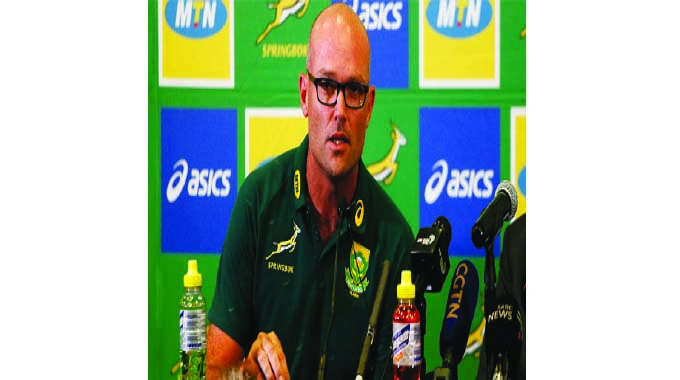
COACH Jacques Nienaber has validated the growing theory that the time for real growth to start happening for his Springbok team is a year in the future by admitting that the world champions are still trying to get back to the level they were in the build-up to winning the Webb Ellis trophy.
Many of those who are critical of the Boks and the rigidity of their game-plan, which vice-captain Handre Pollard described on Tuesday as “unorthodox” but the one the team are committed to, have overlooked the fact that the team is a year behind a side like New Zealand.
The All Black players never had much disruption to their usual routines because the coronavirus didn’t hit their country like it did others. The Aotearoa version of Super Rugby started just a few months after the original more global version of Super Rugby was suspended by the arrival of Covid-19 and games were played in full stadiums and without teams having to go into bio-bubbles.
The All Blacks played in last year’s Tri-Nations whereas the Boks, because of the hard lockdown in South Africa, which meant players were forced to stay home and could do little of the training they needed to keep them conditioned for international rugby. You could say the Kiwis learnt from their mistakes last year, sometimes a necessary process in a team’s growth, for they started off their return to play by suffering a first ever defeat to Argentina. The Boks were denied that opportunity.
When the Boks returned to international rugby this year after 19 months away from the game they pretty much went straight from the 2019 World Cup final into an important, must-win Lions series. That meant there was little room for experimentation or blooding new players, with even one of the two scheduled warm-up tests against Georgia being cancelled because of a Covid outbreak.
Looking back, and looking at what might have been had it not been for Covid, Nienaber appreciates how different it has been, and understands the magnitude of the opportunities that may have been lost to grow depth and to build towards the point where his team are now post a British and Irish Lions series.
“After the World Cup there were two big things we were aiming for, and the first was the Lions series, and then the 2023 World Cup,” said Nienaber.
“I am not saying all the other tournaments aren’t important, but just that because the Lions tours are so rare it is more important. You are only there once, so it is a big thing. If the country wins, then I wouldn’t say you have bragging rights but you have the knowledge that you won that series for 12 years, until you play them again.
“So that was the first focus, and then the second was 2023. Where we are currently is not where we hoped to be or imagined being when I took over as coach at the start of 2020. The plan was to start building and evolving, and to get the foundation back after the World Cup. We were going to play two tests against Scotland and then one against Georgia.”
Covid forced a very different scenario, and it forced Nienaber and his fellow coaches to rely heavily on what had gone before in terms of planning and strategy, while there also hadn’t been enough rugby, and not enough international rugby in particular, for new players to emerge and be blooded.
“We are right now still building towards where we were in 2019. What these recent games have taught me personally is what is in our DNA and what areas we need to apply pressure to and what suits our strengths when it comes to the drive to get results. We’ve found that if we deviate from that we struggle, so we need to get back to that.
“But in 2022 we should have an opportunity to try things and to start getting more experience into our rotational group,” he added.
Nienaber believes that one of the positive spin-offs of what has been required to face down the challenge of Covid is the bigger squads that have exposed a wider group of players to the Bok method and the Bok culture.
“The one positive is that there have been a lot of younger guys coming into the mix,” said the Bok coach.
“Unfortunately we haven’t had much chance to give them a lot of game time, and they generally haven’t been playing. But at least when they do eventually graduate to playing international rugby the environment won’t be new to them.
Guys like Grant Williams, Jaden Hendrikse and others have had a chance to experience what it is like to be with the Boks, and that also means there shouldn’t be a massive void beyond 2023 when we start building towards 2027 either.
“The extended size of the squad because of Covid has given us a big group who you could say have experienced what it is like to be a Bok and have started out on their Bok careers even if they haven’t played. Normally we’d have only 28 players with us now, because of Covid there’s a whole extra team in addition to that.
“Now that the Lions series is over and this initial period of the comeback to international rugby is over we will start building towards 2023. That is the big game from now.” — SuperSport


 Online Reporter
 Bongani Ndlovu