Chronicle Editor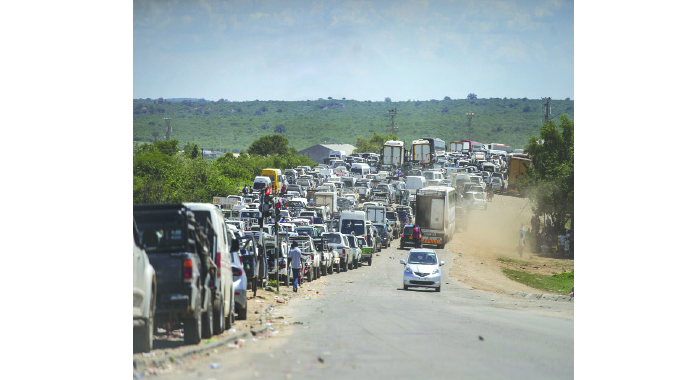
Thupeyo Muleya, Beitbridge Bureau
GOVERNMENT has over the years come up with a number of strategies to remove trade barriers and enhance the smooth flow of people and cargo through its land borders.
This is being done to boost international trade and realise the envisaged globalisation dream.
The drive has seen the Government signing a 17-and-half-year Build, Operate and Transfer (BOT) agreement with the Zimborders Consortium to modernise the Beitbridge Border Post at a cost of US$300 million.
The project is being rolled out in three phases including a new freight terminal with new weighbridges, border roads,
ICT facilities, fire-suppression system, and new warehouses under phase one.
Phase two has the construction of the light vehicle, buses, and pedestrians terminals while phase three includes outside projects like the construction of a fire station, upgrading of roads, water and sanitation facilities, and the construction of 264 houses for border workers deployed to Beitbridge.
The new freight terminal opened to commercial traffic two weeks ago, albeit with a lot of challenges that have created a traffic gridlock on the Zimbabwean and South African sides of the border.
The other two phases are ongoing and are set for completion in December next year.
A volatile situation has been building up at the border in the last two weeks and gradually things seem to be getting heated between transporters, truck drivers, and the border authorities.
The truck drivers have been spending at least a week in the queue attempting to leave or enter Zimbabwe due to the poor co-ordination, slow services, rent-seeking activities, and mercenary attitudes by some border stakeholders.
On Sunday scores of truckers blocked traffic into either country in protest over long delays or the new tolling system being rolled out by the Zimborders and the more ‘unnecessary’ checkpoints at the Zimbabwe border.
The bridge was blocked for four hours only to be opened by security from both countries.
After which, the drivers have engaged in another passive protest where they just park the vehicles on the road arguing that Zimbabwe must re-organise its border traffic flow system first and review the high access fees at the new freight terminal.
To recoup part of the costs used on the project, the Zimborders Consortium, is charging US$115 for heavy vehicles (rigid trucks), US$200 for commercial trucks, and US$344 for abnormal lord vehicles.
In addition, the trucks are expected to pay US$23 to the Zimbabwe National Road Administration Zinara) for using the New Limpopo Bridge.
Previously, all vehicles were paying only bridge toll fees from US$9 to US$100 at Zinara.
Investigations by our Harare Bureau reveal that trucks are stopped at at least eight points before completely leaving the Zimbabwean border and stop at three points on the South African side.
At Zimbabwe, they are stopped at the weighbridge and go through security checkpoints before being checked for compliance at the Zimra commercial section.
On a bad day, they are stopped by various stakeholders including agriculture, the environment, and various security inspectors.
In fact, there is no synchronisation, the payments for various levies are done on a chain of counters.
However, in South Africa, SARS is the lead agency on customs issues, and trucks are stopped when entering the customs yard and stop in the customs yard before stopping once at the exit gate.
Checks are done by customs guards only and the security-only acts on referrals. On human movement, the Department of Home Affairs is in cargo but in Zimbabwe, the traffic flow of traffic is free for all.
South Africa runs with a Border Management Authority responsible for all administrative and operational issues.
Analysts believe that, the lack of co-ordination and accountability of several stakeholders at the border has created a lot of room for rent-seeking and inefficiency.
In 2014, the Cabinet approved the setting up of the National Ports Authority (NPA) to co-ordinate operations and attending to teething challenges at the port of entries on the dot, just like what is happening with South Africa, one of the country’s biggest trade partners in Sadc.
However, the NPA is yet to see the light of the day due to alleged red-tape in some corridors of Government.
According to the proposal, the Authority (NPA) will fall under the Ministry of Transport and Infrastructural
Development, and will be charged with the running affairs at all the country’s entry and exit points.
Such a port authority will deal with operations, administrative, security, health, among other issues.
As it stands, at Beitbridge people are finding it difficult to raise issues of concern in a set up where there is no one in charge of the place or any authority superintending operations.
Adding on to the matrix is the Zimborders which will be collecting toll fees, managing the infrastructure.
To some extent this has complicated the already chaotic situation where a big brother attitude has created many conflicts among the border agencies.
Due to the current chaos at Beitbridge, some transporters have reverted to using the Gobblers’ Bridge border between South Africa and Botswana via the Kazungula Bridge.
Statistics show that trucks using Beitbridge have declined from 1 200 to 750 daily and those at Gobblers’ Bridge have increased from 100 to around 250 daily.
Considering the level of investment by the government and its partners, it is only prudent that it (government) operationalise the proposed NPA to improve service delivery and efficiency and to streamline the number of agencies at the border, just like what the Civil Aviation Authority of Zimbabwe is doing at the airports.
Further, there is a need to synchronise operations at the borders to minimise the number of checkpoints and the processes and importer or traveller spends on a simple process.
In addition, fines against those trucks arriving at the border without papers should be increased because they always fill the customs yard and this leads to congestion at the bridge and ultimately the low number of trucks being cleared daily.
As a results, the Government is losing revenue and this also defeats the whole ease of doing business agenda.
It has become apparent that the NPA is the missing link to the ease of doing business and in essence any investment without accountability and co-ordination of stakeholders at the border will be a waste of time and resources. — @tupeyo


 Online Reporter