Online Reporter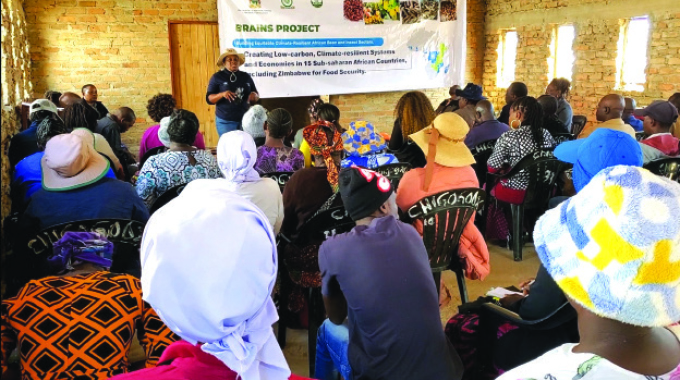
Theseus Shambare
Features Writer
WHEN Knowledge Dzadza stepped into the community hall at Chigogodza Business Centre in Murehwa, she was one of many smallholder farmers seeking answers in an increasingly unpredictable agricultural world.
But by the end of the day, it was clear that her name, Knowledge, perfectly captured the theme of the gathering: that the future of farming in Zimbabwe must be rooted not only in hope but in knowledge.
“I used to think farming was just about putting seeds in the soil and waiting for the rain,” she said after the session. “Now I understand it is about planning, protecting and producing — with information.”
The workshop, held recently, was part of the newly launched BRAINS Project — Building Equitable Climate-Resilient African Bean and Insect Sectors — being rolled out in Murehwa, Mutoko and Mutasa districts.
These areas have faced repeated droughts, pest outbreaks and failed harvests due to worsening climate change.
While the last agricultural season brought good rains, farmers remain anxious. Years of erratic weather patterns have made it clear that one good season cannot be taken as a return to normal.
The BRAINS Project, led by the Ministry of Lands, Agriculture, Fisheries, Water and Rural Development, aims to shift the foundation of agriculture from dependency and guesswork to resilience and innovation.
The programme promotes drought-tolerant bean varieties, sustainable insect farming and ecological pest control.
As chief director of Research and Specialist Services, Dr Dumisani Kutywayo told the farmers gathered at Chigogodza, the most important thing it delivers is knowledge.
“This initiative empowers farmers with the knowledge and tools needed to thrive in an evolving agricultural landscape,” he said. “We must farm with brains, not just hope.”
That message resonated with Dzadza and many others in attendance. In recent years, she has seen her harvests swing wildly, sometimes decent and often disastrous.
When the rains fail or come too late, there is little to fall back on. With each failed season, confidence erodes, especially among female farmers, who often bear the brunt of food insecurity at household level.
At the workshop, participants engaged directly with experts who introduced practical innovations tailored to their local realities.
Mrs Louisa Makumbe, head of the Plant Quarantine Services Institute and principal investigator for the insect component of the project, presented the benefits of black soldier flies and crickets as alternative protein sources and composting agents.
These insects, she said, require minimal water and can be raised on organic waste, making them perfect for dryland farmers.
“Insects are not just for research labs,” Mrs Makumbe said.
“They are affordable, scalable and climate-smart. They are the future of protein and sustainability.”
That future came alive for Dzadza, who had never considered insect farming. “I used to swat flies and sweep them out of the kitchen,” she laughed at her ‘years of ignorance’. “Now I am thinking of how to raise and sell them.”
The workshop also featured apiculture expert Mr Clever Garirofa, who began beekeeping with homemade hives in Chimanimani and now trains farmers nationwide.
He showed how bees can help increase crop yields through pollination while also offering an additional income stream from honey, wax and other products. For Dzadza, it was a lightbulb moment.
“Bees do not ask for fertiliser or diesel,” she said. “They just work. And if you take care of them, they take care of you.”
Such insights were welcome not only to farmers but also to traditional leaders. Village head Mr Kufahakurotwe Marimo, known as Sabhuku Muchemwa, addressed the crowd with heartfelt support for the initiative.
He said the days of relying on tradition alone are gone and welcomed the fusion of indigenous knowledge with modern science.
“Our community has suffered from poor harvests, pests and the lack of reliable information,” he said. “This programme gives us tools, not just talk. It respects what we already know and adds to it. We welcome it fully.”
This participatory model — treating farmers as equal partners and not passive recipients — is central to BRAINS.
Rather than being told what to do, farmers are invited to help design local solutions that suit their landscapes, crops and cultures.
Youths and women, who are often excluded from formal agricultural training, are placed at the centre.
Dzadza, a single mother of two, appreciated the respect given to the experiences of rural women.
“We have been managing households and gardens for years. Now we are being given the science to make those efforts go further.”
She left the session already planning how to set up a compost heap for black soldier fly larvae, how to position bee-friendly trees around her field and how to share what she learnt with neighbours who could not attend.
As the sun dipped behind the hills of Murehwa, she spoke with quiet confidence.
“I used to think my name was just a coincidence,” she said. “Now I see it is a responsibility. I must live up to it and help others see that knowledge is something we grow, just like crops.”
For Dzadza and others in Murehwa, this is the start of a different kind of farming season.
The fields may still be dry, but minds are fertile. Before the first drop of rain falls, preparation has already begun, not with hoes and seed but with ideas, questions and plans.
Farming in Zimbabwe has entered a new era, where the most powerful tool a farmer can have is not a tractor or a loan but understanding.
As the BRAINS Project continues to roll out across the region, it may not only change what farmers grow but how they think.
And in a world where the next drought is always one season away, that kind of shift may be the smartest harvest yet.