Chronicle Editor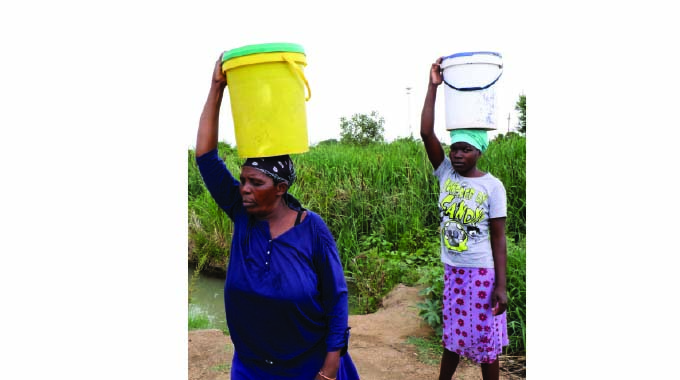
Mashudu Netsianda, Senior Reporter
A HEALTH hazard is looming in Bulawayo as some residents are forced to resort to unsafe water sources in swampy areas amid a deepening water crisis due to the prolonged water shedding exercise.
City residents are enduring a prolonged water shedding exercise as the Bulawayo City Council (BCC) struggles to pump water due to alleged power outages, which the Zimbabwe Electricity Transmission and Distribution Company (ZETDC) has, however, dismissed.
ZETDC absolved itself of any blame in the ongoing water shedding programme saying there was no major electricity fault in the city.
Council recently introduced a weekly 48-hour water shedding programme, with the city centre and industrial sites being exempted.
The local authority has since increased the water shedding exercise to 72 hours per week although residents in some suburbs have gone for almost a week without water.
Residents said failure by BCC to adhere to the water shedding schedule has worsened the water woes forcing them to resort to unsafe water sources.
A Chronicle news crew yesterday visited selected suburbs in the western areas and observed people queuing for water at boreholes.
In Pumula East, some residents were fetching water from swampy areas. Some women were spotted washing clothes using water dug around smelly swamps. “The water crisis is back in Bulawayo and what is worsening the situation is that council is failing to adhere to the water shedding time table. For the past one week, there has been no water in our suburb and we are now fetching dirty water in these swampy areas for washing and toilet purposes,” said Ms Lindiwe Sibanda.
Ms Sithulisiwe Nyoni said she comes to the area daily to do her laundry because there is no water coming out of taps.
“The other challenge we are facing is that our nearest borehole is not working and people are now forced to walk for a distance to queue for water at other boreholes,” she said.
The news crew also observed children utilising water in nearby bushy areas to bath oblivious of the dangers of the threat of waterborne diseases.
Ms Dorcas Sibanda of Mabutweni said the prevailing water crisis is a ticking timebomb in the suburb where four families rely on one toilet and bathroom.
“Mabutweni has four blocks and each family occupying those houses uses one toilet and bathroom. Most of the residents are the elderly and poor people who can’t afford to build their own toilets,” she said.
“The challenge now is that there is no water and we have vulnerable people such as children and old people who are susceptible to contracting diseases through a toilet used by so many people.”
Ms Gloria Ndlovu said the water crisis has worsened the situation.
“We are appealing to council to assist by constructing more toilets so that people do not share the ablution facilities as it is a recipe for a health disaster. We are also appealing for chemicals to disinfect the ablution facilities and kill germs, which are messy,” she said.
Ms Molly Khumalo said: “This is a terrible situation where you find one household with 10 people and sharing one bathroom and toilets. We have Covid-19 and surely how do you expect people to survive under such unhealthy conditions.”
BCC corporate communications manager Mrs Nesisa Mpofu attributed the prolonged water shedding excise to low levels of water in reservoirs, which affects opening times.

“Most of our reservoirs are still stabilising as they still have low levels. We can’t open taps when the levels are still low and that is why we have not been able to follow the water shedding schedule,” she said.
“This is affecting opening times and we are trying the best that we can and when the levels stabilise, normal water supplies will resume. In the meantime, we are asking residents to be patient and bear with us and reduce consumption.”
Mrs Mpofu said it takes long for reservoirs to stabilise.
“The challenge that we have is that when we open reservoirs in some places consumption shoots up and when that happens it means we can’t open again for the next suburb due to a sharp decline in water levels meaning we have to close again,” she said.–@mashnets


 Online Reporter