admin
admin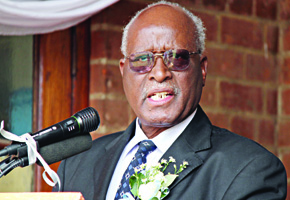
This came out during a meeting between members of the Organ for National Healing, Reconciliation and Integration and traditional leaders in Harare yesterday.
The meeting was aimed at finding lasting solutions to politically motivated violence as the country gears for synchronised elections expected later this year.
Vice President John Nkomo, who was represented by co-Minister in the organ Sekai Holland, said Government legal experts were now transforming the policy into a legal framework.
Legal experts, he said, would develop a Bill for the enactment of an Act of Parliament.
The policy framework will work through a National Peace and Reconciliation Council (NPRC).
“It is envisaged that this Act will spell out in clear terms the legal status, structure, functions and powers of the NPRC,” he said.
“The delineation of responsibility and accountability between different governance structures and authorities at all levels should be encouraged for purposes of mutual benefit and inclusivity.”
VP Nkomo said the policy framework would “institute” an enabling environment to facilitate dialogue and peace building among Zimbabweans through programmes and projects that lead to peace through conflict resolution and transformative engagements.
He said the NPRC would be free from political interference.
“The NRPC shall provide policy advice, facilitate the development of programmes and supervise implementation of programmes and activities for the promotion of equality, national healing, cohesion and unity.
“It should enjoy the confidence of individual Zimbabweans and organisations — including political parties, the traditional leadership, faith based organisations and institutions of governance in the country,” he said.
The NPRC, VP Nkomo said, would have nine members, four of which should be women.
“Members shall be identified through an open and transparent manner after advertisement and a nomination process by Zimbabweans.
“The members shall be distinguished Zimbabweans of impeccable stature and gravitas having expertise and experience in post-conflict, national reconciliation and peace building,” he said.
He said nominated candidates would be vetted for suitability by Parliament’s Standing Orders Committee for appointment by the State President.
The NPRC would report to a designated Ministry and bi-annually to Parliament through the Minister responsible for its administration.
“The NPRC shall establish provincial and district Peace and Reconciliation Councils with their compositions reflecting that of the national body.
“The designated Ministry shall work closely with the NPRC in mainstreaming a structured and co-ordinated approach to resolving conflicts within the country,” he said.
Speaking on the code of conduct for political parties, VP Nkomo said the parties should be committed to regulating the behaviour and conduct of their members.
“This instrument is meant to imbed to zero tolerance to violence in all political engagements and processes. Arrangements for it’s signing is at an advanced and this is being facilitated by the Secretaries General of political parties signatory to the Global Political Agreement,” he said.
VP Nkomo said peace and reconciliation was an “evolving” process and traditional leaders should play a pivotal role.


 Online Reporter