Online Reporter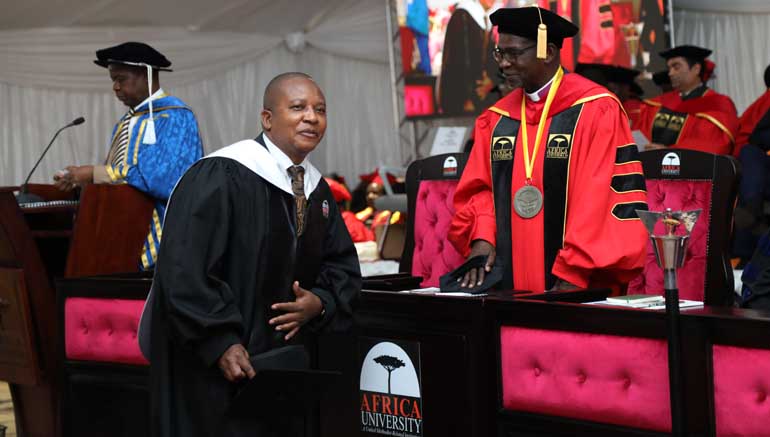
Tendai Gukutikwa
Post Reporter
ON most days, the weight of the country’s mineral wealth sits on Honourable Polite Kambamura’s shoulders.
His diary is a blur of Cabinet briefings, investor handshakes in glass towers, and parliamentary debates that shape the fate of gold seams and lithium fields.
Mining, after all, is the furnace Government hopes will fire industrialisation and economic transformation. It is a portfolio that swallows time.
Yet, behind the polished suits and policy papers, Mines and Mining Development Minister, Honourable Polite Kambamura was quietly carrying a backpack.
Last Saturday, the black executive car gave way to a sea of ululation and camera flashes in Mutare.
The ministerial suit was gone. In its place, a black graduation gown, a mortarboard catching the mid-morning sun.
Minister Kambamura walked the same stage as hundreds of other graduates at Africa University’s 32nd graduation ceremony, not to officiate, but to receive his own Master’s Degree in Public Policy and Governance.
The applause that rose from the tent mattered more than most he hears in boardrooms.
Here was the nut of the story – a man at the pinnacle of public office insisting that learning has no expiry date.
For two years he traded sleep for assignments, slipping between national budgets and academic deadlines, proving that education does not stop when power starts.
There is a metaphor here, and it is not subtle. A miner digs deeper for value. So did the minister. While overseeing a sector meant to add value to raw ore, he chose to add value to himself.
“I learnt quite a lot from this institution. The programme strengthened my understanding of leadership and governance. It also broadened my appreciation of Africa, its people and the importance of African countries working together to protect their sovereignty, culture and values,” he said.
For a minister operating in an increasingly interconnected world, such lessons carry practical significance.
The mining sector itself has become a major arena for international cooperation, regional partnerships and policy development, making an understanding of governance and continental affairs particularly relevant.
Minister Kambamura said one of the most valuable aspects of the programme was its focus on public policy.
The course provided a deeper appreciation of how policies are developed, implemented and reviewed to ensure they achieve their intended objectives.
“I gained a much clearer understanding of policy formulation and governance. I learnt how policies are crafted, implemented and reviewed for further improvement. That knowledge is very important, especially in Government where policies affect people’s daily lives,” he said.
According to Minister Kambamura, effective leadership requires more than simply creating policies. It also demands an ability to communicate them, explain their purpose and ensure they ultimately benefit citizens.
“Furthering my education, helped me understand how Government policies can be communicated more effectively to the people. It also strengthened my ability to advise colleagues and contribute to discussions around governance and public service,” he said.
His remarks echoed one of the dominant themes that emerged throughout the graduation ceremony: that education should equip graduates, not merely with certificates, but with the ability to solve problems and contribute meaningfully to society.
Asked about calls for graduates to become entrepreneurs and job creators, the minister supported the vision, but urged young people to appreciate the value of experience.
He said young graduates should embrace practical outcomes.
“Education 5.0 is about self-empowerment. We should aspire to become employers and not remain employees forever. However, there is value in gaining experience first,” he said.
According to Minister Kambamura, the workplace remains an important training ground where young professionals can acquire skills that complement classroom learning.
“You need that first experience because it teaches you how things work in practice. It allows you to learn the tools of the trade, understand the realities of your profession and develop confidence. Those experiences become the foundation for future success,” he said.
Rather than seeing employment and entrepreneurship as opposing paths, the minister said he views them as stages within a broader journey of professional development.
“After gaining experience, you are better positioned to start your own ventures, create jobs and contribute more effectively to national development,” he said.
He said his advice reflected lessons drawn, not only from his academic studies, but also from years of public service.
Minister Kambamura said he was committed to personal growth, leadership and service.
“Between Cabinet meetings and coursework, policy discussions and assignments, public responsibilities and academic deadlines, I found time to invest in my own development,” he said.
Representing Higher and Tertiary Education, Innovation, Science and Technology Development Permanent Secretary, Professor Fanuel Tagwira, Zimbabwe Council for Higher Education chief executive officer, Professor Peter Dzvimbo, challenged graduates to use their qualifications as tools for transformation.
Addressing the graduating class, Professor Tagwira assured students that the qualifications they had earned compared favourably with those offered elsewhere on the continent and internationally.
For Minister Kambamura, who earned his qualification while serving in Cabinet, the statement carried special significance.
He said Minister Kambamura’s achievement reflects the growing recognition of Zimbabwean universities and the quality of programmes they offer to both traditional students and working professionals.
He noted that Africa University’s educational philosophy was grounded in African realities and designed to prepare graduates to address the continent’s challenges.
“The knowledge you acquired here is rooted in our heritage and our values as Africans. It is intended to place you at the centre of Africa’s development and equip you to contribute towards improving our continent,” he said.
The message resonated strongly with Minister Kambamura.
Throughout his studies, he said, he developed a deeper appreciation of Africa’s shared aspirations, and the importance of collaboration among African nations. He added that beyond leadership and governance, the programme reinforced his belief that sustainable development requires African-led solutions.
As one of 698 graduates from 21 African countries who received qualifications during the ceremony, Minister Kambamura became part of a diverse community united by a common commitment to learning and development.
Professor Tagwira used the occasion to challenge graduates to continue learning long after leaving the university.
“The true mark of an educated person is the ability to learn, unlearn and relearn. Knowledge is constantly evolving and graduates must be prepared to adapt, rethink and continue growing,” he said.
Perhaps no graduate embodied that message more visibly than Minister Kambamura himself.
He said while he already occupies one of the highest offices in Government, he chose not to rely solely on experience accumulated over the years. Instead, he returned to the classroom to deepen his knowledge and sharpen his skills. Learning remains a lifelong process and I am a good example of that,” he said.
Africa University Vice-Chancellor, Professor Peter Mageto, said institutions of higher learning are increasingly creating opportunities for professionals to continue their studies while maintaining demanding careers.
“Over the years, we have worked to make education borderless and accessible. We are witnessing the growth of our Global Campus, and we have quite a number of graduates who completed their studies through online learning platforms. We have many students studying our programmes online, and this gives equal opportunity to professionals like Minister Kambamura to further their studies. This reflects our commitment to responding to the evolving needs of students and working professionals,” he said.