daniel chigunwe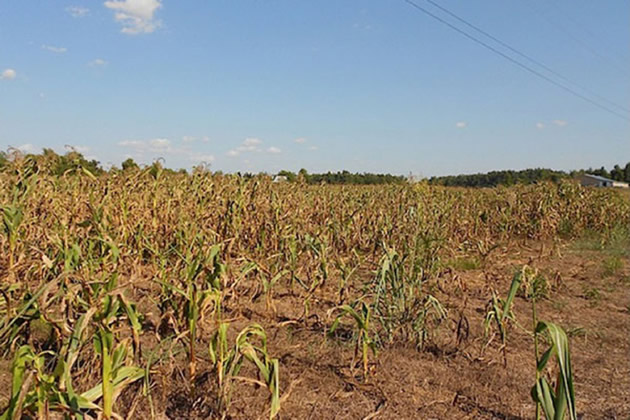
Oliver Kazunga
Business Writer
Climate change has emerged as the most significant economic threat to Zimbabwe, prompting the Government to prioritise its impact and mitigation strategies at this year’s Zimbabwe Economic Development Conference (ZEDCON).
Zimbabwe and other countries in the southern African region have experienced the El Nino-induced drought which has seen 70 percent of the crops in the country declared a write-off, reflecting a bad 2023/2024 agriculture season. In addition, water sources have been diminished and the net impact has been food insecurity for 7,7 million people in the country. With usable water at Kariba Dam running dry, the power situation has also become dire.
It is against this background that ZEDCON, which begins in Victoria Falls on Sunday to Tuesday will be held under the theme, “Building Resilience and Driving Economic Transformation under Climate Change”.
The conference seeks to examine ways and means to grow and expand Zimbabwe’s climate financing and economic development mechanisms.
The agriculture sector is one of the country’s major economic centrepieces contributing between 10 percent and 11 percent to the Gross Domestic Product.
In separate interviews, experts concurred that following the devastating effects of the El Nino-induced drought, focus of this year’s ZEDCON was significant and timely.
Agricultural economist Dr Reneth Mano who is also the Livestock and Meat Advisory Council chief executive officer said agriculture is a critical industry as it generates income and providing food security in Zimbabwe, but the sector’s potential has been threatened by the current drought.
“As a result of the drought, the sector’s contribution to the economy is under threat. The sector provides food security to the nation but due to the El Nino-induced drought food insecurity and loss of income have been magnified.
“Therefore, this conference confirms that the Minister of Finance, Economic Development and Investment Promotion (Professor Mthuli Ncube) really wants to clearly understand the importance of agriculture and the risks that are paused on agricultural growth and agro-economic growth from global climate change.
“So my expectation really from this conference is that it will go beyond explaining the causative relationship between good rains and good harvest, and really start digging deep into the implications that cover the root causes of climate change, which is really global,” he said.
Dr Mano said, Prof Ncube and his Lands, Agriculture, Fisheries, Water and Rural Development counterpart Dr Anxious Masuka should be joining the Pan-African movement to start demanding climate justice as a form of compensation from rich countries.
“I would expect that the Ministry of Finance and the gathering in Victoria Falls will be able to strengthen these arguments and really, in very unflattering terms, point to the source of the risk, point to the need for that compensation,” he said.
In a separate interview, a certified expert in Environmental, Social, and Governance issues Cynthia Tapera said focusing on climate related issues at ZEDCON is a step in the right direction towards a whole-of-government approach in climate action and sustainable development.
“One key resolution that I would expect from ZEDCON is the development of a national sustainability roadmap that will harmonise the various sectoral, economic, social and environmental policies and plans that are operating in the country.
“The roadmap will enable the Government to respond to new and emerging developments, concerns and systematic risks, such as data protection, climate change, biodiversity, energy security to mention a few,” she said.
An economic commentator George Nhepera said climate change has become an emerging risk and threat to the economy and thus through this year’s ZEDCON, the Government and other stakeholders should focus on initiatives to manage climate risk.
“We are living in a moment in history where climate change is becoming an emerging risk and threat to the economy such that if not managed well and in disciplined fashion may adversely affect our economy and livelihoods.
“The coming together of many stakeholders through such a conference is therefore very timely and crucial so that initiatives to manage the climate risk could be put on the table for discussion.
“We certainly require private sector financing models designed to support industry initiatives to reduce carbon emissions,” he said.
The Zimbabwe Farmers Union executive director Paul Zakariya said the Government has a climate response strategy that is inundated by a number of ideas that have the potential to turnaround the country’s fortunes in agriculture and the economy at large.
“Thus, it is important that we look at that document, the climate change response strategy — reference has to be made to that document because all sectors and all key stakeholders were consulted as far as that one is concerned.
“What is very important now is for the Government, the private sector and development partners to look at how we can put feet to the strategies that were put in place. But the number one thing that we need to look at is irrigation development — and not these irrigation schemes that we are seeing countrywide that are being promoted and so on.
“If it is a scheme, it is a scheme that takes only a few people. But what we mean by irrigation, in this sense, as a farmer organisation, is the capacity to draw water from the many water bodies that we have in the country,” he said.
In past few years, President Mnangagwa has been commissioning dams.
“Those dams, when you look at them, you’ll see that there are no economic activities around those dams because there hasn’t been deliberate infrastructure to pipe water from those dams, drawing that water closer to the communities, even rural communities, where that water can then be used.
“That water can be used in the communal areas when our farmers have been equipped with drip irrigation, micro-irrigation kits that can help them to supplement during dry spells because climate change causes a lot of ills, including dry spells and crops begin to wilt.
“With irrigation, our farmers are able to produce all year round and this reduces the burden on the Government to support vulnerable communities because now they are producing and commercialising their enterprises,” he said.
Due to the current El-Nino drought and lack of enterprising irrigation facilities, the country is importing maize from around the world to cover the deficit.
“So, the investment that is required is one that draws water from the many water bodies that we have closer to the communities where the water can be utilised. In my view, this is the factor the conference should concentrate on and the then quantifying, how much is required by way of that investment to draw water to the people,” said Zakariya.
To mitigate the adverse effects of climate change, he said there should be a deliberate action to religiously plant trees and have grass all over so that the soil is not easily washed away.
“We need to sink the carbon that is being emitted. We need to create carbon sequestration.
“In some cases, all the cotton and tobacco stalks that we burn, we need to be capturing carbon in them by way of mixing it (carbon) with manure and then depositing that into the soil.
“And that has a double effect — you are returning carbon into the soil, but also the biomass has the capacity now to hold moisture for much longer periods,” said Zakariya.



 Online Reporter