


 admin
admin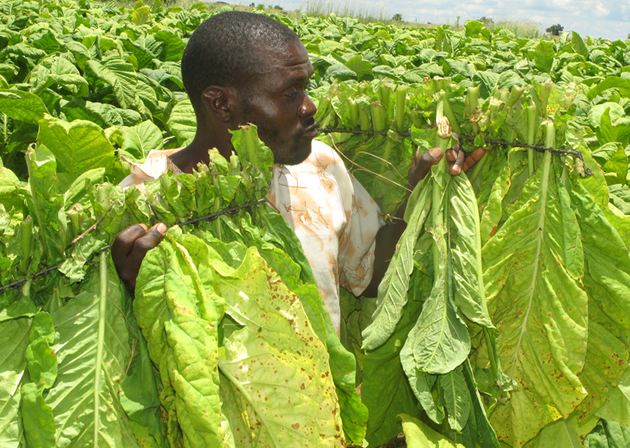

ONE of Germany’s eminent sons, Otto Von Bismarck, once said: “What we learn from history is that no one learns from history.”
While this is a truism, it cannot, however, be treated as an exact science.
This year’s tobacco marketing season, which began on March 4, 2015, has really been a sad tale.
It seems that the market is being haunted by the same ghosts that were exorcised a long time ago, but have been sneaked in through the back door.
After seven months of investing their money, hopes, anxieties and dreams, tobacco farmers expect their toil and back-breaking work to be rewarded with, at the very least, a reasonable reward. This has not been the case. Instead, this year it has been an insult. But it is not surprising that this has happened.
Over the years, tobacco has been extremely rewarding, especially to the new crop of farmers that were given land by Government through the land reform programme.
Last year, tobacco farmers, who once competed with the United States of America for the best quality of tobacco, managed to haul in more than US$651 million, grossing the biggest selling total in more than 13 years.
It has clearly become a money-spinning business. But as in any venture or enterprise that involves money, the human instinct has kicked in.
There are those who feel that by cutting corners – through feeding off unsophisticated farmers or getting a cut from sleek tobacco merchants – they will ultimately become rich overnight.
There were signs that all was not well on the first day of the marketing season. The average price offered by merchants was $3,50 a kilogramme, which is 28 percent lower than the US$4,85 that was offered on the first day of last season.
. . . Enter the Class B buyers.
I believe that whoever took the decision to re-introduce class B buyers is a patriot and was well-intentioned.
However, it must not be lost to memory that in 2012 this clique, which is ostensibly meant to buy, re-handle and repackage tobacco that would have been rejected by Class A merchants and then re-sell it to the same at a higher price, had been banned from the auction for pushing down the price.
Ordinary farmers dreaded the role that was being played by Class B buyers and there were allegations that they were colluding with Class A merchants to reject the bulk of their tobacco so that they could buy it at low prices and re-sell it to Class A buyers at a higher price.
Though they were banned, this lot simply “moved office” as they began operating outside the floors.
There were curious incidences were some bales of tobacco were suspiciously rejected at the auction floors only to be bought outside the floors and resold again at the same auction floors. However, Class B buyers are back, again.
Ultimately, the farmers have become the biggest losers. Unlike Class A buyers who already have customers to which they export the tobacco that they would have bought on the auction floors, there is need to interrogate where Class B buyers are getting their money from and where they are selling their tobacco.
Essentially, Class A buyers would ordinarily have offshore funds to sponsor their activities on the auction floors, so they bring in new money.
But it does not make sense to borrow money from local banks – as most of the Class B buyers are alleged to be doing – to buy the locally produced tobacco.
At the end of the day, there is no new money into the economy. It is a massaged and sanitised form of arbitrage.
In their own special way, the Reserve Bank of Zimbabwe tried to mobilise some offshore funds for small-scale tobacco merchants, and this is welcome. Government needs to get to the bottom of this issue.
They need to start with questioning who lobbied for Class B buyers to return to the market.
Equally as lethal, sleek and cunning as Class B buyers, there are fake Class A buyers, who, in essence, are supposed to directly export most of the tobacco that they buy. While there can be inter-merchant sales to balance stocks and styles (type of tobacco bought), these are not significant for “A” class buyers.
So, they already have a ready market for their product. Market rumors suggest that fake “A” class buyers are competing on the same auction floors with real “A” class buyers who will later buy tobacco bought by the fake “A” class.
So, these cunning buyers end up pushing the prices of tobacco down in order to then re-sell it to genuine Class A buyers.
It’s a mess.
But such opportunities for arbitrage are only possible where there is a dual system of marketing and a compromised regulator that cannot effectively monitor the sector, or, more accurately if the said regulator is compromised.
Board members of the Tobacco Industry Marketing Board (TIMB) need to show that there are fair superintendents and arbiters in a sector were emotions are running high.
They have to declare their interests.
There is evidence that shows that some of the board members are being loaned money to fund their own tobacco operations.
Well, no one will deny them their right as Zimbabweans to access such facilities, but the fundamental question is: What takes precedence between the “contractor-contracted” relationship they have with some of the sector players they are supposed to regulate and the “regulator-regulated” relationship.
I surely hope they are not conflicted.
In as far as this relationship begins to threaten the well-being of farmers, it becomes problematic.
At the end of the day, TIMB, which is a public body that should be accountable to the public and is wholly funded by growers through grower registration fees paid by growers, has to be accountable.
Are they diligently championing the cause of the sector? How are they spending the money collected from growers?
And are the funds that are collected by the growers being ploughed back to assist the farmers through crop assessments, advise on presentation of tobacco, and general education of the farmer so that they produce quality tobacco?
As the steep pricing differentials between contract and auction tobacco continues, and continues rather unjustifiably, there is need to collapse the current dual system in order to ensure that tobacco, whether contracted or not, is bought under one roof.
In such an envisaged scenario, the hessian sack can be used to distinguish the bales.
Contractors and non-contractors can therefore compete in an open market for the golden leaf.
The logic is to ensure that farmers can get the maximum possible value for their crop.
Also, the marketing season will have to be drawn out in order to avoid the possibility of congestion on the auction floors and in warehousing facilities. This used to happen and it is possible. It will further guarantee that money trickles into the economy for a longer and spread period of time.
The current situation is really untenable.
Government needs to act expeditiously on this issue as this is a vulnerable and key constituency that can only be saved by it.
Feedback: [email protected]


 Online Reporter