Online Reporter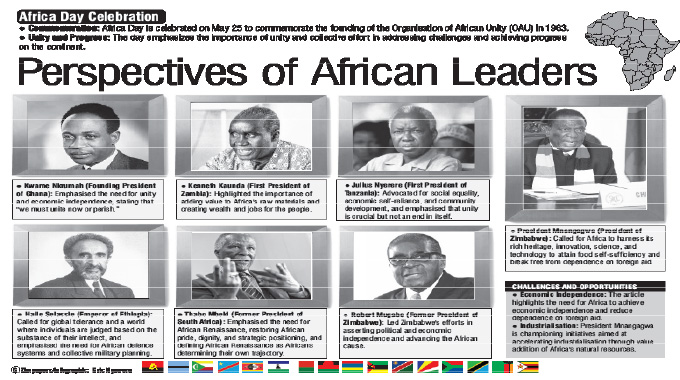
Ranga Mataire
Group Political Editor
ON May 25, the continent of Africa celebrates Africa Day, an annual commemoration of the founding of the Organisation of African Unity (OAU) in 1963, which transformed into the AU on May 26, 2001.
Sixty-two years ago, 32 counties signed the OAU Charter that gave birth to the continental body. Twenty-two other countries have since joined the continental body, which since its birth has achieved a lot in forging political unity on the global stage.
Although political freedom and the right to self-rule have been achieved (with the exception of the Western Saharawi), the continent still faces a myriad of challenges, which require resolute collective effort in dealing with them.
Continental forefathers played a pivotal role during the decolonisation period.
It is now incumbent upon the post-colonial leadership to address issues like health matters, poverty, economic freedom, improving the quality of education, resolving conflicts, ecological issues, fighting climate change and to raise the general well-being of the populace.
So as the continent celebrates Africa Day, an important day on the continent’s calendar, we delve into history for an inspirational dose of African leaders’ perspective on this crucial day.
Founding President of Ghana, Kwame Nkrumah who was instrumental in the birth of OAU is famed for his pan-Africanist stance in calling unity of all Africans on the continent and the African diaspora. In his speech at the launch of the OAU in Addis Ababa, 1963, President Nkrumah was unapologetic on the need for unity, saying:
“We must unite now or perish…We must recognise that our economic independence resides in our African union and requires the same concentration upon the political achievement.”
The euphoric zeal of independence did not cloud leaders like President Nkrumah to realise that political independence would be meaningless without economic independence. He was aware that much of the African economy was still in the hands of the former colonial masters and another struggle needed to be waged to ensure that Africans became masters of their own destinies.
But President Nkrumah faced a challenge from other leaders who in the euphoria of independence felt that their unfettered power could be diluted by a political and economic union of all African countries. The nature in which other countries had attained their liberation also shaped their perception of independence.
In an attempt to placate fears of “dilution”, President Nkrumah told the delegates at the Addis Ababa conference that: “Unite we must. Without necessarily sacrificing our sovereignties, we can forge a political union based on defence, foreign affairs and diplomacy, and a common citizenship, an African currency, a monetary zone and a central bank. We must unite in order to achieve the full liberation of our continent.”
Another founding member of OAU, the late first President of independent Zambia, Dr Kenneth Kaunda, remembers Nkrumah’s words at Ghana’s independence celebrations, which he was privileged to attend on March 6,1957.
Speaking as the guest of honour at an Africa Day celebration event organised by African Diplomats in Quebec, Canada, Dr Kaunda said freedom fighters were inspired by Nkrumah when he said the independence of Ghana would be meaningless without the independence of other African countries.
“Looking back, I can say as a people have succeeded on many fronts. The aspirations of the people to self-determination and independence have largely been met. Colonialism, oppression and apartheid in Africa have been eliminated. The OAU has been replaced by the African Union and there are still challenges that we face as a people of that great continent.
“Initially, the people’s aspirations were for freedom and liberty but that is more meaningful if it is complemented by a higher standard of living. In this day and age, as we engage with other partners in business we need to prioritise the placing of our abundant natural resources at the disposal of the African people in general,” said Dr Kaunda, laying out the mammoth task confronting post-colonial African leaders.
Dr Kaunda called for policies that assist Africa to add value to her raw materials and facilitate creation of wealth and jobs for the people.
“That is what people of Africa are looking for, an integrated prosperous and peaceful Africa,” said Dr Kaunda as he concluded his address.
Widely remembered as the first president of Tanzania and a key figure in the African Liberation Movement, Julius Kambarage Nyerere played a critical leadership role in establishing the OAU. He was an avowed pan-Africanist who advocated for the total liberation of Africa from colonial rule and advanced his Ujamaa philosophy that emphasised social equality, economic self-reliance and community development.
President Nyerere understood that unity crucial but not an end in itself saying: “Unity will not make us rich, but it can make it difficult for Africa and the African peoples to be disregarded and humiliated. And it will therefore, increase the effectiveness of the decisions we make and try to implement for out development.
“My generation led Africa to political freedom. The current generation of leaders and peoples of Africa must pick up the flickering torch of African freedom, refuel it with their enthusiasm and determination, and carry it forward.”
President Nyerere understood that unity makes it harder for other countries to disregard Africa.
Just like Nyerere, Ethiopia’s Emperor Haile Selassie, in whose country the OAU was founded called for global tolerance and a world where individuals are judged not based on the colour of their skin but the substance of their intellect.
In his speech delivered at the founding of the OAU in Addis Ababa on May 25, 1963, Emperor Haile Selassie understood the enormity of the task ahead in safeguarding the independence and territorial integrity of African nations. He called for steps to be taken “to establish an African defence system.”
“Military planning for the security of this continent must be undertaken in common within a collective framework. The responsibility for protecting this continent from armed attacks from abroad is the primary concern of Africans themselves.
“Provisions must be made for the extension of speedy and effective assistance when any African State is threatened with military aggression. We cannot rely solely on international morality. Africa’s control over her own affairs is dependent on the existence of appropriate military arrangements to assure this continent’s protection against such threats while guarding our own independence,” said Haile Selassie. Sad to say that the continent is yet to fully implement Emperor Selassie’s noble goals.
Following on their forebears’ footsteps, the contemporary African leaders have also upped the mantle for Africa to chart its course and insulate itself against neo-colonial threats.
Former South African President, Thabo Mbeki, who was instrumental in the founding of the African Union, whose mandate was to continue with the OAU’s mandate through a more pragmatic and coordinated approach.
Through his foreign policy project, the former president emphasised on African Renaissance aimed at restoring African pride, dignity and strategic positioning. He defined African renaissance as the need for Africans to determine who they are, what they stand for, what their visions and hopes are, how they do things, what programmes they adopt and who they relate to and how.
Although not marked as a public holiday in South Africa, President Mbeki known as a pan-Africanist who believes in an Africa that is capable of charting its own political, social, cultural and economic trajectory. In one of his seminal speeches delivered on May 9, 1996 titled “I am an African,” the former President literally “wrote back to empire” when he declared; “I am an African. I owe my being to the hills and the valleys, the mountains and the glades, the rivers, the deserts, the trees, the flowers, the seas and ever-changing seasons that define the face our native land.”
South of the Sahara, no country has arguably carried the mantle of African Pride in deeds and words than Zimbabwe. First led by President Mugabe who was a founder of the Southern African Development Coordination Conference (SADCC), later SADC, Zimbabwe has led the way in asserting its political and economic independence including advancing the African cause. It is the only country South of the Sahara if not in Africa that embarked on a revolutionary land reform programme meant to correct past colonial inequities on land.
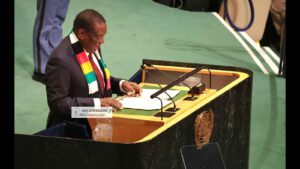
And today in the Second Republic, Zimbabwe counts itself among the few countries that actually mark Africa Day as a public holiday. President Mnangagwa enunciating a foreign policy anchored on being “an enemy to none and friends to all,” President Mnangagwa has on numerous occasion paid homage to the founding fathers of Africa unity, whose legacy continue to be felt today.
In his commemorative Africa Day message last year, President Mnangagwa called for Africa to harness the power of its rich heritage, innovation, science and technology to attain food self-sufficiency and break free from dependence on foreign aid.
“Gone are the days where we approach the world with begging bowls for aid, with its attendant conditionalities. Africa’s collective experience in politics and economic development testimony that it is none but ourselves who have the burden to move Africa forward. We must innovate and implement solutions that will see us becoming a nation and an African continent able to feed itself,” said President Mnangagwa.
President Mnangagwa understands that political unity needs to translate to economic independence. As the chairperson of SADC, President Mnanagwa is championing initiatives aimed at making the region and the continent economically independent by accelerating industrialisation through value addition of our God-given natural resources.