Chronicle Editor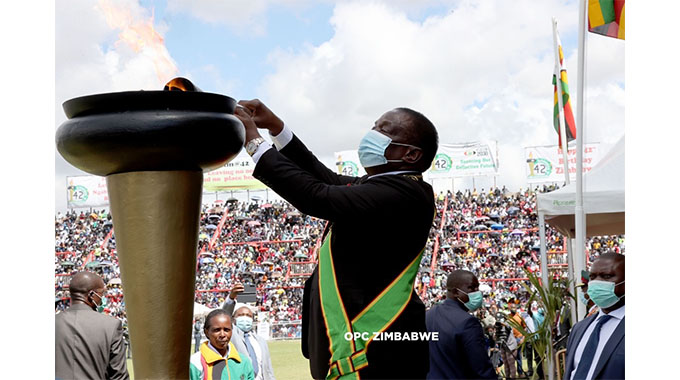
ON that glorious day of Monday, April 18, 2022, President Mnangagwa lit the Eternal Flame 42 years after it was lit for the first time at Rufaro Stadium in Harare and taken to Harare Hill where the Pioneer Column hoisted the Union Jack on September 12, 1890.
An eternal flame is a small fire that is kept burning as a symbol to show that something will never end. In the case of Zimbabwe, what will never end?
In our coverage of the national Independence Day celebrations in Bulawayo, we followed the journey of the Eternal Flame.
This year, the journey began last Saturday when the Eternal Flame was lit at Khami National Monument by Zanu-PF second secretary and party Vice-President Kembo Mohadi, who was with Bulawayo Provincial Affairs and Devolution Minister Judith Ncube and her Matabeleland North counterpart Richard Moyo, alongside Chief Ndondo from Mbembesi and other Government officials.
Khami National Monument is a ruined city located 22 kilometres west of Bulawayo, which was once the capital of the Kingdom of Butwa of the Torwa dynasty.
The national monument, which became a Unesco World Heritage Site in 1986, is a living symbol or eternal flame of Zimbabwean civilisation well before colonisation.
On Sunday, the flame left Khami National Monument and took a tour of Bulawayo, including western suburbs. After about seven hours of being paraded around the city, the flame was taken to the Natural History Museum of Zimbabwe.
The Natural History Museum is the best museum in southern Africa and is ranked fourth in size among the museums of Africa, hence it is an eternal flame of true African history.
On Monday morning, a group of 15 athletes comprising members of the security forces took the flame from the museum to the Joshua Mqabuko Nkomo Statue, then along Joshua Mqabuko Nkomo Street. Dr Joshua Mqabuko kaNyongolo Nkomo, popularly known as Father Zimbabwe, is a founding father of nationalist politics, liberator and above all an eternal flame of unity among Zimbabweans.
The Eternal Flame left Joshua Mqabuko Nkomo Street for Third Avenue into Makokoba, then Mzilikazi and finally Barbourfields Stadium. The 25 000-seater stadium is named after Henry Robert Barbour, who was the mayor of Bulawayo from 1924 to 1926.
Barbourfields suburb is one of the oldest settlements in the city and was built on land formerly owned by Barbour. The township is an eternal reminder of why black Zimbabweans took up arms against a racist settler regime.
The relay team entered Barbourfields Stadium to thunderous applause before handing over the torch to President Mnangagwa who then lit the Independence Flame.
Addressing thousands of people who attended the 42nd Independence Day celebrations, the first time since 1980 for such an event to be hosted outside Harare, President Mnangagwa said: “Good times lie ahead and the fruits of our labour will be there for all to enjoy. Let us not grow tired but keep marching forward with joy, great optimism, determination, zeal and focus in unity, peace and freedom.”
Unity, peace and freedom — that is the eternal flame!


 Online Reporter