Online Reporter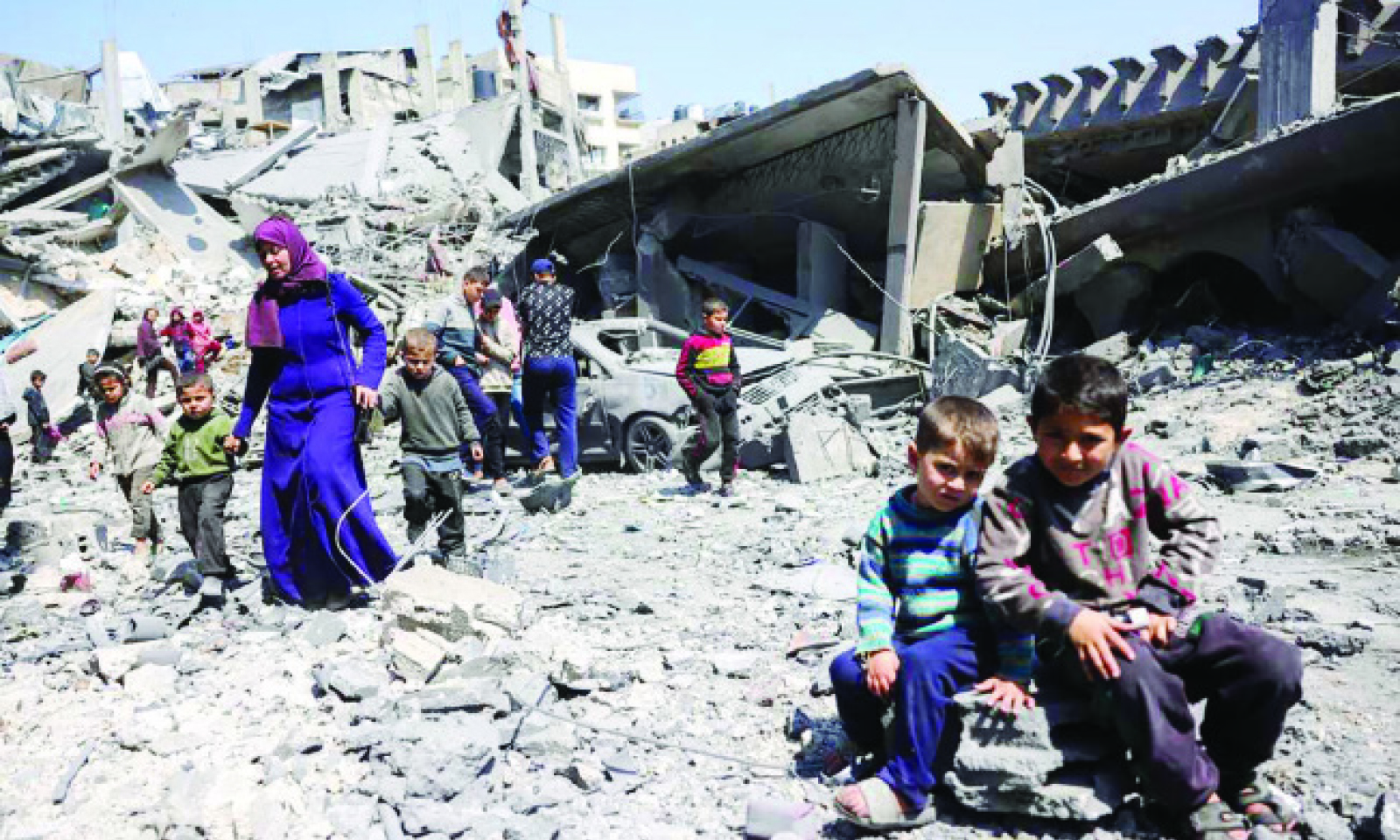
Communion with Bishop Lazarus
World leaders will gather in New York, United States, for the annual political ritual that has been observed for the past 80 years to prevent a major conflagration at the scale and magnitude of World War II (1939-1945) — the deadliest conflict in human history — which claimed between 50 million and 80 million lives.
And this was after the earlier World War I, which ran from 1914 to 1918, had resulted in an estimated 15 million to 22 million deaths.
All in all, we are talking about an estimated 100 million people who lost their lives in these major European wars, in which our forebears from this peace-loving continent were conscripted as battering rams from the colonies.
Yet, today, as the United Nations (UN), an international organisation established to safeguard and guarantee world peace, celebrates its 80th anniversary, the world is teetering on the brink of war as never before. In the Middle East, Israel’s relentless war machine has killed more than 65 000 people in Gaza and injured 160 000 others, mostly civilians, since October 7, 2023.
Ninety percent of homes in the enclave have been reduced to rubble.
Further, health services in Gaza have catastrophically collapsed, while the UN has since declared a famine in part of the territory.
No incident represents how perilous the situation in the Middle East has become than the recent reckless bombing of Qatar by Tel Aviv as it tried to eliminate Hamas officials.
Clearly, a miscalculation by Israel’s military could be calamitous in a region where political temperatures are already febrile.
In Ukraine, fire and brimstone are still raining from the sky almost three years after Russia launched its special military operation on February 24, 2022.
While statistics are not readily available, estimates suggest millions of lives had already been lost.
Again, earlier in May, the world stared at the real prospect of another major conflict when a terrorist attack in Pahalgam, Jammu and Kashmir, sparked a four-day conflict between India and Pakistan.
It was the most significant clash between the two nuclear-armed adversaries in several decades. It saw military action unfold that crossed previous thresholds in geographic reach, systems employed and impacts produced.
Closer to home, in Sudan, entrenched and bitter rivals, the Sudanese Armed Forces led by General Abdel Fattah al-Burhan and the paramilitary Rapid Support Forces commanded by Mohamed Hamdan Dagal, are still locked in a conflict that has rumbled on since April 15, 2023 when hostilities began.
By some accounts, the conflict, which has killed thousands and displaced about 13 million, has become the world’s largest humanitarian crisis.
The situation is hardly any different in South Sudan, where an uneasy peace between Salva Kiir and Riek Machar is hanging by a thread.
Last week, there were fears the world’s youngest nation could plunge into a new civil war after the party of suspended Riek Machar — who is currently under house arrest and is facing charges of murder, treason and crimes against humanity — called for “regime change”.
Equally tenuous is the ceasefire between warring parties in the eastern Democratic Republic of Congo. Despite the modicum of peace, the conflict is still well and truly on as evidenced by episodic clashes and violence.
Unfortunately for the world, all the geopolitical tensions and sabre rattling have led to a new armed race, particularly among the nine nuclear-armed states — the US, Russia, the United Kingdom, France, China, India, Pakistan, North Korea and Israel.
Accordingly, world military spending rose by 37 percent in the past decade, and by 9,4 percent last year alone, to US$2,7 trillion, according to the Stockholm International Peace Research Institute.
So, the situation around the world is almost apocalyptic. Remember Jesus’ sermon on the Mount of Olives.
“Be careful! Don’t let anyone fool you. Many people will come and use my name,” Jesus said in Matthew 24:4-8.
“You will hear about wars that are being fought. And you will hear stories about other wars beginning. But don’t be afraid. These things must happen before the end comes. Nations will fight against other nations.
“Kingdoms will fight against other kingdoms. There will be times when there is no food for people to eat. And there will be earthquakes in different places. These things are only the beginning of troubles, like the first pains of a woman giving birth.”
Institutional paralysis
But the troubling fact the world faces today is that the UN, which was born from the ashes of World War II to save succeeding generations from the scourge of war, now confronts a perfect storm of geopolitical fragmentation, financial strangulation and institutional paralysis that threatens its very relevance in addressing global challenges.
A self-deluding Donald Trump, who believes in the primacy of the US over multilateral institutions, cut or froze substantial funding for the UN and its agencies, eviscerating humanitarian aid operations in the process.
This has effectively disempowered aid agencies such as the World Food Programme, which relied on Washington to cover half of its US$9 billion budget in 2024, as well as the UN High Commissioner for Refugees, which got two-fifths of its funding from the US.
Overall, the UN Secretariat is shedding about a fifth of its staff through the UN80 reform process amid plummeting morale.
What has compounded the UN’s institutional paralysis is the gridlock at the heart of its security architecture as a result of the great power rivalry.
Decision-making remains largely stalemated due to the veto power of the five permanent members (P5) of the United Nations Security Council — China, France, Russia, the UK and the US.
The council’s inability to respond effectively to major conflicts has led to a crisis of legitimacy, with many member states questioning whether the P5 structure reflects contemporary geopolitical realities rather than 1945 power dynamics.
Emerging powers like India, Brazil and Nigeria are increasingly demanding permanent seats.
Also, nowhere is the UN’s diminishing influence more apparent than in its inability to mediate in today’s most devastating conflicts: Gaza, Sudan and Ukraine, among others.
On its part, Zimbabwe has since launched its bid for a non-permanent seat on the UN Security Council in order to lend its voice to global peace-building efforts.
Perhaps the biggest challenge that has systematically eroded the effectiveness and relevance of the UN in the decades after the end of the Cold War has been the domineering attitude of the US and her allies that were hell-bent on entrenching a unipolar world in which voices of the Global South hardly matter.
The fact that Washington could pass a law such as the Zimbabwe Democracy and Economic Recovery Act (ZDERA), which violates the UN Charter’s fundamental principles of sovereign equality and territorial integrity, is a clear sign of the US’ contempt for multilateralism. Such unilateral actions have inadvertently led to the emergence of alternative alliances and institutions that unfortunately bypass UN mechanisms.
Thankfully, they have also strengthened the resolve to establish and capacitate institutions meant to support the Global South from being victimised by Washington-led purported multilateral institutions, not least the Bretton Woods institutions (the World Bank and the International Monetary Fund).
Regardless of the outcome of the US’ new Bill to repeal ZDERA, the coercive measures against Zimbabwe, among other targeted developing countries, were gradually being rendered ineffective and untenable by the crystallisation of a multipolar world, especially as the Global South grows in power, influence, solidarity and cooperation.
So, the UN General Assembly will this week provide world leaders with the opportunity to help the world step back from the precipice of disaster by de-escalating global tensions and promoting peace.
But do not hold your breath.
This is not likely to happen.
They will continue fiddling while Rome burns.
God help us.
Bishop out!