

 admin
admin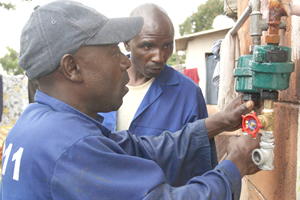
in the first quarter of this year.
The pilot project will involve 5 000 households in Mabvuku and Tafara.
The suburbs will eventually get 80 000 prepaid water meters when the project is fully rolled out. Prepaid meters have an advantage because consumers pay for actual consumption and there is no carry over of debt.
Residents who fail to pay will not receive water. Harare has 264 000 water meters connected to 106 924 properties, which means some properties do not have meters.
This comes at a time the city has acquired 40 000 ordinary new water meters to be installed at households that have been using city water for free.
Some households either have no meters at all or they were vandalised.
The city began installing the new meters in Mabvuku/Tafara yesterday where it is targeting about 10 000 households. The meters are being installed free of charge.
City officials said the programme will move to other high-density residential areas soon. Harare has about 200 000 water meters and most of them are not functioning. Harare Water distribution and customer services manager, Engineer Hosiah Chisango, yesterday said the new water meters will help curb theft of treated water and boost revenue collection. The prepaid meters will avoid unnecessary use of water.
Eng Chisango said council was losing “a lot of money” through inaccurate meter readings.
“There is need for accurate billing as it helps both the residents and the council,” he said.
“The new meters are in stock and a single meter costs about US$60 and we saw it fit to buy the meters for the residents. We are failing to account for a lot of water and this move will go a long way in ending some of the problems we have been facing as a city.”
OF HARARE AND IT’S WATER PROBLEMS
Most residents, Eng Chisango said, were refusing to pay council estimated bills.
“The danger with estimated bills is that many residents were refusing to pay for the water consumption and it compromised service delivery as it meant little revenue for council,” he said.
“It would be ideal if the residents see for themselves how much water they would have used at the end of the month.”
The city is losing half of its 650 megalitres of potable water through theft, pipe bursts and leakages through corroded water pipes.
Revenue collection for the city stands at about 69 percent, while about 31 percent is not accounted for as some residents either by pass or vandalise meters.
“There has been a lot of meter by-passing in most residential areas where most people steal water by connecting the pipes directly to the main pipes. It was difficult to bill such people who by-pass the meter,” he said.
Eng Chisango said the water meters in most residential areas were old and needed to be replaced.
“If it is old, the meter accuracy gets low and a meter should be replaced after at least seven years but you will find out that most of our meters are between 15 and 20 years old,” he said.
When The Herald visited Mabvuku yesterday, city workers were busy replacing the water meters.
Residents welcomed the meters, saying they will now pay for the water they would have used.
“We were tired of being overcharged and we hope these meters will help in solving the clashes between residents and council.
“We now expect them to serve us with proper bills not estimates,” said Mrs Sharon Guzha.
Another resident added: “I think I last had an accurate bill 10 years ago. We will pay the new bills but we don’t know what will happen to the bills we already have.” Ratepayers owe the city over US$40 million in unpaid water bills and sewerage charges.


 leeroy
 Online Reporter