admin
admin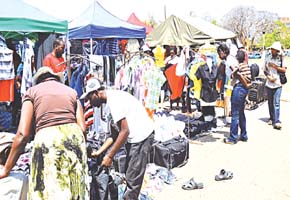
Unlike in the old days when women would expect the husband to even provide small things like salt and tomatoes, women have assumed different roles nowadays. Women have learnt to be more assertive and are more empowered than ever before socially, politically and economically. Women are now able to supplement their husbands’ incomes thereby reducing the dependence syndrome. Of course there are still women out there who look forward to their spouse to do everything for them.
One area which more women than men have used to alleviate poverty at household level is cross-border trade. This is in line with Sadc’s objectives to achieve sustainable development, economic growth, alleviate poverty and enhance the standard of living and quality of life. Testimonies from some of the women engaged in cross-border trade revealed that they managed to open boutiques, flea markets as well as buying fixed assets when cross-border trade grew really big a few years ago.
There has also been a lot of speculation from men in terms of whether this was the right trade for women considering what they believed to be excuses for engaging in promiscuity and other degrading behaviours on their trips abroad. However, most women were not deterred despite even the difficulties they face during their engagements.
The importance Sadc places on cross- border trade culminated in the regional bloc signing the Sadc Protocol on Trade and the Sadc Protocol on Gender and Development and the launch of the Sadc Free Trade Area in 2008. In the Sadc region, informal cross- border trade contributes substantially to intra regional trade.
Cross-border trade has had greater impact in the wake of increased poverty, shrinking formal-sector employment, declining living standards, rigorous import controls imposed on formal business, among others. In fact, cross-border trade has had great impact among Sadc countries in terms of regional and social integration, direct and indirect employment creation and above all the advancement of women as entrepreneurs.
While the role of cross-border trade in socio-economic advancement of women cannot be ignored, women traders face a host of challenges in their businesses. The women are more vulnerable to abuse, exploitation, rape, sexual harassment and at times they operate under very unsafe and insecure environments. At times while on transit there are no ablution facilities.
A research conducted by UNIFEM and other partners on informal cross-border traders revealed that while men and women engage in cross-border trade, men tend to realise more profit than women. The reason being that while females use their income for household needs such as food, school fees and health services, males reinvest in their businesses thereby making higher profits than their female counterparts.
There is also need for growth as some women have been in the informal cross border trade without showing any signs of business growth. It is also unfortunate that many cross-border traders have never gone through book-keeping training. The Ministry of Women Affairs, Gender and Community Development has started training on internal savings and lending at community level and one of the elements covered in the course is financial records. In terms of business success, mastery of record keeping skills is a prerequisite.
The study also highlighted that there were usually delays at the borders due to complicated paper work and inefficient customs officials; in the end the traders are harassed if they do not pay bribes. The informal cross-border associations also cited highly restrictive visa procedures and fees. Apart from that it was highlighted that the absence of laid down policies and procedures for small-scale traders is a major constraint.
Besides, the traders lose some of their goods and cash to thieves. In addition, the traders faced stiff competition in supplying goods to the same markets as well as stiff competition from Asian products. In terms of business expansion women traders also fail to access credit from banks due to lack of collateral and access to information thereof. Informal cross-border traders also use public transport such as buses, mini-buses and “lifts.” Quite a number of cross-border traders have lost their lives due to fatal accidents. Transport costs are also too high and storage facilities on transit are quite poor leading to damage and theft of the goods.
Cross-border traders do not have fixed accommodation when they are on business; they usually rely on private, rented houses or they stay with friends and relatives. Quite often they sleep on buses. This exposes them to ill health due to over-crowding, poor sanitation, airborne, waterborne and skin diseases, backache, feet sores, fatigue and malaria just but to mention a few. The study revealed that some cross-border traders engaged in sexual relations in order to get accommodation thereby exposing themselves to HIV.
Cross border trade can also have a negative impact on family relations. Most traders go away for days, weeks or a month leaving behind children in the custody of friends and relations. There are numerous reports in the media of children who get abused after being left in the hands of friends and relatives. The welfare of children is of paramount importance and it is important to ensure that children are always in a safe environment.
Comesa has played a critical role in cross- border trade by putting in place trade policies that can promote growth and sustainability of cross-border trade. The bloc has put in place the Simplified Trade Regime (STR) and facilitated the formation of the Comesa-Sadc Cross-Border Traders Association. The Ministry of Women Affairs, Gender and Community Development in conjunction with ZimTrade also conduct workshops for women in trade so that they are aware of these regimes. The ministry has also assisted cross-border traders through its Women in Trade Association to undertake trade trips regionally and internationally as well as to participate in local fairs.
The UNIFEM study recommended that there is a need for the informal cross-border traders to engage in productivity and value addition activities instead of them limiting themselves to buying and selling. There is also need for the Government to put in place policies that address constraints faced by cross-border trades. Apart from that there is need to create a conducive environment at the border posts by establishing banking facilities, storage facilities, adequate water and sanitation facilities, catering facilities and so on.
l The writer is the provincial development officer in the Ministry of Women Affairs, Gender and Community Development. She can be contacted on 0772 111 592 or 09 889224


 Online Reporter