WE continue our interview with former freedom fighter and Highlanders Football Club goalkeeper, Cde Smart Moyo, whose pseudonym during the liberation struggle was Cde Makhakhi Zondo.
A beneficiary of Zimbabwe’s Land Reform Programme, Cde Moyo has been recounting his extraordinary journey from the football field to the battlefield. Last week, he spoke about completing six months of guerrilla warfare training at CGT in Zambia before being selected for a specialised military engineering course.
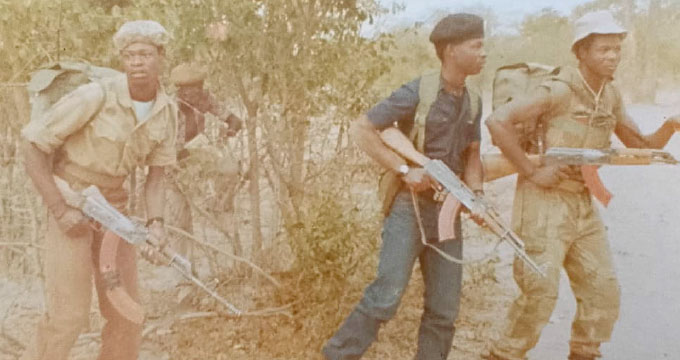
This week, he explains how that elite training prepared him for deployment to the front and vividly recalls the perilous crossing of the Zambezi River and the arduous march into Rhodesia.
MS: In our last interview, you spoke about being selected for a three-month specialised military engineering course after completing your guerrilla warfare training. Tell us more about that programme and what it involved.
Cde Moyo: After completing the six-month guerrilla warfare course at CGT, I was among a select group chosen for military engineering training at the same camp. The camp command deliberately picked recruits who had attained secondary education because the course demanded a high level of understanding, discipline and precision. I had left school the previous year after sitting for my Junior
Certificate examinations at Sobukhazi n Mzilikazi. Our intake was joined by comrades who had returned from advanced military training in Yugoslavia. They possessed considerable technical expertise and their experience greatly enriched our training.
The course concentrated mainly on explosives and demolition. We were taught how to handle and deploy various anti-tank landmines, including the TM-46 and TM-57, as well as magnetic mines used in specialised sabotage missions.
Magnetic mines were particularly effective because they could be planted with the assistance of the povo, the local civilian population at places frequently visited by enemy personnel, such as military installations, meeting venues and other strategic targets.
We also received intensive training in the handling of TNT and other explosive materials. Military engineering was one of the most demanding specialisations because there was absolutely no room for error. A single mistake could kill not only yourself but also your comrades. Every procedure had to be followed meticulously.
Before we completed the course, our camp came under heavy aerial bombardment by the Rhodesian Air Force. I survived the attack, but the explosions damaged my eardrums, an injury that affected me up to now. Some comrades I had trained with them had already been deployed to the front by then, while others were selected for further military training overseas.
MS: When were you eventually deployed to the front and where were you assigned?
Cde Moyo: I was deployed around March 1978. We left as two platoons and we were about 56 fighters.
My platoon was assigned to reinforce Northern Front Two (NF2), covering operational areas that included Lupane, Nkayi and Binga. The second platoon was destined for Tsholotsho. Although our destinations were different, we travelled together from CGT Camp to a crossing point near along the
Zambezi River close to Kazungula. Initially, we had been informed that we would pass through
Tsholotsho before proceeding to Lupane. As darkness approached, we arrived at the banks of the mighty
Zambezi River, where comrades responsible for ferrying guerrillas into Rhodesia were waiting for us.
They used inflatable dinghies to transport us across. The larger boats carried about 24 fighters at a time, while the smaller ones accommodated between six and eight.
Crossing the Zambezi remains one of the most frightening experiences of my life and many former ZPRA guerillas would testify. That river was an enemy in its own right. Apart from the constant threat of
Rhodesian security forces, we also had to contend with crocodiles and aggressive hippos. When the dinghy first pushed away from the riverbank, you would convince yourself that if anything happened, you could simply jump into the water and swim back. But once we reached the middle of the river, reality dawned on you.
There was no turning back. All you could do was pray that the dinghy would move as quickly as possible to the opposite bank. Fortunately, despite all the dangers, every one of us crossed safely without encountering either the enemy or the deadly wildlife that inhabited the river.
MS: What happened immediately after crossing into Rhodesia?
Cde Moyo: Once we reached the Rhodesian side, our commanders ordered us to move cautiously along the banks of the Zambezi. They warned us that enemy forces could have planted anti-personnel mines and booby traps along likely infiltration routes.
To reduce the risk, we sometimes relied on the movements of wild animals. If fresh animal tracks crossed a particular stretch without signs of an explosion, it gave us some confidence that the area was free of mines. Even then, we remained extremely cautious because one careless step could have ended in tragedy.
MS: What weapons and equipment were you carrying during this journey?
Cde Moyo: Each platoon was divided into three sections. Every section had one comrade carrying a Light
Machine Gun (LMG) and another armed with a Rocket Propelled Grenade (RPG), commonly referred to as a bazooka. Those comrades also carried AK-47 rifles like the rest of us. In total, each platoon had three machine guns and three RPG launchers. Every fighter carried a sealed ammunition box, commonly known as a kashar, containing about 720 rounds. We also carried four or five fully loaded magazines in pouches strapped to our bodies for immediate use.
Besides our weapons and ammunition, we carried food supplies, mostly tinned rations. Those of us trained as military engineers also carried anti-tank landmines, which were extremely heavy. Because of their weight, we constantly rotated the load, with one comrade carrying a mine for several kilometres before handing it over to another.
The march was physically punishing. There were times when a comrade became so exhausted that he simply sat down and refused to continue. Since everyone was armed, you could not force anyone to keep walking. The practical solution was for the whole unit to halt and rest together. After a short break, the exhausted comrade would regain strength, announce that he was ready to continue, and the entire column would move on.
The trek from the Zambezi River to our operational areas remains one of the toughest ordeals I experienced during the war. It demanded immense physical endurance, mental resilience, discipline and unwavering determination.
MS: Who commanded your platoon?
Cde Moyo: Our platoon commander was Cde Siziba, while I served as the Political Commissar. Among the comrades in our platoon were Sifiso, Mthunzi, Donald, Craw, Mangerengere and Hobohobo. The platoon heading to Tsholotsho was commanded by Cde Oliver and Cde Killer. We travelled together for some distance before parting ways in the Tsholotsho area. Their unit continued to its operational zone while ours proceeded towards Lupane.
MS: When you finally arrived in Lupane, who did you first meet?
Cde Moyo: The first guerrilla commander we met was Cde Dwala, a seasoned fighter who had already seen extensive combat in Lupane and Binga. He arrived with a section of fighters to receive and escort us safely into the operational area. From there, we were taken to the regional commander, Cde Phebion Mutero (Lt-Col Ernest Sibanda), also known as Moyo.
He commanded the entire Northern Front Two operational area and coordinated military operations across that vast region. After assessing us, Cde Phebion deployed our unit to the Daluka area with specific operational instructions. Our primary task was to monitor and harass enemy movements along the Bulawayo-Victoria Falls Road, one of the Rhodesian forces’ most important supply and troop movement routes. We also operated in the Gwampa Valley, around Makhuyana Stores, and later moved towards Nkayi.
Another important assignment was to patrol the Lupane-Nkayi-Kwekwe road, which was heavily used by Rhodesian security forces. Fighting along that route became so intense that it earned the name ‘Fighting Road’ a name that has stuck to this day. Our operational area also included Sivalo across the Tshangane River, Patrick Stores, Mpahla 1, 2 and 3, Maphaneabomvu and several surrounding villages, where we carried out reconnaissance, ambushes and other military operations aimed at disrupting enemy movements.
To be concluded next week with Cde Smart Moyo recounts the fierce battles his unit fought against Rhodesian forces, the losses suffered on both sides, and his experiences during the ceasefire that paved the way for Zimbabwe’s independence.