admin
admin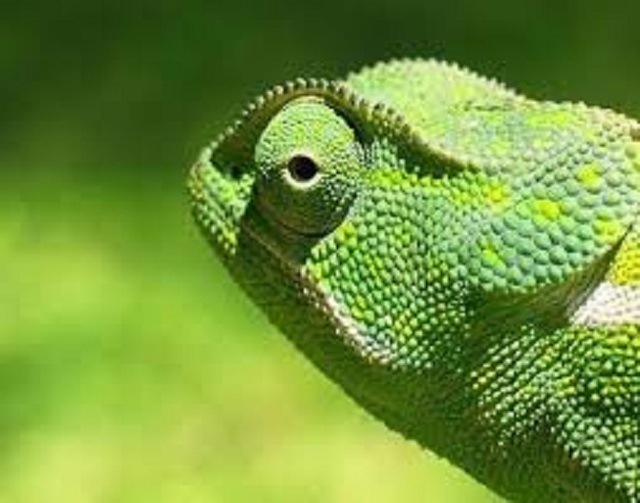

Pathisa Nyathi
SMALL, susceptible and vulnerable creatures are sometimes in the habit of mimicking bigger animals that survive by virtue of their threatening size and body disposition. This is exactly what the harmless chameleon has learnt to do in order to frighten potential predators and thus ensure its own survival. To the Greeks the chameleon was a dwarf lion, but lion all the same and seemingly dangerous. The two words that constitute the word chameleon are derived from the words meaning dwarf and lion, so says Professor of Chameleons, Cecille Knight.
Research adds to the corpus of knowledge. This has certainly been the case with regard to the pet chameleons that Cecille keeps at their Suburbs house in Bulawayo. Cecille exudes self-confidence regarding knowledge about the mating exploits of chameleons. By and large chameleons are territorial creatures. This is true especially when they get all they need in relation to food supply in the form of insects. These solitary creatures will defend territory when necessary. Two chameleons will not want to live in the same plant. They do not share the same space.
However, mating instincts will bring male and female chameleons together. Chameleons will mate for twenty minutes before they go their separate ways. After a month thirty eggs are deposited in the ground. The female chameleon uses its hood-like structure at the back of its neck. The eggs are laid in batches at different levels in the ground. The tunnel where the eggs are laid is oriented at 45 degrees to the horizontal. The eggs are laid when the ground is wet and soft.
For a whole year the eggs remain in the ground. In essence, that means the eggs will hatch during the next rain reason.
Amount of rainfall determines how many eggs in the three batches will hatch. A certain amount of rainfall may only manage to get to the top most batch. It is that batch of eggs reached by moisture that will hatch. The batches deeper in the soil will not hatch. However, if the amount of rainfall is adequate enough to reach all the three batches that means all the eggs will hatch.
Egg batches will hatch at different times in response to moisture percolating to the ground. Little rainfall means little food available, so why have many little chameleons that may starve to death?
Cecille informs me there are two species of chameleons in southern Africa: dilepis which is found in Zimbabwe and lays eggs like most reptiles. There is also the Dwarf chameleon which does not lay eggs but rather gives birth to live chameleons which are tiny in size. Mother chameleon does not look after her young ones. In fact, she may even consume her own young which she sometimes confuses with flies or locusts.
It was then time to give water to the chameleon perched still on a plant bough next to the window. Cecille holds a jug of water above the plant and allows a gentle stream of water to fall on the plant. Normally, the chameleon will see the water and stretch its long tongue to take some slaking sip. But lo and behold, today the chameleon seems to ignore the water on offer. I wonder whether it has seen a stranger and decided not to oblige. Cecille explains that a chameleon drinks water on a daily basis.
Perhaps today it resorted to the water drops on the plant. Chameleons prefer well-watered gardens because water is available and the flowers attract insects that provide it with food.
Humans are aware that the power to learn is not their sole preserve. Reptiles, among other creatures, also have the ability to learn. Whenever the pet chameleon is being fed it simultaneously gets some loving stroke on her back. Like Pavlov’s dogs the chameleon learns that each time it is stroked there is food. Over time a stroke alone is sufficient to cause the chameleon to turn its head in anticipation of food-conditioned reflex! For breakfast the pet chameleon gets five grasshoppers or more. In the afternoon it gets five more and later in the day it receives the last five, a total of fifteen in a day when fully grown. Perched on a window sill is a net that is used to catch flying insects to feed the chameleon. A nearby box is teeming with captured insects, breakfast, lunch and supper crawling as one.
Cecille has learnt the messages being conveyed when the chameleon behaves in a particular way. A chameleon will open her mouth when it is hot. This is a way of cooling herself. Cecille will assist the cooling process by giving the chameleon some cool water spray. Temperature variations are monitored by the chameleon which responds accordingly. On a cold day, the chameleon assumes lighter colours but when it is hot its body gets darker.
Chameleon lessons that Cecille conducts zero in on three fascinating aspects of the chameleon, what she terms the three magics: the skin, tongue and eyes. The strange-looking circular eyes are able to rotate independently of the body. They are able to execute a 360-degree view of the world. An insect to be attacked has both eyes focused on it and what transpires next is best understood in Lobengula terms. Cecille reveals that when there are many objects in front of the chameleon it fails to focus on one and may actually starve — some curious form of starvation in the midst of plenty.
The tongue is another feature of a chameleon that King Lobengula was familiar with and used in his trademark description of imperial Britain’s machinations towards his beleaguered kingdom. The tongue is as long as the body, tail included. The sticky tongue has strong suction power and the tongue shoots at high speed once both eyes are focused on a target. Many flies confuse the eyes of a chameleon and may lead to its starvation through indecision as pointed out above.
During workshops, pupils have a chance to measure the length of a chameleon including its tail so that they appreciate the length of its tongue. The tape measure that they use bears the image of a chameleon — the pervasive theme of workshops at nursery schools that Cecille visits.
A chameleon will change its skin colour in less than five seconds. Chameleons in Malagasy are the most colourful. The female is more colourful than the male. Bright colours are used to entice a male for joyous mating and also when she has eggs in her body. Colour will reflect her mood too. When uncomfortable or disturbed, her colour changes to a darker hue. The basic colours she can turn to are blue, yellow, white and red and a combination of some of these — a natural expert painter indeed.
The workshops Cecille conducts provide educational fun to the young who do word searches, identify hidden chameleons and sing along the Kimmy song. Kimmy is the name of the Muppet and the captivating song is adapted from the one done by Boy George in the 1980s.
It was time to say goodbye to the reptilian creature that Ndebele origin myth attributes to humans’ mortality, the treacherous symbolic creature in the powerful imagery applied by King Lobengula. I could only imagine, with some sense of regret, the sort of unenviable situation our king found himself in and the power of symbolism resident in the otherwise harmless reptilian creature. Bye-bye dwarf lion of the Greeks who art in Bulawayo’s Suburbs!



 Online Reporter