admin
admin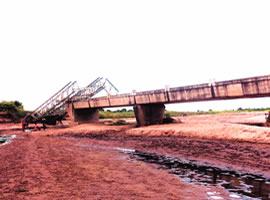
been repaired cutting off vital communication and transportation links.
The major bridges which have not been repaired include Hoya River Bridge which links Muzarabani and Mukumbura, Nzoumvunda Bridge which links Chadereka and Chimoyo and the Kadzurure River Bridge which connects Muzarabani and the Dambakurima communal area.
“It’s now more than 10 years since some of the bridges were destroyed and nothing has been done to repair them,” said elderly Chenje Chadereka pointing at the Hoya River Bridge.
“During the rainy season people are totally cut off, they can’t cross this river to do business and visit relatives in Mukumbura. At times I really wonder whether we are still part of Zimbabwe. Rural people here are a forgotten lot.”
Queried Revayi Kagodo from Chadereka Village, about 260km north of Harare: “A lot of money is being collected from tollgates and where is the money which is supposed to assist in the construction and maintenance of our bridges and roads going? We have not heard anything from the council, the Government and ‘ava vematollgates’ (Zinara).”
Buses have since stopped plying most routes in some parts of Muzarabani owing to bad roads and damaged bridges.
Muzarabani is in Mashonaland Central province and is found in the floodplains of the Zambezi River with Lake Kariba upstream and Lake Cabora Bassa downstream at the confluence of Msengezi and Zambezi rivers.
The critical piece of infrastructure bridges still remain unrepaired and most people in the area say it is time the Government listened to the rural communities and step up efforts to support their vital infrastructure.
“Every time my son comes from town, he tells me kuti vematollgates (Zinara) are patching up some potholes and mending some roads in town. Here nothing of that sort is happening and we are totally forgotten when it comes to our share of the national budget for the construction and maintenance of roads,” said Chadereka.
Apart from roads, Muzarabani has a significant portion of flood-damaged schools, health posts, homes, toilets and wells that have not been repaired.
Dwindling donor support and the dollarisation of the Zimbabwean economy have made it difficult for most of the infrastructure to be repaired.
The situation has been made worse by declining capital expenditure on rural infrastructure by the Government’s unexpected increase in current spending on civil service salaries.
Muzarabani suffers from disasters triggered by weather-related hazards such as drought, floods and epidemics such as cholera and malaria.
A Bindura University of Science Education natural resource management expert said although year-to-year droughts have been experienced especially in the last decade, the current decade has seen floods of unprecedented magnitudes in the area leaving a trail of destruction.
“Perennial flooding is the leading cause of losses from natural hazards and is responsible for a greater number of damaging events in Muzarabani,” he told participants at a workshop on disaster risk reduction held recently in Bindura.
“It is normally flooded from January to the end of the rainy season in March. The floods are mainly caused by localised heavy seasonal rainfall and run-off which often result in rivers overflowing. Cyclones in February 2000 and March 2003 are also responsible for flooding which has caused a lot of damage in the area.”
Chadereka, some 60km north of Muzarabani Business Centre, is usually the worst affected area because it is at the confluence of rivers.
It is affected by the backflow from Lake Cabora Bassa and inflows from Zambezi River and also when Kariba Dam floodgates are opened.
Muzarabani has suffered extensively from floods resulting in the loss of human life.
The cyclone-induced floods in the 1999/2000 season claimed the lives of more than 700 people and left more than 500 000 people homeless and caused over US$1 billion of infrastructural damage in Zimbabwe and Mozambique, according to a ReliefWeb report in 2001.
In the 2007/2008 cropping season, Muzarabani was hit by floods that affected 1 000 households with 400 of them losing almost all of their belongings.
During this period, flood resulted in the loss of livestock, destruction of bridges such as Kairezi, Hoya and Chadereka. Most of the roads are inaccessible up to now as nothing has been done to repair damaged bridges and roads in the area.
“During the rainy season most students don’t go to school. How can they report to school when most bridges are damaged,” said Chadereka. “Absenteeism is high during the cropping season and the Government must do something to help repair our bridges.”
Small businesses in Muzarabani still face many problems when it comes to procuring supplies for their shops deep in the Zambezi Valley.
“When it’s raining you can’t get new supplies. We have to spend more money paying people to cross flooded rivers with our goods. This is dangerous for the people we hire and this pushes up our costs,” said Fanuel
Mukondiwa, a shop owner from the Msengezi area of Muzarabani.
The minor attention paid to the repair and maintenance of rural infrastructure fails to create the real change needed to stimulate rural economic activity.
Economic analysts say this tends perpetuate social inequities and regional asymmetry that could bring social disharmony.
Agricultural trading among rural communities is often affected by poor roads and communication.
The liberalisation of the economy and the adoption of economic strategies modelled to suit IMF and World Bank requirements have worsened the situation forcing the Government to cut significantly capital
expenditure on rural infrastructure.
“There is a bias towards the big cities leaving nothing for us here in the deep interior (Zambezi Valley),” said Chadereka. “Money is being spent in big cities and there is nothing for us here.”
The lack of reconstruction efforts is quite visible for many to see in Muzarabani and this simple means many rural areas will remain trapped in a vicious circle for many years to come while politicians and economists sing the false gospel of economic prosperity and growth.
Lack of roads lead to lack of marketing opportunities which lead to lack of cash and in turn inability to buy consumer goods, resulting in reluctance on the part of the rural population to produce agricultural surplus and this results in economic stagnation.
There is no change in the standard of living of the majority of people in the Zambezi Valley and disappointment on this account is now strongly expressed in all quarters.
“We are not happy about the state of our bridges. People are frustrated and the widespread persistence of grievances about the bridges does not bode well for the future,” the elderly Chadereka said looking at
Mavuradona Mountain Range, with a sense of uneasiness written on his face.


 Online Reporter