Online Reporter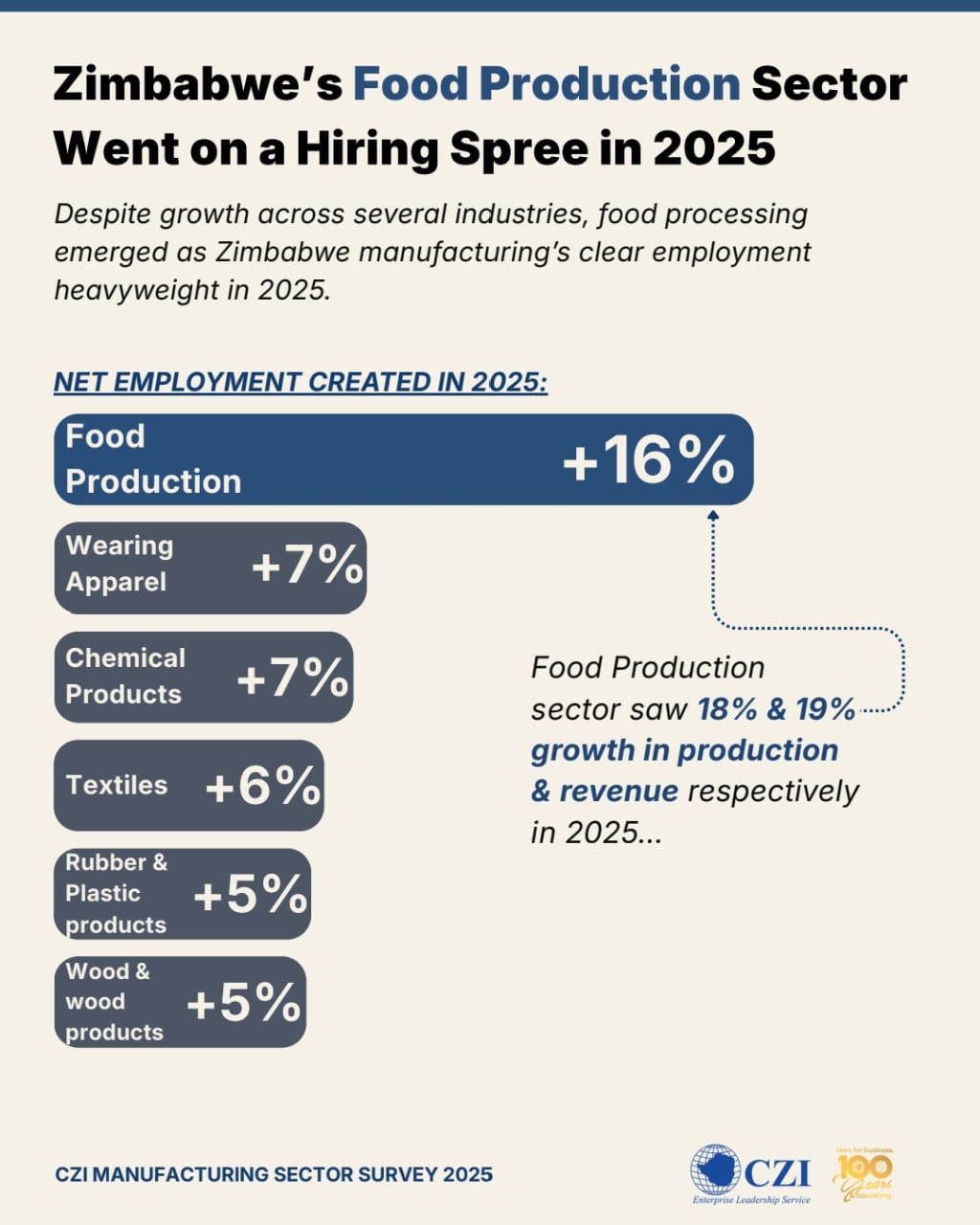
Business Reporter
THE Confederation of Zimbabwe Industries (CZI) will launch the 16th edition of its annual manufacturing survey on June 18 at Hyatt Regency Harare, promising the most revealing assessment of the sector to date.
The survey is the first instalment of CZI’s ZimIndustry and Manufacturing Indaba — which is a suite of events, dialogues, showcases and business exchange initiatives that will be run to specifically bring into focus Zimbabwe’s industry and manufacturing. It culminates in the annual ZimIndustry Indaba.
To produce the 2025 report, CZI surveyed 388 formal manufacturing firms across all the 10 provinces, covering every sub-sector.
Critically, 72 percent of respondents are non-CZI members — meaning this is not the chamber talking about itself but the sector as a whole speaking for itself.
Statistically, the sample clears the 95 percent confidence interval, rendering the findings highly reliable.
While the survey has consistently provided valuable insight into manufacturing performance over the past decade and a half, this year’s edition has evolved in terms of the range of variables and indicators being analysed.
Unlike in previous years, the 2025 survey does not stop at capacity utilisation but delves deeply into several burning questions.
The insights now extend far beyond that measure, providing a broader assessment of manufacturing performance, competitiveness, operating conditions and the key factors shaping the sector.
On the recovery question, capacity utilisation reportedly hit a 14-year high, but questions remain whether this translated into sustained growth in output, turnover and employment, with nearly half of the sector’s productive capacity still lying idle.
New analysis of the employment structure will reveal whether growth is producing secure, permanent jobs or accelerating the shift towards casual labour. The difference matters for families and for the Treasury.
On the currency issue, manufacturers have been asked directly where they earn their revenue and where they source foreign currency. The answers will land squarely in the middle of the mono-currency policy debate.
Import dependence
under the spotlight
More than half of manufacturing inputs are still imported despite Zimbabwe’s strong primary industries.
The survey breaks down exactly why and what it means for local value chains under the National Development Strategy 2 (NDS2).
The data already circulating is sobering.
The textile sector sources 75 percent of its raw materials externally, while fabricated metal products rely on foreign markets for 72 percent of their inputs.
Figures for paper and rubber products stand at 71 percent and 69 percent, respectively.
Even food products — traditionally a strength — sit at 51 percent imported inputs. The sector average across all 15 sub-sectors is 55 percent.
Experts say this is not value addition but light assembly of foreign materials.
AI and the Fourth Industrial Revolution
For the first time, the survey benchmarks artificial intelligence (AI) adoption in Zimbabwean manufacturing against the global shift to Industry 4.0.
It will also identify what is holding back firms — from skills shortages to connectivity problems to cost.
The report further assesses technology upgrading, the penetration of foreign products, sustainability as a condition of market access, gender mainstreaming in industrial leadership, and the utilisation of regional trade agreements.
Finally, the survey closes with the sector’s own 2026 outlook — which sub-sectors are optimistic and which ones are not, and why.
Early findings turning heads
One early finding is already attracting attention as the food production sub-sector went on a hiring spree in 2025, with net employment growing by 16 percent.
Production and revenue followed with 18 percent and 19 percent growth, respectively. Wearing apparel added 7 percent net employment, chemical products — 7 percent, textiles — 6 percent, rubber and plastics — 5 percent, and wood products — 5 percent.
These are real jobs. The question the survey raises is simple: How does Zimbabwe maintain that momentum when raw material dependence remains high?
Featured speakers
The guest of honour at the launch, Minister of Industry and Commerce Mangaliso Ndlovu, will look at policy strategies to grow the manufacturing sector.
Proceedings will be officiated by CZI president Mr Mucha Mkanganwi and the organisation’s chief executive officer, Ms Sekai Kuvarika.
Dr Cornelius Dube, the CZI chief economist, will present the review of the manufacturing sector’s 2025 performance.
Industry leaders will then take the stage with first-hand accounts.
Montgomery Foods CEO Mr Liam Philp will speak about technology leapfrogging.
Grobbie Foods CEO Mrs Nancy Guzha will share her experience of starting up in an expanding milling sub-sector.
Edgars Stores Zimbabwe CEO Sevious Mushosho will unpack the Edgars growth story and the network of over 100 local players driving value chain expansion.
DripTech Irrigation CEO Mr Bob Henson will discuss expanding manufacturing capacity to ensure growth in agriculture.
Who should attend
Those who should attend include manufacturers and policymakers who prefer evidence over instinct, academics training the next generation, development partners placing bets on Zimbabwean industry and investors trying to decide whether the country is serious about local production.
The bottom line
Zimbabwe is chasing Vision 2030. Manufacturing is meant to be the engine. However, engines need diagnostics. This survey is diagnostic. The indaba is where the diagnosis is discussed.
For anyone serious about where Zimbabwean industry stands — and where it needs to go — the Hyatt is the only place to be on June 18.