admin
admin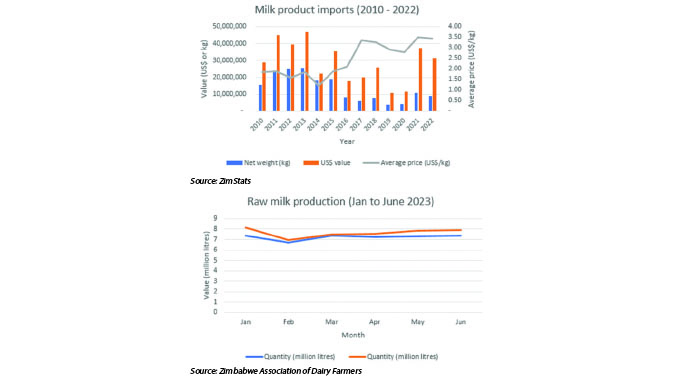
Edgar Vhera-Agriculture Specialist Writer
THE Governmentpolicy of import substitution through local production continues to bear fruit, as dairy products import dropped by 20 percent to US$12 million from January to June this year against
US$15 million during the corresponding period last year.
Statistics from Zimbabwe National Statistics Agency (ZimStats) show that imports of dairy products dropped to US$11 825 470 from January to June this year against last year’s US$14 815 563 during the corresponding time period.
In volume terms dairy products plunged by 20 percent from 3 624 466 kilogrammes to 2 910 253 kg.
This dip comes on the backdrop of similar trends experienced last year when dairy product imports fell 16 percent to US$31 325 651 from January to December in comparison to US$37 171 772 in 2021. Over the same period volume of dairy product imports fell by 14 percent to 9 105 095 from 10 639 972.
Among the dairy products imported by the country are various forms of milk and cream, yogurt, buttermilk, ice cream, whey, butter and different kinds of cheese.
Raw milk production increased six percent to 45 902 216 litres from January to June this year against last year’s 42 078 894 over the same period.
Lands, Agriculture, Fisheries¸ Water and Rural Development permanent secretary, Dr John Basera, recently attributed the rise in dairy production to the Government’s synergies with the private sector and development partners.
“The interventions are part of the country’s Livestock Recovery and Growth Plan including the Government’s private sector-funded dairy heifer programme with a deliberate effort on increasing the national cows in milk from 19 000 in 2021 to 29 000 in 2022,” said Dr Basera recently.
The population of cows in milk rose 45 percent from 20 000 in 2021 to 29 000 in 2022.
Livestock and Meat Advisory Council (LMAC) administrator Dr Reneth Mano recently said the Government’s four-year reduction on powdered milk imports was to be commended, as it capacitated local milk production.
“Government’s move to reduce on a sliding scale milk products imports will go a long way in capacitating local producers as well as depriving regional exporters of a ready market for dumping cheap milk products,” he said.
Mindful of the need to revitalise the local dairy industry, Finance and Economic Development Minister Professor Mthuli Ncube introduced a five percent levy on the value of imported dairy products to re-capitalise the Dairy Revitalisation Fund (DRF) in the 2022 budget.
The DRF was targeted at growth and development of the dairy sector by increasing the national dairy herd, enhancing competitiveness of the dairy sector, supporting modernisation and standardisation of local milk production.
Prof Ncube said the funds would be disbursed from the consolidated revenue fund (CRF) to smallholder farmers at a concessionary interest rate, in order to ensure sustainability of the fund, as well as optimising growth of the sector.
For guaranteed growth of the sector, a minimum of 80 percent of the funds would be utilised towards procurement of the dairy herd.
In the 2023 budget Prof Ncube said there was need to gradually substitute imports through increased local production, coupled with simultaneous increase in the uptake of raw milk by processing companies from the current level of 70 million litres to 130 million per annum by 2025.
Government proposed to gradually reduce on a sliding scale, ring-fenced milk powder imports starting at 75 percent in 2023 to 50 percent in 2024 and then to 25 percent in 2025. The effects of these fiscal measure are manifesting with these encouraging results.



 Online Reporter