Online Reporter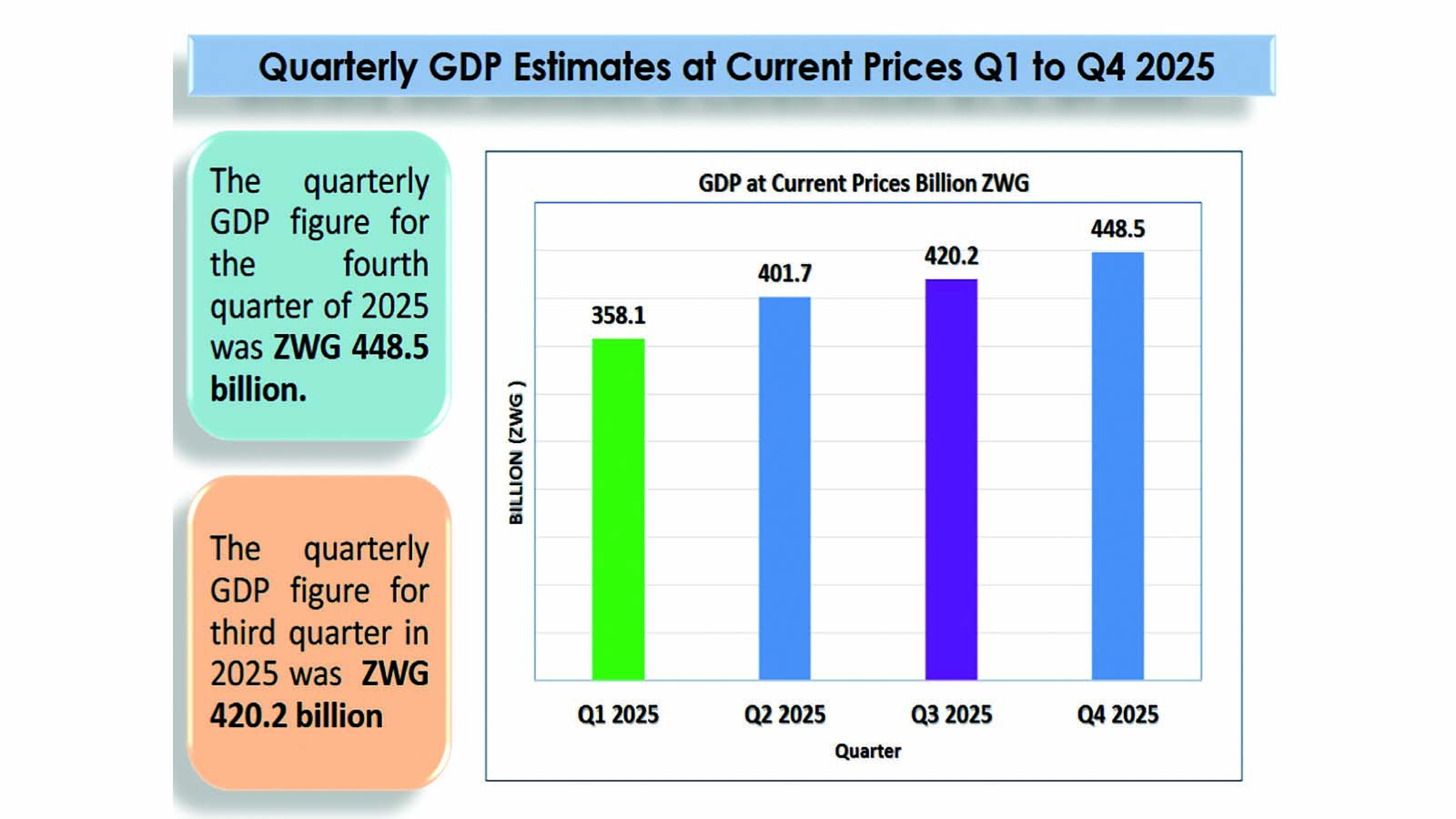
Tapiwanashe Mangwiro
Senior Business Reporter
The economy maintained a positive growth trajectory in the fourth quarter of 2025, driven by strong performances in agriculture and other key sectors, according to the latest official data from the Zimbabwe National Statistics Agency.
The latest Quarterly Gross Domestic Product (GDP) estimates released by ZimStat on Thursday showed that GDP at current prices increased to ZiG448,5 billion, up from ZiG420,2 billion in the third quarter.
At constant 2023 prices, GDP rose to ZiG19,1 billion from ZiG19,0 billion in Q3.
“The GDP at current prices for the fourth quarter of 2025 stood at ZiG448,5 billion, from the third quarter figure of ZiG420,2 billion,” ZimStat reported.
“The GDP figure at constant prices for the fourth quarter of 2025 was ZiG19,1 billion, up from ZiG19,0 billion in Q3 2025.”
The figures indicate continued resilience across the economy as Zimbabwe consolidates growth within productive sectors, following robust activity earlier in the year.
According to ZimStat, the economy recorded quarter-on-quarter growth of 0,34 percent in the fourth quarter of 2025. While this was lower than the 1,08 percent recorded in the third quarter and the 9,12 percent achieved in the second quarter, the economy remained firmly in positive territory.
More significantly, year-on-year growth remained strong at a 7,04 percent rate in the fourth quarter of 2025.
Zimbabwe’s economy is forecast to grow by at least 6 percent this year, driven by mining, agriculture, tourism and construction.
“During the fourth quarter of 2025, the year-on-year GDP growth rate dropped to 7,04 percent compared to 10,7 percent in Q3,” ZimStat noted.
The latest statistics show agriculture playing a major role in supporting economic growth during the period.
The agriculture, fishing and forestry sector recorded the strongest quarter-on-quarter growth among major sectors, expanding by 16,37 percent in the fourth quarter — a sharp recovery from the 14,99 percent contraction recorded in the previous quarter.
This rebound lifted agriculture’s contribution to GDP to 11,09 percent in Q4, up from 9,53 percent in the third quarter.
This strong agricultural performance reflects improved output across farming activities and reinforces the sector’s strategic importance to Zimbabwe’s economy, food security, and industrial value chains.
The information and communication sector also delivered robust growth, expanding by 8,85 percent during the quarter. This continued expansion highlights the increasing contribution of digital technologies, telecommunications, and innovation-driven services to national economic activity.
Mining and quarrying remained the single largest contributor to GDP during the quarter, despite experiencing a slight slowdown in growth.
The sector accounted for 15,47 percent of GDP in Q4 2025, maintaining its position as Zimbabwe’s leading economic pillar. Manufacturing remained the second-largest contributor at 14,59 percent, underlining the sector’s role in industrial development and value addition.
Wholesale and retail trade contributed 11,11 percent to GDP, while financial and insurance activities accounted for 10,70 percent, demonstrating the growing strength of Zimbabwe’s financial services sector.
According to ZimStat, the top five contributing sectors to GDP in the fourth quarter were mining and quarrying, manufacturing, wholesale and retail trade, agriculture, and financial and insurance activities.
Several other sectors also posted positive growth during the quarter. Transportation and storage expanded by 1,04 percent, while accommodation and food service activities grew by 1,85 percent, reflecting the continued recovery in tourism, hospitality, and logistics-related activities.
Public administration and defense contributed 4,47 percent to GDP, while education accounted for 4,03 percent, highlighting the ongoing importance of public services.
However, some sectors experienced temporary slowdowns.
Mining and quarrying contracted by 2,83 percent on a quarter-to-quarter basis, while manufacturing recorded a 1,51 percent decline.
Electricity, gas, steam, and air conditioning supply declined by 18,37 percent, reflecting operational pressures in the energy sector. Construction activity also moderated, contracting by 1,28 percent after a stronger expansion in the previous quarter.
Despite these sectoral slowdowns, the broader economy continued to show resilience, supported by agriculture, services, and stable domestic demand.
ZimStat stated that the quarterly GDP estimates were compiled in line with the 2008 System of National Accounts using the production approach and proportional benchmarking method.
The agency noted that data sources included surveys conducted by ZimStat, administrative data from the Government and ZIMRA and industry-specific indices.
ZimStat also clarified that quarterly GDP estimates remain subject to revisions as more information becomes available.
“Revisions were made to several industries due to the availability of new information,” the agency concluded.