Online Reporter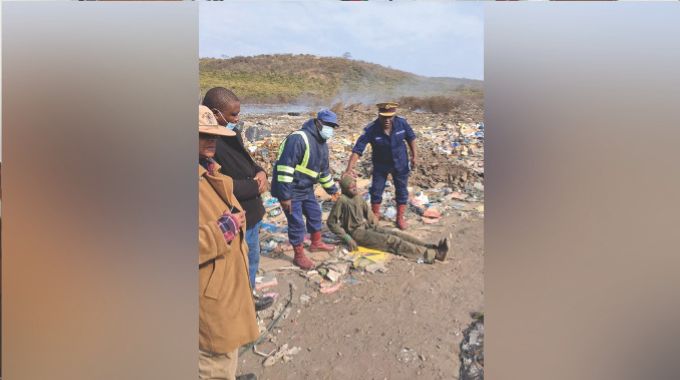
Patrick Chitumba, [email protected]
A YOUNG man allegedly battling drug addiction sparked panic at the Kwekwe City Council dump site after scavengers mistook his legs protruding from a heap of refuse for those of a dead person.
The bizarre incident happened on Tuesday night after the man, believed to be in his early 30s, allegedly climbed into a council skip bin at the Kwekwe long-distance bus terminus and fell asleep while heavily intoxicated.
Unaware that someone was inside the bin, council workers arrived the following morning, emptied it into a refuse truck and transported the waste to the city’s dump site.
It was only when scavengers started sifting through the rubbish that they discovered the man buried beneath the waste.
A council employee, who requested anonymity, said the man had climbed into the skip bin at about 9PM.
“At around 6.30AM, a Kwekwe City Council refuse truck arrived for its routine collection. The driver lifted the bin and drove to the city’s dump site on the outskirts of Kwekwe to offload,” said the employee.
Kwekwe mayor Councillor Albert Zinhanga confirmed the incident, saying scavengers initially believed they had stumbled upon a body.
“The man was found buried in a heap of rubbish at the dump site. The people who collect discarded objects such as wood and scrap metal saw human legs protruding from the dump and assumed it was a corpse,” he said.
Cllr Zinhanga said one of the scavengers alerted council officials, who reported the matter to police.
“When the police came, they realised the person was breathing and ferried him to Kwekwe District Hospital for medical care,” he said.
The man was later transferred to Amaveni Rehabilitation Centre for assessment.
“This is what drugs are doing to our children. A young man climbs into a bin to sleep and ends up being dumped as rubbish,” said Clr Zinhanga.
“We are pleading with parents, schools and churches to talk to our youth. Mutoriro is destroying futures.”
Clr Zinhanga said the incident has highlighted the desperate conditions faced by some people battling drug and substance abuse. He said addicts are increasingly using public spaces, abandoned buildings and toilets as places to sleep.
Mr Tariro Moyo (46), who makes a living collecting recyclable material, said they immediately fled after seeing what appeared to be a human body.
“I make a living from collecting recyclables at the dump site. We were looking for plastic and metal when I saw legs sticking out from under a sack,” he said.
“The trousers were dirty and his feet were not moving. We all thought it was a dead person killed for ritual purposes and dumped, and we fled from the scene.”
A police officer who attended the scene said the man’s condition initially made it difficult to determine whether he was alive.
“When we pulled back the rubbish, we heard a faint snore. He was buried under plastic, cardboard and food waste. He was breathing, but he was very weak and disoriented after spending the whole night in the bin,” said the officer.
He said the man had cuts and bruises on his arms.
The incident has renewed concerns over the growing drug and substance abuse crisis, particularly among young people in mining communities such as Kwekwe.
Queen of Peace Rehabilitation and Crisis Centre founder and executive director, Dr Stella Khumalo, said prolonged substance abuse could expose users to a range of physical, psychological and social dangers.
She said drug-dependent people could suffer mental health problems, malnutrition, injuries and exposure to harsh weather, while some may resort to petty crime to sustain their addiction.
“We cannot arrest our way out of this problem. We must rehabilitate, we must give young people skills and hope, so that they do not see a skip bin as a bedroom,” said Dr Khumalo.
Amaveni Rehabilitation Centre is the only public facility dealing with drug and substance abuse rehabilitation in Kwekwe, while Queen of Peace Rehabilitation Centre provides services in Gweru.
National efforts to tackle the scourge include rehabilitation, awareness campaigns, vocational training and community reintegration programmes being spearheaded by Government and various partners, including the Angel of Hope Foundation, which has assisted thousands of addicts to regain their livelihoods through therapy, vocational training and reintegration support.
Meanwhile, police in Midlands, working with other security agencies and communities, have intensified the crackdown on drug bases.
More than 100 suspected drug bases have reportedly been dismantled and over 380 suspects arrested in the province.
Midlands Minister of State for Provincial Affairs and Devolution Owen Ncube said Kwekwe and Shurugwi have emerged as hotspots for drug trafficking and abuse, with the problem increasingly spreading beyond urban centres into mining and rural communities.
“Drug and substance abuse is no longer confined to urban centres but has, sadly, spread to rural and mining communities. It is disheartening to note that schools have not been spared and are now vulnerable to dangerous substances such as crystal meth and cannabis-laced cakes, among others,” said Minister Ncube.
He said the problem was also contributing to other social ills, including violent crime and prostitution.