Online Reporter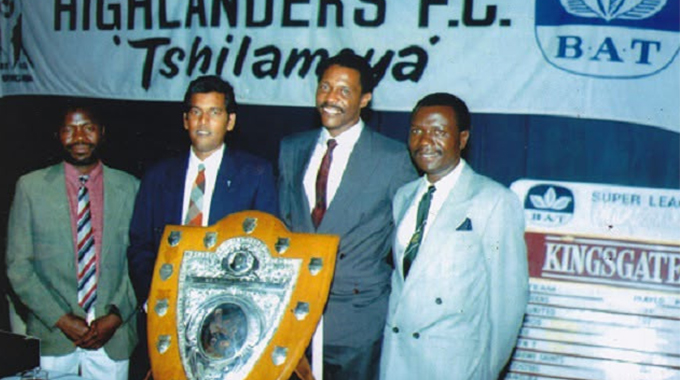
Lovemore Dube, [email protected]
ZIMBABWEANS have joined the Roy Barreto family in mourning the successful coach who died on Monday evening in Portugal after a long spell battling ill-health.
Barreto died at the age of 72, leaving behind wife Fazi and two adult daughters.
His longtime friend Illan Elkaim confirmed on Monday evening the passing of the legendary coach after a long illness in Portugal where he lived with his wife Fazi.
Elkaim was gutted by the news.
Highlanders yesterday morning sent a condolence message to the family.
Cosmas ‘Tsano’ Zulu, who worked as Barreto’s assistant at Highlanders for five years described the former Bosso, Chikwata and Orlando Pirates’ title winning coach as having a very good coach and mentor.
Zulu and Barreto were at Highlanders together from 1989 to 1994, a period in which the club won two league titles with the former National Railways of Zimbabwe civil works department foreman as coach.
“Death is a privilege to human nature, we cannot do without it. I am saying go well Roy and assemble another team that will win things in heaven. You have your assistant Barry Daka, Mercedes Sibanda, Willard Khumalo, Rahman Gumbo and many others, come up with a winning team until I join you with Lawrence Phiri,” said Zulu.
Zulu said they were known as the Four Musketeers when they were at the helm of Highlanders with Lawrence the fourth guy operating as manager. He said individual characteristics among the four technical department members had seen each come up with ingredients different from the other to make a winning team.
“As the Four Musketeers, we had different attributes that made us a strong winning team. Barreto was tough, Barry very soft and Lawrence short-tempered but knew how to draft things and deal with players well.
“To be honest Barreto was a technical and tactical genius, we have to appreciate that death is God’s arrangement,” said Zulu.
Itai Masawi, one of the most exciting talents to emerge out of Bulawayo in the early 1990s and worked with Barreto at Bosso, Black Rhinos and Shu-Shine Wolves, said Barreto was more than a coach to him, but a father figure.
“He is the one who brought me to Highlanders from Eagles Football Club. He insisted on signing me even though I was playing the same position as Mercedes ‘Rambo’ Sibanda, who was arguably the best rightback in Africa at the time. That belief he had in me never left me.
“When Roy left Highlanders, he had a brief stint with Shu-Shine Wolves, and he took me with him, together with the late Sifiso Mguni and Itai Godzamapere. From there we moved together to army side Black Rhinos, where we became key to implementing his style of play. At first, most of the Rhinos players did not understand his philosophy. But with time, everyone bought in, and we all started to enjoy the football,” said Masawi, elder brother to Highlanders legend Thabani.
Masawi said he was pained because he was always in touch with Barreto.
Roger Muhlwa who was club secretary when Barreto crossed the floor to coach Highlanders from Zimbabwe Saints in 1989, said the legendary gaffer managed to save a sinking ship.
Highlanders were struggling that season with key players of the cup winning side of 1989 having left the club. Among those that left were Madinda Ndlovu, Tito Paketh and Willard Khumalo to West Germany, Alexander Maseko to Harare, the late Rahman Gumbo and Mercedes Sibanda had moved briefly to Randers in Denmark. A couple of promising youngsters moved too.
The club turned to juniors and when Barreto came, more got the opportunity to play as the no-nonsense Barreto released stars like Tanny Banda.
Muhlwa said: “When we took over with Silas Ndlovu, the club was rock bottom. Silas moved just a street to talk and convince Barreto to come on board. He had in the previous year won the Chibuku Trophy and League title. We thought he was the man to add a spark to our fortunes. Did, he did as we won the League and Cup double the following year. We won several other accolades with him including the 1993 title and the BP League Cup in 1994.”
Muhlwa admitted that Barreto was not an easy coach to deal with.
“One year we bought Boy Ndlovu for $20-22 000 and they were not fielding him. Back then Highlanders executive had a technical meeting every Monday. We would get a briefing on how we won or lost. Get the coaches’ technical outline, if we won we insisted that all done towards the result needed to be repeated.
“So Boy was not being selected by Roy and the bench. So at one of the meetings we said he must choose Boy first and then their other 10 players because we had spent a fortune on him. Boy vindicated us, he played a brilliant game and thereafter became a regular. Roy came back to say that besides being argumentative, I had won on the Boy bet.”
Muhlwa said he had a good working relationship with Barreto and knew that he had not played the game at a high level but respected his technical acumen.
Muhlwa said when Reinhard Fabisch became national coach because of Barreto’s success with Highlanders and Zimbabwe Saints it was automatic that he be assistant alongside Sunday Chidzambwa, a success story with Dynamos as both a player and coach.
Barreto was part of the famed Dream Team.
He had several players in the side that he worked with at both Highlanders and Zimbabwe Saints.
Ephraim Chawanda, Agent Sawu, Henry Mckop, Madinda Ndlovu, Willard Khumalo, Mercedes Sibanda, Adam Ndlovu, Benjamin Nkonjera, Rahman Gumbo, Abraham Mbambo and Alexander Maseko.
“I am not surprised he had so many players that he had worked with at some stage. Such was his character, he was bold and stuck to what he believed was right technically. We have lost a good coach who did so much for the country.”
Vincent Pamire who was part of the Zimbabwe Saints executive in 1989 and was at Zifa as Leo Mugabe’s deputy president, described Barreto as coach par excellence.
“He knew his stuff. He was a great asset for Zimbabwe Saints and the country. He contributed so much to the game and it is poorer without him,” said Pamire.
Barreto started his coaching career in Mutare and became topical when he joined Zimbabwe Saints where he worked with Tendai Chieza on their way to the 1988 successes.
After leaving Highlanders in 1994 he worked at Shu-Shine Wolves before getting a job at Black Rhinos. He had a brief stint as Warriors coach.
Barreto coached in Namibia and his first job in South Africa was at Free State Stars whom he left at the beginning of the 2002/2003 season to coach Orlando Pirates whom he helped to the title.
With a clipboard on his armpit, a drawing board in his left hand, training gear and a whistle, he is said to have charmed Pirates even recommending the departure of big stars like Tso Vilakazi to allow his boys from Stars like Jimmy Kawuleza.
Barreto went on to coach in India, Portgugal and the United Kingdom.