admin
admin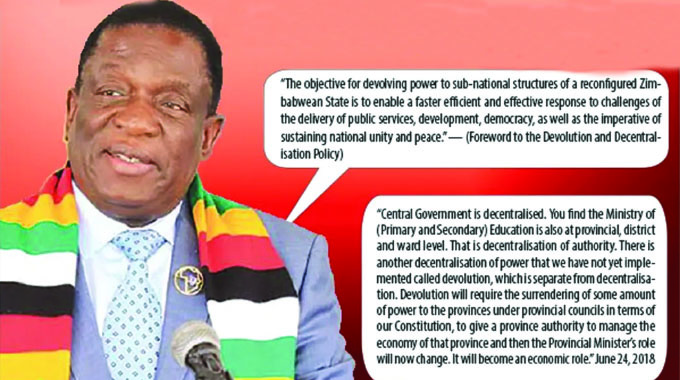
Lovemore Chikova Development Dialogue
The New Dispensation has been pressing ahead with the devolution development model that is changing the outlook of the country as it moves towards achieving an upper middle income economy by 2030.
Devolution is one of the developmental models expected to play a major role in the achievement of Vision 2030 because of its empowerment potential that is being realised in various parts of the country.
The development concept is bringing schools, clinics, roads, sanitation facilities, water, irrigation and many other aspects that uplift livelihoods.
Many communities, especially those in remote areas, have benefited from devolution, thanks to President Mnangagwa’s model of leaving no one and no place behind when it comes to development.
The aim of devolution eventually is to make sure that provinces and districts ultimately stand on their own in terms of economic development, with their own Gross Domestic Product that contributes widely to the national GDP.
This brings development closer to the people who are now active participants in deciding the kind of development they would want to see in their areas and how to proceed in instituting the projects.
This is in line with the provisions of the National Development Strategy 1 and the Devolution and Decentralisation Policy.
Government has been availing funds to all areas for devolution through the national budget, but in future, provincial structures will be required to raise their own funds for development, while central Government will only intervene in critical areas.
This places a huge responsibility on those responsible for leading development trajectories within their jurisdiction, as they are being called upon to be innovative and come up with projects that can enhance their areas’ GDP.
Progress that has been registered in the devolution process through which central Government is financing development projects should have by now inspired provinces to start thinking about how they can effectively harness their advantages for local development.
If devolution is to be a success, provincial officials should start gravitating more towards the use of internal resources to develop their areas rather than continue to look up to central Government for funding of projects.
History will have been made the first day there will be a province stating the GDP and economic progress it would have made for the particular year. This will mean that the provinces will now be accountable for their own development as envisaged by the devolution model.
All the provinces are equipped in terms of natural resources and other provisions that contribute to the strengths placing them on a good footing for making devolution a success.
Mining, agriculture, manufacturing and tourism appear to dominate the economic activities of all the districts in the country, and it is on this basis that the provinces can harness their potential to uplift the livelihood of the people.
Many of these resources have not been exploited because of the bureaucratic nature of running the government on a single tier level, whose decisions may take long to cascade to the grassroots.
The three-tier government system at central level, provincial level and local level means decisions on development are now being made at the local level, bridging the gap that existed between the lower level and higher levels of governance.
This demands discarding old ways of doing business and adopting a positive frame of mind which leads to framing of strategies based on the regional situation and regional strength.
It obviously appears to be a tough call, but what has been achieved so far with devolution indicates that the task is not insurmountable.
The provinces have to create conditions that are conducive for the attraction of both local and foreign investors to their areas to ensure the flow of capital for bigger projects.
For example, the implementation of Special Economic Zones within provinces can be a good starting point as these reserved areas have a huge potential to attract high-end investors that can bring big business that changes the status quo of the areas.
In fact, Special Economic Zones are renowned for leading in the modernisation and industrialisation of developing countries as witnessed in many Asian countries.
The insistence of the Government on value addition and beneficiation of minerals is a big starting point for the provinces as that creates employment and ensures products are exported at a much higher value.
Government has been firm with the lithium mining industry, a move that has resulted in many of those mining this important mineral setting up production centres locally.
In other words, the exportation of raw lithium has been banned, and this means provinces that host lithium mines are already set on course to drive huge benefits from the Government policy. The Government has been laying a good foundation for devolution.
Transportation, which entails good road networks, has been a priority under the Emergency Road Rehabilitation Programme to ensure easy movement of people and goods and help integrate rural areas with urban areas.
There has been moves by Government to ensure adequate supplies of energy, with major works taking place in Hwange and Kariba to generate more electricity.
Solar energy projects have been lined up and these are expected to generate more power and leave some for export to neighbouring countries.
In the sense of good governance, devolution is viewed as part of the ideas that promote good governance through transparency and accountability of resources.
Citizens are thus encouraged by devolution to participate in good governance advancement as they are availed an opportunity to take part in development at their local levels.
The devolution programme in Zimbabwe can be traced to the Zimbabwe Constitution Amendment (No. 20) Act 2013.
The constitutional provision that defines devolution was being acted upon with hesitance since 2013, until it was accelerated with the coming in of Second Republic, which started allocating budgets to local authorities for the purpose of devolution.
In fact, devolution is not entirely new to Zimbabwe as a form of the development concept has been practiced through government ministries like that of health, home affairs, local government and education.
But this type of devolution that occurred before the amendment of the constitution in 2013 had minimal participation of people in the implementation of centrally planned policies.
Another form of devolution was being practiced through the creation of development committees at the local level like the ward, village, district and province.
All in all, Zimbabwe already had some devolution exercised through local authorities in the form of urban councils and rural district councils established to provide services to a heterogeneous citizenry in geographically defined and demarcated areas of jurisdiction.
But the coming in of the constitutional amendment in 2013 and the accelerated implementation of devolution has meant a change of approach, as devolution is now more directly implemented, with minimum interference from the central Government.
According to Zimbabwe’s Devolution and Decentralisation Policy (2020), the objectives of devolution are to facilitate democratic participation of people in making decisions that will affect them and to promote good governance.
The policy also aims at maintaining Zimbabwe as a single peaceful State, enhance citizens’ participation in the management of local affairs and development, provide a mechanism for resource sharing and enable fiscal capacitation of the lower tiers of government.
The policy envisages that devolving such decision making will enable the low tiers of government to respond to issues of development and service delivery much faster than the previous arrangement where a long protocol was to be followed before approval and implementation.
The Devolution and Decentralisation Policy (2020) summaries the objectives of devolution in Zimbabwe as follows:
To give powers of local governance to the people and enhance their participation in the exercise of the powers of the State and in making decisions on issues affecting them.
To promote democratic, effective, transparent, accountable and coherent government in Zimbabwe.
To preserve and foster peace, national unity, and indivisibility of Zimbabwe as a sovereign State
To provide recognition of the right of communities to manage their own affairs and to further their own development
To encourage and ensure the equitable sharing of local and national resources
To transfer local fiscal responsibilities and resources from the national government to sub-national entities in order to establish a sound financial base for each provincial and metropolitan council and local authorities in rural areas.



 Online Reporter