admin
admin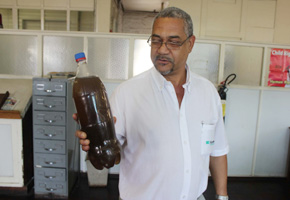
saying the city council is putting their health at risk.
The residents said they feared that the dirty water could cause an outbreak of diseases.
A disgruntled Morningside resident, Mr Donavan Jones visited the Chronicle newsroom yesterday with a sample of the dirty water and said residents in the suburb have been using it for the past one-and-a-half years.
He said the local authority was yet to sort out the problem despite several reports from residents.
“For the past one-and-a-half years we have been supplied with dirty water by the city council and the situation has not changed. The water is muddy such that we cannot wash our clothes, drink it or use it to bath,” said Mr Jones.
“We rarely get clear water. It is always brown and most residents have resorted to borehole water. The situation has become worse and today I had to run the tap for almost two hours to allow it to clear, but the water remained brown.”
He appealed to the city council to do something about the dirty water, saying residents felt cheated since they pay bills.
“It is unfortunate that most of the residents do not have boreholes and they are forced to use the water despite the risks. For those who want to do their laundry, they have to wait until the water has settled, but it is a waste of time because it takes hours for the water to settle,” he said.
Another resident, Ms Constance Makanza said the city council was cheating them by making them pay for the dirty water.
“If this water was for free maybe we would not be complaining. The city council should do something about this situation because we are paying for this water every month.
“Most of us do not have boreholes and it is not fair for us to ask for water from other residents on a daily basis, yet we pay our bills every month,” said Ms Makanza.
Contacted for comment, the city council senior public relations officer, Mrs Nesisa Mpofu, acknowledged that the water that came out of the taps in most suburbs was dirty and attributed the problem to shedding.
“The water that comes out of the taps is sometimes not of the required quality due to problems associated with water cuts.
“The water is at times milky, reddish, muddy or smelly especially after water cuts,” said Mrs Mpofu.
She, however, said the local authority was educating residents about the problems associated with water shedding.
“We are educating our valued customers in the form of text messages sent through cellphones and notifications on water bills.
We are also planning an awareness campaign through radio and television. Residents should be aware that water shedding is inevitable because of the critically low levels of our supply dams. Residents must not consume reddish water since it contains iron deposits which build up in the pipes due to rusting of galvanised pipes. Some of the rust settles down, while some remains suspended in the water,” she said.



 Online Reporter