admin
admin

Alex T. Magaisa Correspondent
The disaster situation in various parts of the country has led to various questions over the authority that the Acting President has in the absence of President Mugabe, who is presently on his annual leave away with his family in the Far East.
Who really is in charge and what powers do they have? Can they deploy the military to assist civilian authorities in dealing with the flooding? This note deals with these and related questions on the authority of an Acting President – what they can do and what they cannot do in terms of the Constitution, which is the supreme law of the land.
First, however, I need to clear some confusion that has arisen over the so-called hierarchy of Vice Presidents. The Constitution has two different provisions that deal with the appointment of an Acting President.
The first provision is s. 100 (1) which provides that whenever the President is absent from Zimbabwe or is unable to exercise his functions due to illness or some other cause, those functions must be exercised by the first Vice President or in his absence, the second Vice President. Where there is no Vice President, this role is assumed by a minister who is designated by the President for such a scenario or is nominated by Cabinet.
The second provision is s. 14(3) of the Sixth Schedule of the Constitution, which provides that where there are two Vice Presidents, the President may nominate one of them to be Acting President in his absence or where he is unable to exercise his functions due to illness or for any other reason.
There is, therefore, a conflict between the two provisions, with s. 100(1) suggesting that there is a hierarchy between the Vice Presidents and s. 14(3) suggesting, on the contrary, that the two Vice Presidents are equal. S. 100(1) is based on the application of provisions for the election of Vice Presidents as running mates of the presidential candidate under s. 92. Under that system, there is a first and a second running mate, who eventually become the First and Second Vice President, in that order, if they are successful in the election.
However, this hierarchical structure does not apply under the present system, because s. 92 and the running mates system does not become operational until 2023. Under the current system, the Vice Presidents are appointed by the President in terms of s. 14(2) of the Sixth Schedule. The two Vice Presidents are equal at law. One might contend that there is an internal political hierarchy within Zanu- PF, which might make one of either VP Mnangagwa or VP Mphoko more senior than the other, but under the national Constitution, they are equals.
The question then is, which applies between s. 100(1) and s. 14(3) of the Sixth Schedule? This conflict is easily resolved by s. 2 of the Sixth Schedule, which provides that where there is such a conflict the Sixth Schedule prevails over all other provisions of the Constitution. This means s. 14(3) of the Sixth Schedule has superiority over s. 100(1) in regard to the issue of hierarchy of the Vice Presidents and how Acting Presidents are appointed.
However, it would have been better had Parliament simply made it clear that s. 100(1) does not apply for the first ten years, as it did with s. 92. But the Constitution was a rushed job in the end and there were some omissions and this is one of them. Thankfully, the inconsistency is not unresolvable, as we have seen above. This clears the matter – there is no first and second Vice President under the present system.
Now to the question of the powers of an Acting President.
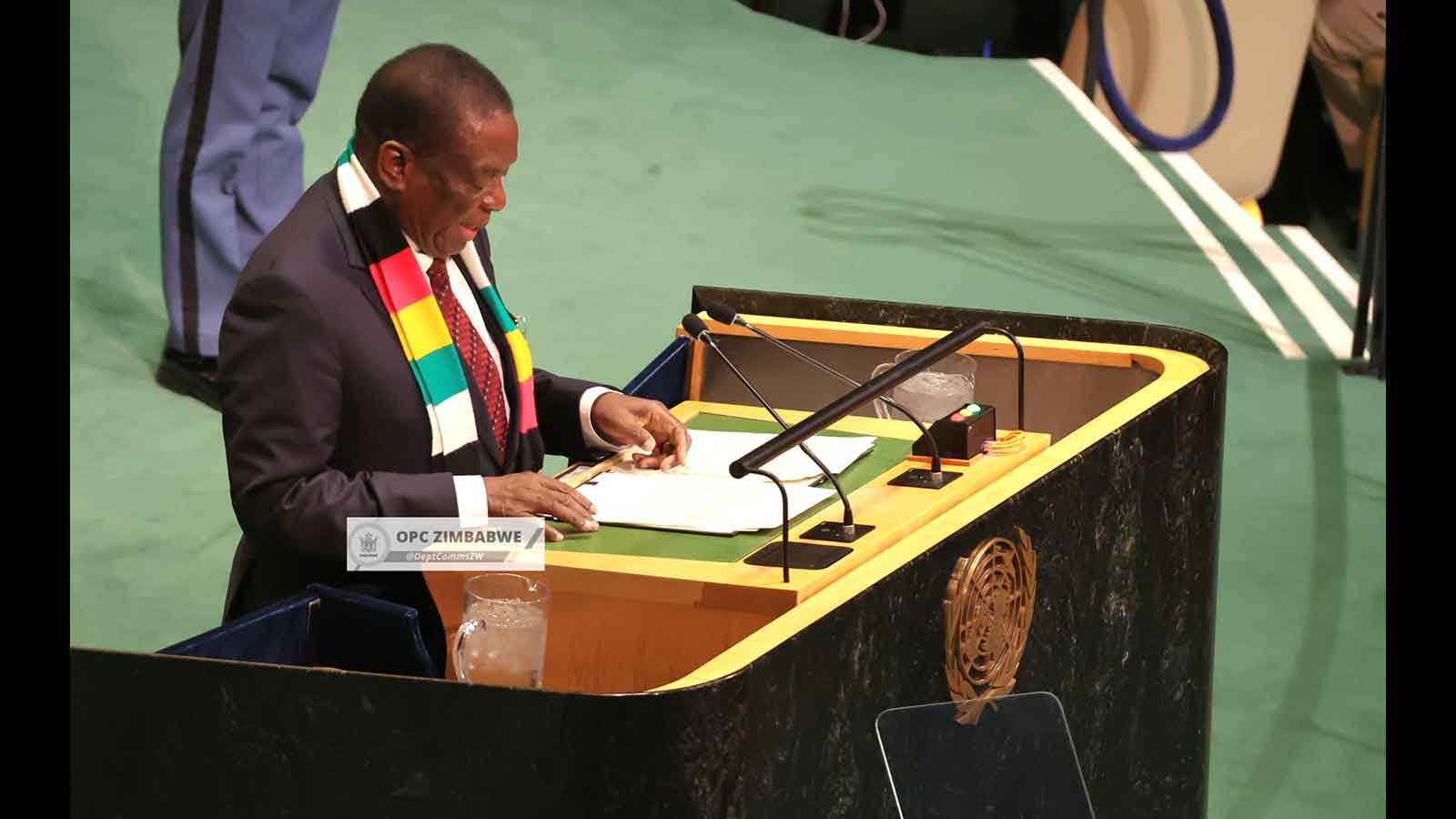
In the present scenario, VP Mnangagwa was left in charge as Acting President in terms of s. 14(3) of the Sixth Schedule.
But what powers does an Acting President have? Does an Acting President assume all the powers of the President? Can the current Acting President, Emmerson Mnangagwa, exercise all the functions that President Mugabe would otherwise exercise if he wasn’t on leave? Can he deploy the military to disaster areas in the absence of the President?
Answers to these questions are to be found in the Constitution. While the Acting President can exercise the majority of functions of the President, there are some functions which he can only exercise with the majority support of the Cabinet. Still, as we shall see shortly, this is an improvement from the position under the old Constitution, where the Acting President’s role was more limited.
The powers of the President which an Acting President cannot exercise unless he has a majority resolution of Cabinet are as follows:
Deployment of the Defence Forces; entering into international agreements, treaties or conventions; appointing or sacking the Vice President, ministers or deputy ministers; assigning or reassigning functions to the Vice President, ministers or deputy ministers.
This means if the Acting President wants to exercise any of these powers, he would need to convince Cabinet to secure a majority. In fact, the powers of an Acting President have been expanded because under the old Constitution, if he wanted to dissolve or prorogue Parliament, he also had to seek majority support of Cabinet.
However, under the new Constitution, an Acting President does not need the support of Cabinet to dissolve Parliament. The existence of this power under the current political climate is not to be underestimated, but that is a separate matter for another time.
Of the stated powers, and of interest in the present circumstances, is the deployment of armed forces that is the most critical. It is also the most sensitive, given the political ramifications of using that kind of power affecting, as it does, command of the military.
However, it is not unusual for the Government to deploy members of the Defence Forces to assist civilian authorities in responding to disaster situations. In this regard, s. 213(2) provides that the President has the power to deploy the Defence Forces “in support of the Police Service and other civilian authorities in the event of an emergency or disaster”.
The question therefore is whether the Acting President can deploy the Defence Forces in the event of an emergency in the absence of the President?
The answer to this is that he can but only with the support of the majority of his Cabinet colleagues. Critics may argue that s. 213(1) states that only the President, as Commander-in-Chief of the Defence Forces, has the power to authorise the deployment of the Defence Forces, but it is clear that this provision is qualified as it is “subject to this Constitution”.
As we have seen, the Constitution allows the Acting President to deploy the Defence Forces if he has the majority support of Cabinet. Here, the role of Cabinet is to check and balance the power of the Acting President but that power is not circumscribed.
During the constitution-making negotiations this was a hotly debated issue as the MDCs argued that there must be specific authority for the Acting President to preside over Cabinet in such cases.
This is why s. 105 (2) specifically provides that, “Cabinet meetings are presided over by the President or, in his absence, by a Vice President or in their absence, by a [designated] minister …” This provision was included with the intention of making it plain that the Acting President does have legal authority to chair Cabinet meetings in the absence of the President.
The implication of all this is that Acting President Emmerson Mnangagwa does have the constitutional authority to call and preside over Cabinet meetings and further, if the majority of Cabinet agrees with him, he also does have the power to deploy Defence Forces to assist in the disaster situation if circumstances warrant such a measure. They do not have to wait for President Mugabe to exercise these functions. The Constitution allows them to do so.
There are, of course, political considerations that might dissuade and prevent him from exercising these powers.
- Dr Magaisa is based at the University of Kent and was a technical advisor to the team that wrote the new Constitution of Zimbabwe. He can be reached at [email protected] Visit his blog at www.newzimbabweconstitution.wordpress.com


 Online Reporter