admin
admin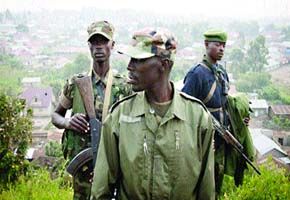
Fighters from the M23 group were seen loading seized government weapons onto trucks on Thursday and the group’s leader told Al Jazeera that they were preparing to leave the city.
“We must respect what the presidents of the Great Lakes have asked us to do,” Sultani Makenga said.
Regional leaders have pressured M23 to withdraw from the area after they seized Goma, provincial capital of the eastern North Kivu province, on 20 November .
A deal was announced at the weekend during the 5th Summit of the International Conference on the Great Lakes Region (ICGLR), held in Uganda.
The ICGLR is made up of Angola, Burundi, Central African Republic, Republic of Congo, DRC, Kenya, Uganda, Rwanda, Sudan, Tanzania and Zambia.
Leaders of the countries fear the rebellion in DR Congo could escalate into a wider conflict.
Al Jazeera’s Azad Essa, reporting from Goma, said residents there were growing increasingly anxious at the prospect of a power vacuum once M23 leaves.
“There are unverified reports of theft and even the hijacking of vehicles in the city. Many residents did not open their businesses on Thursday and by early evening, the streets had emptied.”
Rebels have left the northern territory of Masisi but remain in the strategically important town of Sake.
On Thursday, lines of government troops carrying weapons and ammunition were advancing north from Minova on the road to Goma, approaching to within a few kilometres of M23 positions.
UN peacekeepers held the ground between the two opposing forces.
The humanitarian situation in Goma and the neighbouring towns taken by M23 is worsening, with tens of thousands of people uprooted due to the fighting.
In Sake, the International Committee for the Red Cross (ICRC) said people had returned, abandoning a camp for displaced persons, but many found their homes looted or destroyed.
“They have almost no food supplies and are unable to reach their fields,” said Franz Rauchenstein, head of the ICRC delegation in Congo.
Congo has agreed to negotiate with the rebels and hear their grievances, once they have retreated to 20km north of Goma.
But in Minova, Lieutenant-General Francois Olenga Tete, Congo’s newly-appointed head of land forces, said government troops were preparing to re-enter the city after the rebels had left it, and that only war could end the rebellion.
“I am going back to Kinshasa to prepare for war,” he said. “I’m going to ask our leaders for permission to wage war. We don’t want more negotiations. It’s war that will bring peace to Congo.”
President Joseph Kabila met M23 rebels for the first time at the weekend after a summit in the Ugandan capital Kampala.
The pullout agreement would allow the rebels to stay in their home region of Kivu, which is believed to hold up to three-quarters of the world’s reserves of coltan, a mineral used in the manufacture of many electronic products.
The rebellion erupted in April when the M23, which UN experts have said is backed by neighbouring Rwanda and Uganda, broke away from the DR Congo army, complaining that a 2009 deal to end a previous conflict had not been fully implemented.
Since April, more than 475 000 people have been displaced in the country and more than 75 000 others have been forced to seek refuge in neighbouring Rwanda and Uganda, according to UNHCR.
Rwanda and Uganda deny supporting the rebels. — Aljazeerah


 derick.khumalo