Online Reporter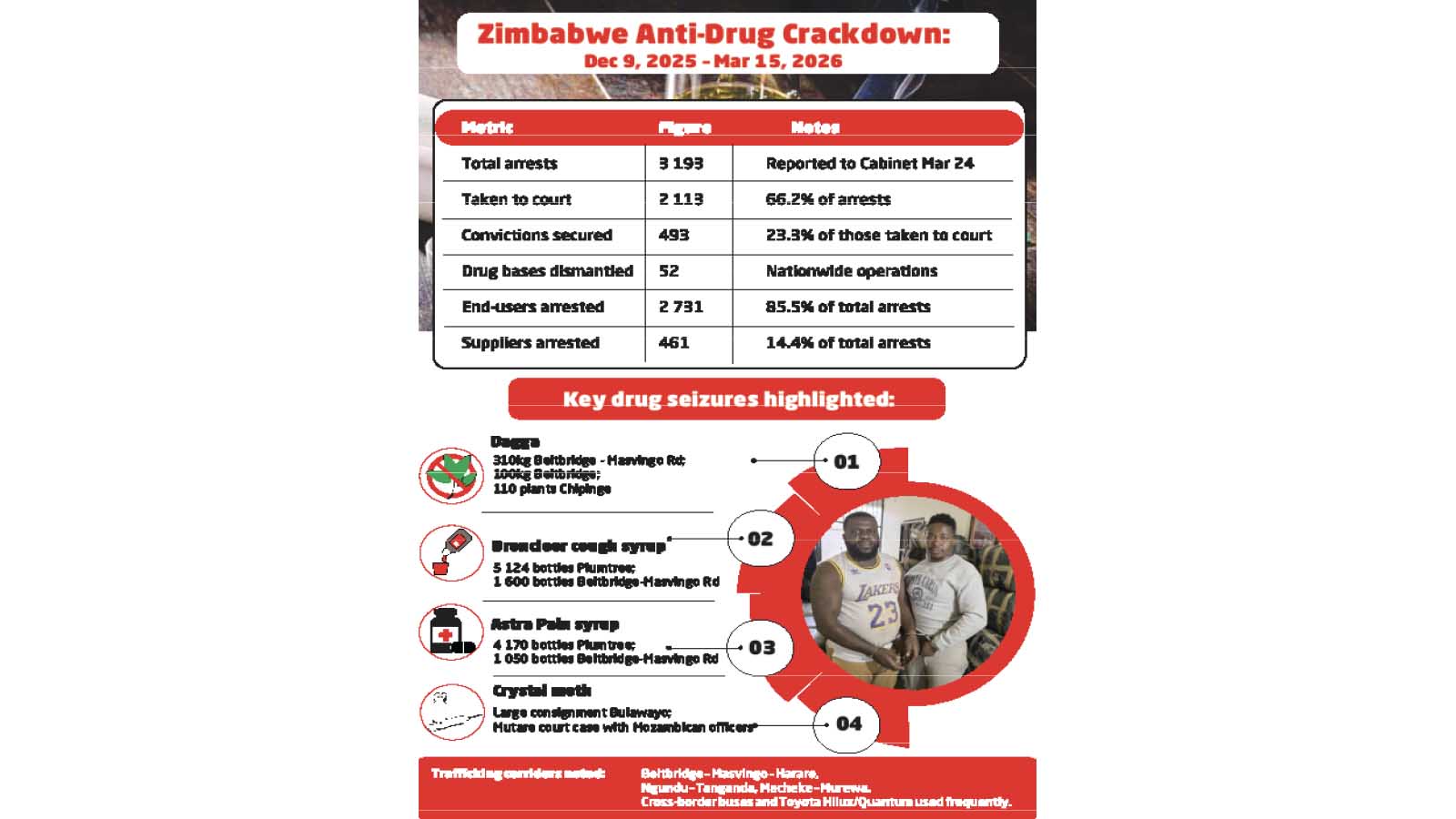
Emmanuel Kafe
CheckPoint Desk
ZIMBABWE’S anti-drug crackdown has generated impressive statistics: thousands arrested, dozens of drug bases dismantled, hundreds hauled before the courts and nearly 500 convictions secured.
Official figures presented to Cabinet on March 24 show that between December 9, 2025 and March 15 this year, the authorities arrested 3 192 people in anti-drug operations across the country.
Of these, 2 113 were taken to court and 493 were convicted.
The authorities also reported the dismantling of 52 drug bases.
The same report reveals a striking statistic.
Of the 3 192 people arrested, 2 731 were classified as end users, while only 461 were identified as suppliers.
In percentage terms, about 85,5 percent of those arrested were users, compared to 14,4 percent suppliers.
Faces of the crackdown
On January 3, detectives intercepted a Toyota Hilux along the Beitbridge-Masvingo road and arrested Leonard Mushava (34) and Opprah Ndavambi (30).
Police recovered 310 kilogrammes of dagga, 1 600 bottles of BronCleer cough syrup and 1 050 bottles of AstraPain cough syrup.
It was one of the largest drug seizures reported at the beginning of the year.
The same day in Chipinge, police arrested Tafadzwa Mare (33) after recovering 110 dagga plants allegedly being cultivated in Chiutani village, Ngungunyana.
On January 3, detectives from the CID Drugs and Narcotics Unit intercepted a cross-border bus travelling from Masvingo to Harare.
The bus was escorted all the way to the High Glen terminus in Harare, where Peter Zambara (40) was arrested while allegedly collecting a consignment containing 300 bottles of BronCleer cough syrup.
The same operation exposed another trend emerging in police reports: traffickers increasingly using long-distance buses and public transport systems to move illicit substances between cities.
In Mutare, police arrested Johannes Ndarowa (41) at a car park in Sakubva after allegedly recovering dagga, BronCleer cough syrup, AstraPain cough syrup and Benylin cough syrup.
On the same day, Ivan Gombere (36) was arrested along the Macheke-Murewa road while travelling in a Nissan AD van carrying similar substances.
By February, police operations intensified.
On February 12, four suspects — Angeline Tavengwa (44), Charity Chinyandura (45), Hamilton Nyandoro (34) and Edward Mukwesha (40) — were arrested in Featherstone after police recovered 20 boxes of BronCleer cough syrup from a Nissan Note.
On the same day, Malvin Tafirenyika Mupambiki (30), Patrick Tafirenyika (44), Precious Charumbuka (30) and Vivian Bhanhire (47) were arrested at a checkpoint along the Ngundu-Tanganda road after allegedly attempting to evade police while transporting bags of dagga in a Toyota Probox.
Police also arrested Timothy Mushati (30) in Juliasdale, Nyanga, after recovering sachets of dagga and rolling papers allegedly intended for retail distribution.
On February 15, one of the year’s most unusual arrests occurred along the Harare-Beitbridge highway.
Police arrested Norest Jingura (35), who was allegedly wearing a full Zimbabwe Republic Police (ZRP) uniform, complete with assistant inspector rank badges, together with Alison Maredza (43), a member of the State security services.
Police recovered 120 cobs of dagga from their vehicle. Investigators later launched inquiries into how the suspect obtained the police uniform. The following day, another major seizure was recorded in Plumtree.
Police intercepted a Toyota Quantum and arrested Msawenkosi Ndlovu (49) and Vengai Chawa (41).
Officers recovered 5 124 bottles of BronCleer cough syrup and 4 170 bottles of AstraPain cough syrup with an estimated street value of US$80 000. The same weekend, Tinashe Mero Shoko (22) and Eliot Badza (33) were arrested in Dulibadzimu, Beitbridge, after police allegedly recovered 100 kilogrammes of dagga from a residential property.
In April, police in Bulawayo arrested Mbongeni Sibanda (28) after a dramatic vehicle chase through the city. Officers recovered a large consignment of crystal methamphetamine, BronCleer syrup, AstraPain syrup and drug-consumption equipment from his vehicle.
The drugs driving the crisis
An analysis of the reported seizures reveals that five substances dominate Zimbabwe’s drug landscape.
The first is dagga, which remains the most frequently seized illegal drug in police reports. From Beitbridge to Chipinge, Featherstone, Nyanga and Bubi, cultivation and transportation cases involving mbanje continue to dominate arrests.
BronCleer cough syrup, commonly known on the streets as “Bronco”, comes second.
The syrup appears in nearly every major police operation reviewed during this investigation. Thousands of bottles have been recovered from buses, private vehicles, roadblocks and urban distribution points.
AstraPain cough syrup, another pharmaceutical product repeatedly seized alongside BronCleer, is increasingly becoming common as well.
Fourth is Benylin cough syrup, which police continue to recover in several drug-related operations.
Crystal methamphetamine, popularly known as mutoriro, which the authorities describe as one of the country’s most dangerous drugs due to its addictive nature and growing popularity among youths, comes fourth.
The transport network
The reports also reveal recurring trafficking corridors.
The Beitbridge-Masvingo-Harare route appears repeatedly in police reports.
Major seizures involving dagga and cough syrups were recorded along this corridor in January and February.
Cross-border buses have become a preferred transportation method for traffickers because consignments can be mixed with legitimate passenger luggage and commercial cargo.
The arrest of Peter Zambara after detectives tracked a bus from Masvingo to Harare illustrates how transport networks are allegedly being exploited. Private vehicles are another common feature.
Toyota Hilux vehicles appear in multiple major seizures, including the January arrest of Mushava and Ndavambi and the February arrest of Jingura and Maredza.
Police roadblocks and checkpoints along the Ngundu-Tanganda, Harare-Beitbridge and Macheke-Murewa roads continue to account for many interceptions.
The crackdown has also been accompanied by a public naming strategy aimed at deterring offenders and encouraging community reporting.
ZRP spokesperson Commissioner Paul Nyathi said they would soon be releasing the names, ages and prison sentences of drug offenders.
Recently, 55 convicted drug offenders from across the country, with sentences ranging from four months to 51 months, were named and shamed.
“The convictions involved offences related to crystal methamphetamine, dagga and unregistered medicines, including BronCleer and AstraPain cough syrups.
“The Zimbabwe Republic Police reiterates that the police will not hesitate to name and shame drug barons and suppliers in any part of the country,” said Comm Nyathi.
Criminologists say drug enforcement statistics should be viewed alongside broader indicators such as rehabilitation rates, repeat-offending patterns and the disruption of supply networks.
Dr Tendai Muchengeti, a criminologist and lecturer in criminal justice studies, said the figures suggest the authorities are confronting both a public health challenge and a criminal enterprise.
“When a large proportion of arrests involves users, it tells us that substance abuse has become deeply embedded within communities. Law enforcement can remove drugs from circulation and bring offenders before the courts, but lasting success also requires prevention programmes, rehabilitation services and intelligence-led investigations targeting those who organise and finance the trade,” he said.
Dr Muchengeti said the recurring appearance of the same transport corridors and substances in police reports points to established trafficking patterns that require sustained monitoring.
A cross-border dimension
Court records also point to an international component.
In January, two serving Mozambican police officers, Felizardo Fernando Ernesto (48) and Aviso Julio Aviso (43), appeared before the Mutare Magistrates’ Court facing allegations of dealing in methamphetamine allegedly brought into Zimbabwe from Mozambique. The two denied the charges and the matter remains before the courts.
The case points to concerns among law enforcers that the country is increasingly becoming part of regional trafficking networks involving crystal meth and other dangerous substances.
Stuggle continues
The data leaves little doubt that police have intensified operations.
Thousands have been arrested.
Hundreds have been convicted.
Drug bases have been dismantled.
Illicit substances worth millions of dollars have been seized.
Yet the same data also indicates the scale of the challenges that the authorities are up against.
Analysts believe that the war against drugs will be ultimately won after dismantling all the networks that finance and profit from the trade.