Chronicle Editor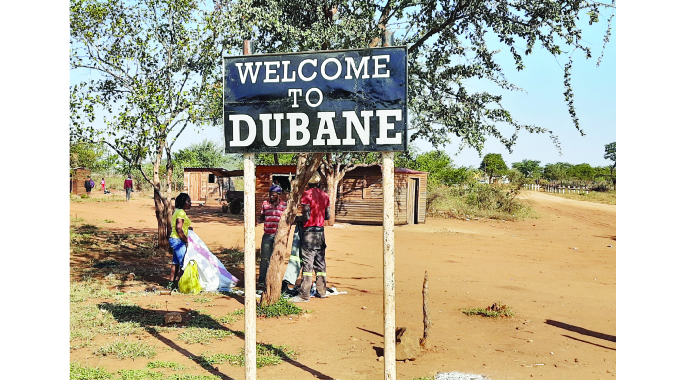
Yoliswa Dube-Moyo, Matabeleland South Bureau Chief
AMID the sound of bleating goats and bellowing cattle, children covered in red sandy soil are seen playing hopscotch under the southern sun on a Friday afternoon in Dubane, Gwanda District.
Not only are their clothes laden with dirt from the soil they’re playing on but little tears here and there show that these threads have seen better days. They, however, are not bothered by how they look and are busy being their happy selves.
Just as they’re busy playing, a group of illegal gold miners, otsheketsha, as they’re popularly known, play a game of slug a short distance away.
Music by South African artiste Makhadzi masks their shouts and jeers as they cheat through the game. Some women sell their wares by the roadside while others have set up a make-shift takeaway place where isitshwala and beef stew or chicken and vegetables are sold to whoever will have it.
Locals say a typical day in Dubane, a new resettlement area surrounded by gold deposits, is characterised by women cooking isitshwala from the shed, endless games of slug, children playing, villagers tending to their livestock and the odd stranger in-between. While the area is surrounded by vast mineral wealth, it is only a few who have managed to tap into it.
“I live in Gwanda but I’ve got a mining claim in this area so I spend a lot of time here. There’s a combination of people; those who actually live here and those that visit the area for mining purposes only. Development in the area has been a bit slow that’s why you notice that a lot of the structures are make-shift,” said Mr Enoch Zhou, a small-scale gold miner operating in the area.
He said the resettlement area is surrounded by gold mines where illegal gold miners operate from.
“Whenever large amounts of gold are found; people start fighting over who gets what. Some of these fights escalate and end up affecting villagers who will be going about their business,” said Mr Zhou.
Mr Zhou, who also runs a small tuckshop in the area, said Dubane is yet to be electrified and there is no running water. “The way of life has evolved into what we used to experience at the reserves where we lived with no electricity or running water,” he said.
Some children have sadly stopped going to school as the schools are too far. Parents are reluctant to send their children to the schools which are a distance away as there are otsheketsha, who are feared to rape children, along their path.
“Some children go to school but most of them have stopped going because it’s unsafe for them. Those whose parents can afford to hire taxis everyday which take them to school in Colleen Bawn, about 7km away do so. Some take their children to Gwanda while others go to Tshindeni,” said Ms Janet Moyo, a villager from the area.
She said there was an urgent need to address the challenge of illegal gold miners abusing children.
“While the available schools are far, it would be better allowing the children to walk the 6km to Tshindeni knowing that they’re safe instead of constantly living in fear that they might be raped on their way to or from school,” said Ms Moyo.
In an effort to equitably distribute land, the country embarked on the land redistribution exercise which saw beneficiaries moving to vast tracts of land. Most of the areas, however, need schools, health facilities and service centres.
Gwanda District Ward 22 is one of the resettlement areas where Councillor Marry Mpofu said: “We found the resettlement areas with no schools. We’ve since applied to the Government to build schools in the ward, but the processes are cumbersome and it has been taking a long while.
The area has no Early Childhood Development facility, primary or high school. It also doesn’t have a health facility. It’s a relatively new area and it would seem resettlement areas are not getting as much attention as we would like them to.” She said parents had resorted to finding their children rented accommodation in areas such as Colleen Bawn so that they could go to school.
“The children are struggling. They stay at people’s houses, young children who are doing ECD. That’s why we get a lot of cases of children being raped and a lot of the times, the cases go unreported,” said Clr Mpofu.
She appealed to the Government to step up efforts to develop the area so as to improve the quality of life for villagers.”It’s a really sad situation. Some parents opt to go back to their old homes so that their children can get an education. The ward also doesn’t have a health facility and some women end up giving birth along the way to Silonga, which is far. Some don’t make it, sadly.
It’s a big ward which needs a lot of attention. Children have to go as far as Colleen Bawn to access schools. Villagers have to go to Gwanda town to access a hospital. Despite having made our applications, nothing seems to be moving in terms of developing the area.”
Gwanda acting district development co-ordinator Mr Thulani Moyo said rural service centres in these areas are being planned and supervised by the Ministry of Lands. However, their planning needs to be improved, he said, adding that most of the rural service centres lack ablution facilities and roads. Also, a good number of people in the areas are retired who tend to concentrate on farming.
“When they go there, their children are left in towns and when they go to these places they go solely for farming. Those farmers are not keen to develop infrastructure for schools because they say their children are already grown so they’ll concentrate solely on farming. A good example of such a scenario is Moodspruit where it has taken more than 10 years to construct one primary school block. When we go there to inquire what the challenges are, they say their children are not there and they have no motivation to build a school,” said Mr Moyo. He said rural district councils should have a deliberate policy for the construction of a clinic in every ward.
“We’re trying by all means to spread development evenly through the wards,” said Mr Moyo. – @ Yolisswa.



 Online Reporter