Online Reporter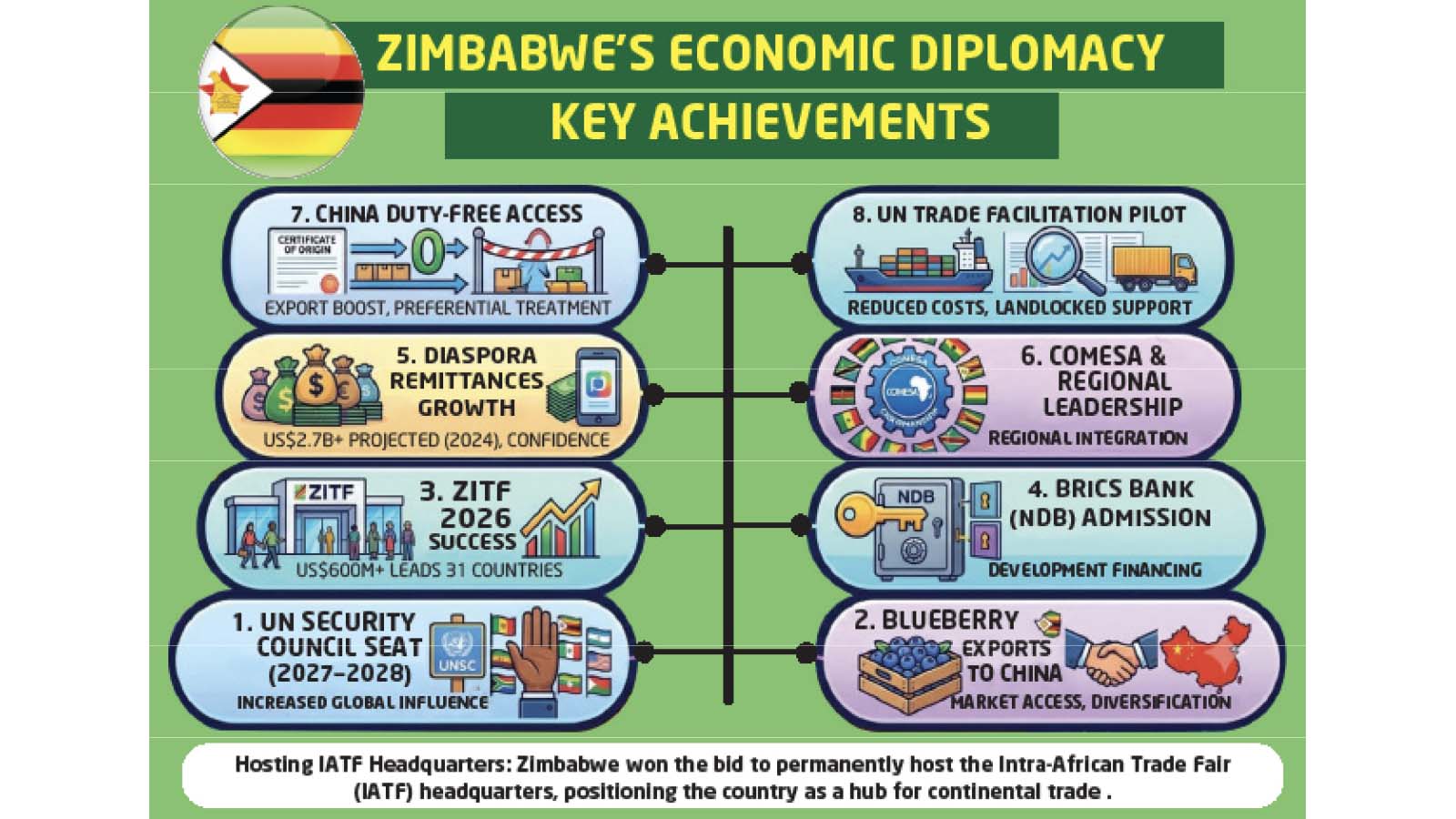
Nqobile Bhebhe
Zimpapers Business Hub
THE 2027 National Budget strategy will consider economic diplomacy, international engagement, trade facilitation and diaspora participation, in a significant policy shift that seeks to transform foreign relations and national branding into powerful engines of investment, export growth and long-term economic development.
The strategy signals the Government’s intention to complement domestic economic reforms with an outward-looking approach that strengthens Zimbabwe’s competitiveness in attracting global capital, expanding export markets and integrating local businesses into regional and international value chains.
The policy direction, outlined by the Minister of Finance, Economic Development and Investment Promotion, Professor Mthuli Ncube, reflects a growing recognition that in today’s global economy, countries increasingly compete on the strength of their reputation, policy credibility, diplomatic influence and ease of doing business, alongside traditional investment incentives.
Economists say this marks an important evolution in the country’s economic strategy, with international engagement no longer viewed solely as a diplomatic function, but as a catalyst for industrialisation, foreign direct investment, tourism growth and sustainable export expansion under the National Development Strategy 2 (NDS2) and Vision 2030.
Prof Ncube said the 2027 National Budget would prioritise image building, international relations and trade as strategic enablers of economic transformation.
“Government will position Zimbabwe as a competitive destination for investment, tourism and trade by strengthening international relations, promoting economic diplomacy, enhancing the country’s global image and facilitating access to regional and international markets, while advancing the Arrears Clearance and Debt Resolution Process in order to normalise creditor relations and unlock concessional financing,” he said.
The emphasis on image building reflects an emerging global reality in which investor perceptions increasingly influence capital allocation decisions.
Countries that consistently project policy certainty, macroeconomic stability and institutional credibility generally attract stronger investment inflows and enjoy lower financing costs.
Prof Ncube said the media and local content have a central role to play in this endeavour, as they shape both domestic and international perceptions of Zimbabwe.
He said the Government would coordinate communication across various platforms to highlight the country’s investment opportunities, tourism assets and economic potential.
“Government will, therefore, harness the power of the media and locally generated content to project authentic, positive narratives that showcase the country’s investment opportunities, cultural heritage, natural attractions and economic potential,” said Prof Ncube.
“This deliberate investment in strategic communication will reinforce Brand Zimbabwe, counter negative perceptions and build the confidence necessary to attract investment, boost tourism and expand trade.”
Prof Ncube said Zimbabwe would continue building on the gains recorded under the country’s engagement and re-engagement policy.
“Building on the gains of the engagement and re-engagement initiatives, Government will continue to intensify diplomatic, political and economic engagement with the international community, guided by the principle of being ‘a friend to all and an enemy to none’,” he said.
Prof Ncube said diplomatic missions would increasingly serve as platforms for investment promotion, export development and commercial partnerships.
“Emphasis will be placed on strengthening bilateral and multilateral relations, deepening cooperation with SADC (Southern African Development Community), the African Union and the AfCFTA (African Continental Free Trade Area), while leveraging diplomatic missions as instruments for investment attraction and market development,” he said.
Prof Ncube said reducing the cost and time associated with cross-border trade would improve industrial competitiveness and support export-led growth.
“Recognising trade as a critical driver of growth, industrialisation and employment, Government will prioritise measures to improve trade competitiveness and reduce the cost and time of cross-border trade,” he said.
Prof Ncube said Zimbabweans living abroad represent a strategic development partner whose financial resources, skills and international networks can contribute meaningfully to economic transformation.
“Recognising the strategic importance of the diaspora in national development, Government will continue to create an enabling environment to deepen diaspora participation in productive sectors, including infrastructure, housing, agriculture, manufacturing and tourism, supported by innovative financial instruments to attract diaspora savings and capital,” he said.
The Government will also encourage knowledge transfer and entrepreneurship through structured engagement programmes.
“Government will further promote skills and technology transfer through mentorship programmes, business linkages and knowledge-sharing platforms, while continuing measures to reduce remittance transaction costs and promote the use of formal and digital remittance channels,” he said.
Prof Ncube said the Zimbabwe Diaspora Policy (2027-2032) would provide the framework for coordinated participation by Zimbabweans abroad in national development.
Mr Busani Malaba, a business strategist with ConsultWorld Enterprise, said reputation has become an important component of national competitiveness.
“Capital is highly mobile today and investors compare countries before committing resources,” he said. “A positive national image, supported by policy consistency, reduces perceived investment risk and improves investor confidence. That ultimately translates into more investment inflows, technology transfer and employment creation.”
Analysts say image building, however, cannot succeed in isolation.
Its effectiveness depends on continued policy consistency, regulatory certainty, infrastructure development and successful implementation of economic reforms that reinforce investor confidence.
Recognising the importance of strategic communication, the Government intends to strengthen the role of the local media in projecting Zimbabwe’s economic opportunities.
Economic analysts believe an effective Brand Zimbabwe strategy could support higher tourism receipts, attract greenfield investment and improve market access for Zimbabwean products, particularly as global investors increasingly assess environmental, governance and institutional factors alongside commercial returns.
Beyond branding, the Government intends to deepen international engagement by deploying diplomacy more directly in support of economic development.
Trade specialist Dr Mildred Mandipika said economic diplomacy had become a defining feature of successful export-oriented economies.
“Diplomatic missions should become active facilitators of exports, investment promotion and business matchmaking,” she said. “Countries that successfully commercialise diplomacy generally experience stronger export growth and improved foreign investment inflows.”
Dr Mandipika said the country’s diaspora represented an underutilised strategic asset.
“The diaspora is not only a source of foreign currency inflows, but also a reservoir of expertise, entrepreneurial experience and international market connections,” she said.
“If effectively integrated into the national development agenda, diaspora communities can become key partners in industrialisation, infrastructure development and export expansion.
“Many members of the diaspora have accumulated capital, advanced skills and exposure to global business practices.
“Creating structured investment pathways will allow them to move from being remittance providers to becoming active participants in Zimbabwe’s economic transformation journey.”
Analysts say stronger commercial diplomacy could help Zimbabwean firms penetrate new export markets, attract strategic investors and establish supply chain partnerships, particularly under the AfCFTA, which presents access to one of the world’s largest integrated markets.
Trade facilitation is expected to be another important pillar of the 2027 National Budget.
The planned reforms include modern customs administration, digital trade systems and improved border infrastructure.
Economists say efficient logistics and faster border clearance are increasingly becoming decisive factors in determining export competitiveness, particularly for manufacturers seeking to participate in regional and continental value chains.
The Government intends to elevate diaspora engagement from a remittance-centred approach to one focused on investment, innovation and industrial development.