Online Reporter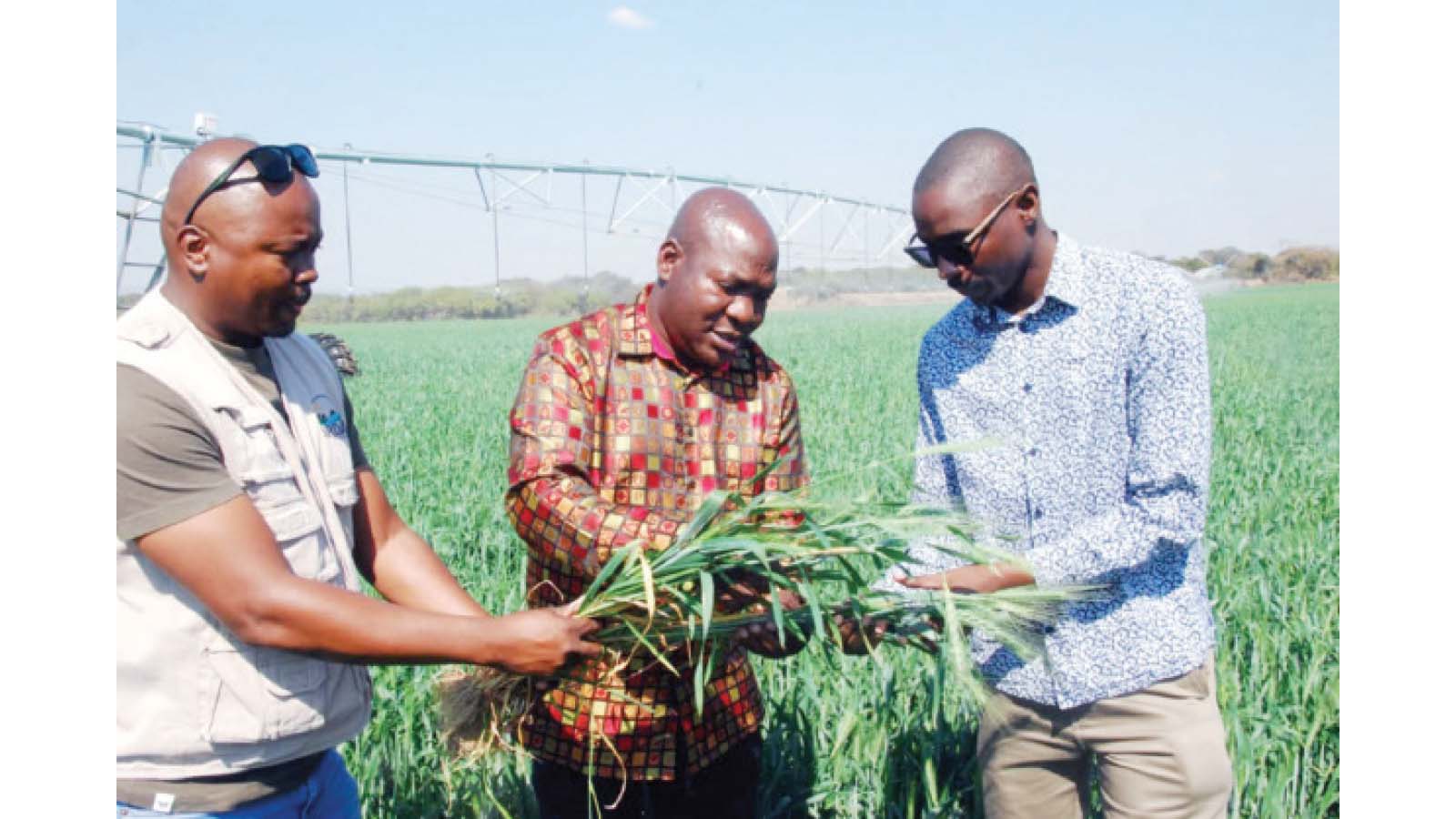
Theseus Mauruki Shambare
THE next drought has not yet arrived.
But on a crisp winter morning at Victory Farm in Mashonaland West province, Zimbabwe is already preparing for it.
A drone slices through the cold air, sweeping over an emerald sea of wheat.
Below, centre-pivot irrigation systems rotate with quiet precision, delivering water to a crop expected to yield about six tonnes per hectare.
Agronomists study digital dashboards while tractors and harvesters stand ready for another production cycle.
The scene is striking not because of the machinery, but because of what it represents.
This is where Zimbabwe is trying to answer one of the defining questions of its agricultural future: Can the country build its food security before the next climate shock arrives?
Behind every tonne of wheat harvested here lies a much larger question.
Can Zimbabwe keep bread affordable when drought returns?
Can millers source enough grain locally?
Can vulnerable households avoid the hunger and soaring food prices that have accompanied previous El Niño-induced seasons?
The answers may begin in fields such as these, where climate resilience is no longer simply an environmental ambition but an economic necessity.
For Mr Tichaona Mapfoche, chairperson of the Strategic Grain Reserve (SGR) 200 Hectare Plus Club Zimbabwe, the answer begins with production.
“I am doing 1 000 hectares of wheat from various farms I have entered into joint ventures with after being capacitated under the ARDA (Agricultural and Rural Development Authority) framework,” he said.
The confidence with which he now speaks about producing wheat on such a scale gives little indication of where his journey began.
Born in Chivhu in 1982, Mr Mapfoche first worked in the packaging industry before briefly joining South Africa’s construction sector.
Returning home in 2009, he ventured into the transport business, growing a single commuter omnibus into a sizeable fleet.
Farming came later.
In 2014, armed with little more than determination, he planted three hectares of potatoes in Beatrice using an ox-drawn plough.
The crop failed. Many would have walked away.
He did the opposite.
“I refused to give up,” he recalled.
Instead of abandoning agriculture, he learnt from failure, reinvested every available dollar and gradually expanded production.
Fifteen hectares became hundreds.
Irrigation pivots replaced ox-drawn ploughs.
Wheat, maize, sorghum and potatoes replaced uncertainty.
Structured support
Today, Mr Mapfoche coordinates about 1 500 hectares (ha) of production, including 1 000ha under irrigation, spread across nine joint venture farms in Zvimba and Makonde districts.
He attributes that remarkable rise to Zimbabwe’s Land Reform Programme, Government-backed mechanisation, financing through CBZ Bank and AFC Land Bank, and, more recently, the ARDA joint venture model.
For him, affordable financing has become just as important as rainfall.
“After Command Agriculture, financing was left largely to commercial banks, where high interest rates threatened production viability. ARDA stepped in with structured support, affordable financing and reliable markets that gave farmers the confidence to expand production,” he said.
His story mirrors a broader transformation taking place across Zimbabwe’s agricultural landscape.
Once largely associated with administering State land, ARDA has evolved into Zimbabwe’s national food security agency tasked with driving commercial grain production, irrigation development, climate-smart agriculture and rural industrialisation. Its mission is bigger than farming.
It is to build a permanent buffer against hunger.
The transformation aligns with Sustainable Development Goal Two, which calls on countries to end hunger, achieve food security, promote sustainable agriculture and build resilient farming systems capable of withstanding climate change.
The cost of failing to prepare
For Zimbabwe, those global aspirations have become an urgent national priority.
Climate scientists have warned of a likely return of El Niño conditions during the 2026/2027 agricultural season, raising the prospect of below-normal rainfall across Southern Africa.
Zimbabwe understands the cost of failing to prepare.
Following the devastating 2023/2024 drought, the country spent close to US$1 billion importing grain and oilseeds to stabilise domestic food supplies.
The lesson was unmistakable.
Food security cannot begin when drought starts.
It must be built long before the first failed rains.
Every dollar spent importing grain is a dollar that could otherwise finance irrigation infrastructure, mechanisation, agricultural research or rural industries.
Climate resilience, therefore, is no longer simply an agricultural objective.
It has become an economic strategy aimed at protecting national sovereignty while reducing dependence on imports.
That philosophy now underpins ARDA’s production model.
The authority has already surpassed its target of delivering 150 000 tonnes of grain to the SGR from the previous summer cropping season.
Another 150 000 tonnes is expected from the current winter wheat crop, while a further 150 000 tonnes is targeted from the forthcoming summer season, creating a strategic grain buffer before the anticipated El Niño-induced season.
Preparations are also underway to place at least 75 000ha under irrigated maize during the coming summer, while farmers in drier regions will increasingly focus on traditional grains such as sorghum and millet, crops better suited to changing climatic conditions.
Speaking during Parliament’s nationwide oversight visit to ARDA estates and supported farms, the authority’s chief executive officer, Mr Tinotenda Mhiko, said Zimbabwe’s approach to agriculture had fundamentally shifted from reacting to droughts to preparing for them.
“The observations by the Portfolio Committee reinforce the critical role ARDA is playing as the national food security agency,” he said.
“Our mandate goes beyond producing grain; it is about creating a resilient agricultural ecosystem where farmers, communities and the nation can withstand climate shocks and guarantee food availability.”
ARDA, Mr Mhiko said, was strengthening climate-smart seed production while expanding farmer support through technical expertise, production assistance and innovative financing.
“Currently, about 32 percent of our production is directly financed by ARDA, while the remainder is being unlocked through bank guarantees, allowing more farmers to participate in productive agriculture,” he said.
He said the authority planned to expand irrigation infrastructure to 25 000ha by 2030, significantly reducing dependence on increasingly unpredictable rainfall.
Leveraging technology
Technology has become agriculture’s newest crop.
At Victory Farm, agronomists no longer wait for wheat to show visible signs of stress.
Drones equipped with advanced sensors detect nutrient deficiencies before they become visible to the human eye.
Digital monitoring systems track crop performance in real time.
Artificial intelligence analyses weather forecasts, soil moisture and crop growth patterns, enabling irrigation systems to deliver water only where and when it is needed.
Every hectare is managed with unprecedented precision.
Every litre of water counts. Every decision is increasingly driven by data.
For a country where rainfall has become increasingly erratic, technology is emerging as one of agriculture’s most valuable inputs.
The transformation has not gone unnoticed beyond Zimbabwe’s borders.
During a recent visit to ARDA-supported farms, Kavango East Region governor Hambyuka Hamunyera of Namibia described Zimbabwe’s approach as a model worthy of emulation.
“When you compare it to where I come from — Namibia — we have farmers, but it is not the way they are doing it here,” he said.
“There is one thing which one has to learn from here. What they are doing is wonderful, and we are ready in the few years to come for us to say, ‘go away food insecurity, go away hunger, go away poverty.’”
Those sentiments were echoed by Parliament’s Portfolio Committee on Lands, Agriculture, Water, Fisheries and Rural Development after touring ARDA estates and supported farms across the country.
Committee chairperson Hon Felix Maburutse said what legislators had witnessed demonstrated Zimbabwe’s growing capacity to secure its own food future.
“With what we have been witnessing across provinces, it is clear that we are destined for greatness if we continue on this path,” he said.
“We urge ARDA to engage more farmers so that we grow a pool of potential farmers whom we can rely on to drive the food security agenda.
“It is never too late to achieve food security. This is the right time to show the world what we are capable of doing. We have seen how even Namibians were impressed with our approach to food security. We are no longer doing this for ourselves, but we are becoming a regional agricultural and industrial hub.”
For Mr Mapfoche, however, success is no longer measured by the number of hectares he cultivates.
It is measured by how many farmers he helps to grow.
As chairperson of the SGR 200 Hectare Plus Club Zimbabwe, he champions a philosophy that has become the organisation’s guiding principle.
“We only grow by growing others.”
The club brings together established and emerging commercial farmers, facilitating access to mentorship, production knowledge, structured financing and modern farming technologies, with particular emphasis on empowering young Zimbabweans.