peter
peter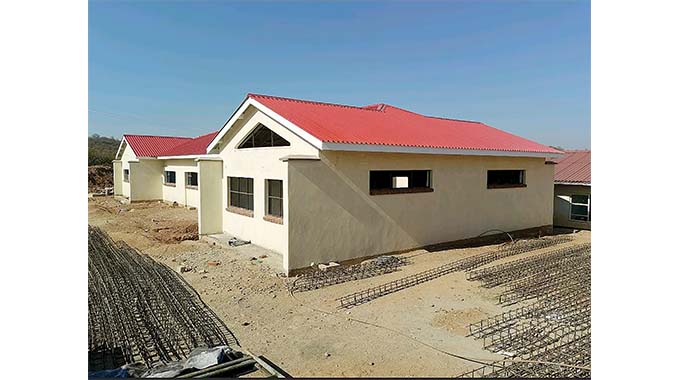
Rutendo Nyeve, Sunday News Reporter
AN engineering laboratory and innovation complex at Gwanda State University (GSU) is more than ninety percent complete with the project set to spur mineral beneficiation and exploration in the mineral rich Matabeleland South province as the country moves towards achieving a US$12 billion mining industry milestone.
The university has also set sights on harnessing the region’s livestock potential with flourishing agriculture projects on course backed by 200 breeding heifers, 300 breeding goats and 2 000 layers while the construction of an agro-innovation hub and industrial park is at 60 percent completion.
The fairly new university is pacing up and joining other tertiary institutions in the country which have set up innovation hubs and industrial parks that are propelling the country’s modernisation and industrialisation thrust through local production of goods and services.

The innovative focus by institutions of higher learning is in line with the Government’s drive to transform the economy into an upper middle-income status by 2030 through Education 5.0. Sunday News recently visited the university and got the full scope of the projects with Information and Public Relations Officer Mr Walter Ndlovu saying the engineering laboratory and innovation complex will be completed by end of September with commissioning set to be done by the President in November during the university’s graduation ceremony.
“The construction of the engineering laboratory and innovation complex is at 92 percent towards completion. So far, the cost of the project is ZWL$706 000 000. The project is expected to be completed at the end of September 2023 and commissioning is expected to take place on 17 November 2023 when the University will be holding its graduation ceremony.
Thereafter, the Engineering Laboratory and Innovation Complex will be fully operational,” said Mr Ndlovu.
He said the laboratory will enable the university to train engineering and mining graduates that have the requisite skills and competences fit for purpose.

“The Engineering Laboratory and Innovation Complex is set to spur mineral beneficiation and exploration as the country moves towards attaining a US$12 billion mining milestone and beyond. It will support the small-scale miners and established mining houses through assays of samples at reduced cost. It will be instrumental in providing teaching and research facilities that will yield high-end innovations and competitive graduates. The faculty and departments will assist small-scale miners through hands-on training on various aspects of mining, mineral recovery, safety issues and environmental management and remediation,” said Mr Ndlovu.
Also cognisant of the agriculture potential in the region, Mr Ndlovu said the university was running various livestock and breeding projects which were supplying the surrounding business communities as well as staff and students’ needs.
“Gwanda State University has a thriving livestock project that consists of 200 breeding heifers, 300 breeding goats and 2 000 layers. Egg production is prolific and the university supplies the Filabusi business community as well as staff and student needs. The poultry project is being extended to accommodate an additional 3 000 birds thus bringing the total number of layers to a projected 5 000 by September 2023. The cattle herd is expected to increase at the end of 2023 following the bulling of 80 heifers,” said Mr Ndlovu.

The university is also constructing an agro-innovation hub and industrial park which is expected to play a pivotal role in the production of agricultural products through equipping students with requisite skills in the use of smart technologies.
“Construction of the agro-innovation hub and industrial park is at 60 percent completion. It will be the bedrock for production of agricultural products such as crops and livestock as well as training of graduates through use of smart technologies to contribute to the food security cluster as envisaged in the NDS1 blueprint.
“So far, ZWL$348 967 424 has been injected towards the project. As the project is being undertaken in three phases (2022, 2023 and 2024), completion is envisaged in December 2024,” said Mr Ndlovu.
Tertiary institutions’ innovation hubs and industrial parks have propelled the country’s modernisation and digitalisation thrust while saving on imports of various products. Ideas hatched in innovation hubs have so far led to the commissioning of the Marula processing plant in Rutenga, Mwenezi and the production of medical and industrial oxygen at a plant near Feruka in Mutare by Verify Engineering, through the mechanism of the heritage-based solution.
At the Harare Institute of Technology (HIT), innovation hubs have birthed national projects such as the Zupco tap-card system, the fuel management system which provides a real-time fuel monitoring, the electrical power transformers manufacturing, and the local authorities digital systems (LADS). -@nyeve14



 Online Reporter