admin
admin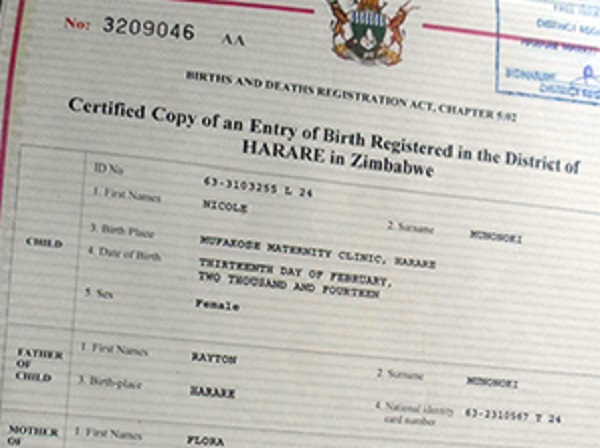

A birth certificate is a fundamental document any person must have if they are to function effectively and holistically.
It formally identifies the person who holds it. A person who does not have it is unknown, effectively they don’t exist. He or she cannot go to school to acquire an academic qualification. Without an academic qualification, one cannot proceed to tertiary institutions such as colleges or universities to acquire a professional qualification. They, therefore, cannot acquire a formal job, cannot seek and secure a political position.
There can be exceptions here and there but a person in this circumstance is frequently condemned to a life of poverty thanks to the encumbrance of non-registration and its negative multiplier effects. The predicament is worse if we consider that such a person cannot have his or her children registered as well. It therefore becomes a generational challenge.
A staggering 2,4 million children under the age of 17, or 39 percent of minors in the country, are living in such a situation, according to the Zimbabwe (2016-2018) Interim Poverty Reduction strategy paper (I-PRSP). Most of the unrecorded births are in rural areas.
“Children aged between 0-17 years totalling 2,4 million, had no birth certificates, constituting 38.9 percent. Rural areas had a higher proportion (45,7 percent) of children aged 0-17 years with no birth certificates, compared to urban areas with 21,7 percent,” reads the document.
It is obvious that the population of people who are unregistered is far higher than the 2,4 million as the I-PRSP covered minors only. There are many more who are adults who are not covered by the strategy paper. This tells us that the challenge is huge, thus demands immediate corrective action.
Reasons why so many children are unregistered are many.
Some parents might just be lazy, irresponsible or unwilling to have their children registered. This sometimes happens when there are paternity disputes.
It can also be because of orphanhood with treasury’s strategy paper saying in 2012 there were 982 839 children. The prevalence of orphanhood is 34.4 percent in rural areas, a large figure compared to 7,1 percent in urban areas. Without a father or mother or both parents, there is no one to step forward to register a child.
Probably the biggest hindrance to children obtaining birth certificates is lack of the service in some of the remote areas in the country. The nearest the Registrar-General’s Office is to the population in the countryside is at district capitals which are typically situated long distances away from some villages.
Seeing that the impact of unregistered births is huge and sometimes generational, the Government has from time to time run mobile birth and death registration processes, reaching people in desperate need for birth certificates in the remotest parts of the country. During voter registration exercises conducted at five-year intervals, some people have taken advantage to get registered.
However, we note that these, in addition to existing district offices are not effective enough, hence the 2,4 million unregistered children, not counting those aged more than 17. We note the prevailing economic challenges and their effect on government revenue, but birth registration must be a priority issue with long-term ramifications on people’s wellbeing. Therefore, we implore the Government to further decentralise the RG’s Office.
It may not be down to ward level, but wards can be clustered so the services are available closer to those who need them. If resources don’t permit for the establishment of fully-fledged sub-offices from district centres, the Government can consider ensuring that mobile units are deployed more regularly, perhaps twice or once every year.
On parents who see no reason to register the births of their children, we encourage the political and traditional leaders to make it a point that they raise awareness in their areas on the dangers of non-registration.
We noted the issue of orphans who are only known to exist by their relatives and neighbours, but don’t exist in the eyes of the Government. There should be a way the political and traditional leadership can offer themselves as witnesses at the RG’s Office for such people to be registered.


 Online Reporter