

 admin
admin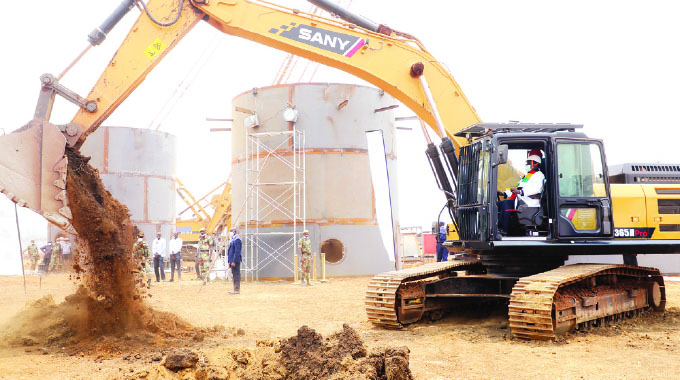
THE creation and recreation of Zimbabwean primary and heavy industry is moving forward rapidly under the Second Republic with the largest single investment, the giant steel mills of the Dinson Iron and Steel Company at Manhize, meeting another milestone last week with the ground-breaking ceremony.
President Mnangagwa must have been delighted to accept the invitation to officiate since he had personally made the contacts and given the investor the assurances required to put in a very large steel mill with associated processing plants, plus the investment into mining, other metal processing and coking.
And no doubt he will be there again next year when the first blast furnace goes live.
Dinson, a subsidiary of Tsingshan Holdings, a giant private Chinese conglomerate, has been proceeding steadily with its huge investment since Tsingshan founder Xiang Guangda met President Mnangagwa in China in the very early days of the Second Republic.
The President was able to assure Mr Xiang that his pro-investment policy was serious and for real, that Tsingshan would be able to invest with the minimum of fuss, that the Government would smooth out any problems and that the first Zimbabwean who even whispered about a “present” would be in very serious trouble.
But what is also now needed is for other Zimbabwean industrialists to start working out their future with a secure supply of steel, which will include the useful forms for sheet, various stainless steels and other primary products as well as the ingots and rods.
Dinson will be making steel, in a lot of forms, but will not be making things with that steel. That needs other manufacturers, but with an assured supply of quality local steels they have no excuse not to start.
But they need to start planning now so that when the blast furnaces and other mills start producing they are ready.
Tsingshan are using their Zimbabwean works to supply their products to regional markets across a swathe of Africa.
That is one reason why the mills are so big, able to produce 600 000 tonnes a year. For a start with all raw materials on site or a short journey away, costs are lower so the mills are very viable.
Secondly with free trade becoming ever more common in Africa, with SADC and Comesa now existing and the Africa Free Trade Area itself in process of initial formation, being inside these free trade areas is important.
Dinson, using 100 percent Zimbabwean raw materials in Zimbabwean mills will meet every single rule of origin for free trade, so will be able to increase exports as freer trade opens up. But besides these large flows of exports, Zimbabweans will also be a major customer. Right now steel imports are one of the larger blocks of purchases on the foreign exchange auctions, so the demand is there although at the moment largely in the construction industry, but there is plenty for manufacturing as well as meeting primary exports.
And a lot of that manufacturing output can also go into export markets as well as domestic markets. Once again costs come down.
Importing steel to make goods for export adds to costs. Moving steel short distances inside Zimbabwe makes these costs lower, and so makes more manufacturing for export viable. But now these users of steel, and potential users of steel, need to start showing the same commitment we have seen from Tsingshan through Dinson.
After being satisfied that President Mnangagwa was willing to act on his promises and policies, Tsingshan then started moving, setting up the Dinson companies and sorting out all the preparatory work, including investments into nickel and chrome processing, building coking ovens in Hwange and commissioning the first unit of its large power station, also in Hwange.
Manhize, near Mvuma, was considered the ideal site for the steel mills, right by a large and very rich field of easily mined iron ore, the necessary limestone in the area, the other metals, primarily chrome and nickel for the alloys.
These are easy to move by truck once processing plants are turning out ingots. Even the coke from Hwange is easy to transport. Even the major electricity grid connection, so that the new power station on the coal fields could feed the new steel works, was organised, with the Government agreeing to the joint venture with Zesa with negligible delay.
And now the first destinations in that journey are in sight.
The question is will Zimbabwean industry be ready to take up the baton and keep running, so we get double benefit, first from Dinson and then from everyone else?
Zimbabwe has rapidly growing agricultural and mining sectors, and has a solid although easily expandable secondary industrial base. The missing part has been the bit in between.
The Second Republic is encouraging the investment needed to fill that absolutely critical gap, and in fact last week was a good week for this.
A couple of days before going down to Manhize for the ground-breaking ceremony, President Mnangagwa was represented in Chegutu for the re-commissioning of David Whitehead Textiles by another significant and active investor.
Last week showed that respectable and responsible investors appreciate the policies being pursued by the Second Republic and accept that the Government is not just promising but delivering on promises.
So they respond, and they too deliver. This is how it should be and this is how Zimbabwe will be able to forge ahead so much more quickly.



 Online Reporter