

 admin
admin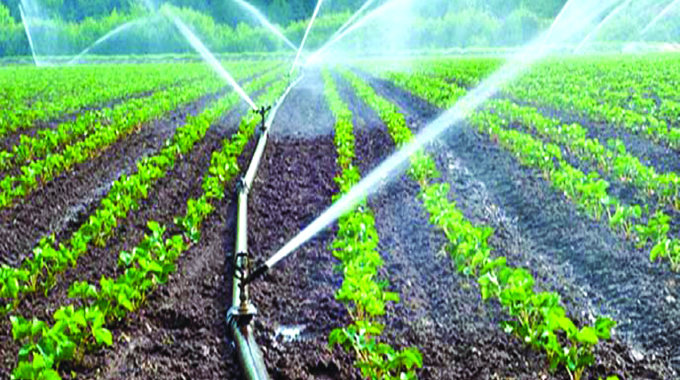
A GREAT deal of progress has been made over the past few years under the Second Republic to ensure that both small-scale and commercial farmers have access to the correct inputs and are planting the best crops for each ecological zone, but the severe drought in the last summer season showed the need for a lot more irrigation.
Already since 2020, the amount of land under irrigation has been increased four-fold, with older irrigation systems rehabilitated and upgraded, and new schemes being opened and commissioned.
In addition to the new dams, there is also the fast borehole programmes and village business units connected to the new boreholes, and the new water points for livestock.
While the implementation of Pfumvudza/Intwasa saw small-holder progress, which needs to be continuous, it has been noted that some provision for a lot more access to irrigation needs to be built up.
The build-up needs to go beyond the creation of new irrigation schemes and the distinct separation of dryland and full irrigation farming.
A lot of summer irrigation requires supplementary irrigation. In a normal season, or one of the better watered seasons, supplementary irrigation will simply aid higher yields, largely by allowing early planting and being able to cope with any gaps in the rainfall.
In drought years, the supplementary irrigation could be as high as half the water that the crops in some areas need.
Supplementary irrigation keeps the costs down, while still guaranteeing the yields and so making full use of the rest of the inputs, including fertiliser and seed.
In the livestock sectors, the supplementary irrigation will help ensure that the forage crops are sufficient to supplement pastures and that water points are available for cattle and other livestock, largely through boreholes.
The main difference between irrigation of winter crops, such as wheat, and summer crops, such as maize, is that even in the worst drought years, the same irrigation water and equipment for a hectare of wheat will irrigate at least 2ha of summer crops, and probably quite a bit more.
Supplementary irrigation can also allow farmers to select the higher-yield longer maturing varieties, although careful calculations need to be done to ensure that the extra costs of water are value for money.
Sometimes the faster maturing varieties with the lower water demands may well provide better value.
Pfumvudza has been a major success story, both in the conservation farming methods, the supply of inputs and the matching of the right crops in each zone.
Around half the farmers, even in a very bad drought, had reduced yields rather than total write-offs of crops as a result.
Now the challenge will be to find ways of getting some supplementary irrigation to these farmers.
In the meantime, the farmers will need sympathetic encouragement after the very bad drought to continue the hard work that Pfumvudza requires, as in most seasons it will produce not just the results, but the best possible results.
The continuing construction of new dams, and the reservoirs and fish tanks that come from the borehole drilling, means that fisheries are being developed to move from a modest marginal addition to food production to becoming one of the central pillars of agriculture.
Already 59 dams have been stocked with 465 000 fingerlings and commercial cage fishing is to be promoted as a business on 134 dams.
The expansion of irrigation should mean that even in a bad year, the farmers can grow the 1,8 million tonnes of summer grain that are needed, with surpluses coming in the better years, surpluses that can be stored in strategic reserves for the bad years and, as irrigation expands, even exported.
One major area for increasing production is the Agricultural and Rural Development Authority (ARDA). This very large State agency has been a very bad patch and has not been the major production agency it was intended to be, despite the amount of land allocated.
A lot of the ARDA land is in the lower rainfall areas, where it might be difficult for individual farmers to operate and hence the need for larger estates, but with irrigation resources in the areas.
Last year, the Government approved the reactivation of ARDA to something far closer to its full potential of 500 000 tonnes of summer grains on 100 000ha of irrigated land, and 300 000 tonnes of winter wheat on 60 000ha of irrigated land.
The summer harvest should be higher since efficient estates should have yields higher than 5 tonnes a hectare.
ARDA now needs to implement the sort of farming practices and targets that it has been set.
The huge State enterprise should be growing something close to a third of Zimbabwe’s minimum food requirements and when we look at this year’s food import bill for food aid, we note that the proposed ARDA output is in fact higher, and so could provide some of the other deficiencies that the private sector has to fill for the commercial grain demand.
The irrigation may well require capital spending to bring it back up to the required level and to extend what needs to be rehabilitated. But this capital spending will be worthwhile if it results in Zimbabwe always being self-sufficient, even in the worst climatic years.
Climate change and global warming will see a higher rate of El Nino years, and these will probably be worse El Ninos.
The El Nino phenomenon is largely driven by the backwash of warmer waters in the central Pacific, so warmer oceans mean they will be worse and more frequent.
This requires Zimbabwe to cope, and the projected expansion of irrigated land, and irrigation facilities, needs to be pushed hard.



 Peter Tanyanyiwa
 Online Reporter