Online Reporter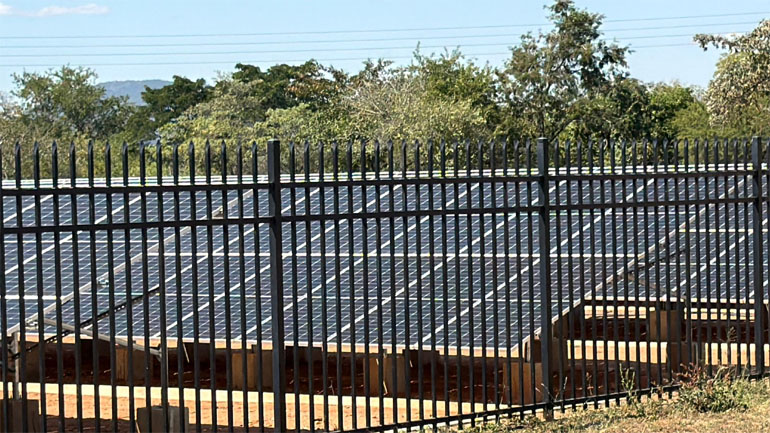
LAST Thursday’s commissioning of the 153kW Nzvimbe solar mini-grid in Manicaland is more than just an energy milestone — it is a profound turning point in the story of rural transformation, resilience, and innovation.
For decades, communities like Nzvimbe have lived with the limitations of unreliable or non-existent electricity, a reality that has constrained economic growth, hindered access to modern education and healthcare, and perpetuated cycles of poverty.
With the flick of a switch, this solar mini-grid has illuminated, not only homes and schools, but also the boundless possibilities of a brighter future.
Electricity is often described as the lifeblood of modern society, and for Nzvimbe, this lifeblood has finally begun to flow steadily.
Families who once relied on paraffin lamps or candles can now enjoy safe, clean lighting.
Children can study after sunset without straining their eyes, and schools can integrate digital learning tools that connect learners to the wider world. Clinics and health centres, previously constrained by the absence of refrigeration and reliable power, can now store vaccines and operate essential equipment, ensuring that healthcare delivery is both timely and effective.
In short, the mini-grid is not just powering bulbs and appliances—it is powering opportunity, dignity, and hope.
Economically, the ripple effects are equally transformative.
Small businesses, from tailors to welders, can now operate with greater efficiency and expand their services. Farmers can process their produce locally, adding value before it reaches the market.
Women, who often bear the brunt of energy poverty, are empowered to pursue entrepreneurial ventures that were previously impossible without electricity. The mini-grid, thus becomes a catalyst for inclusive growth, ensuring that prosperity is not confined to urban centres but reaches the heart of rural Manicaland.
Beyond the immediate community, the Nzvimbe solar mini-grid positions Manicaland as a national hub for renewable energy innovation.
Zimbabwe’s energy challenges are well-documented, with demand often outstripping supply and reliance on fossil fuels proving both environmentally unsustainable and economically burdensome.
By embracing decentralised, renewable solutions like mini-grids, Manicaland is charting a path that other provinces can emulate.
The region is demonstrating that clean energy is, not a distant aspiration, but a practical, scalable solution that can be deployed today to meet the needs of underserved communities.
This commissioning also speaks to a broader narrative of climate resilience. Rural communities are often the most vulnerable to the impacts of climate change, yet they are also the least responsible for the emissions driving it.
By harnessing solar power, Nzvimbe is, not only reducing its carbon footprint, but also insulating itself from the volatility of fuel prices and the fragility of centralised grids.
In doing so, Manicaland is aligning itself with global commitments to sustainability while ensuring that local communities reap tangible benefits.
The symbolism of this achievement cannot be overstated.
It is a testament to the power of collaboration—between Government, private sector, and local communities—to deliver solutions that are both visionary and practical.
It is a reminder that progress does not always come in the form of massive infrastructure projects in capital cities; sometimes, it comes quietly, in the form of a solar panel array in a rural village, changing lives in ways that are both profound and enduring.
As Zimbabwe looks to the future, the Nzvimbe solar mini-grid stands as a beacon of what is possible when innovation meets determination.
It challenges us to imagine a country where every rural community has access to clean, reliable energy; where children in the remotest villages can dream as boldly as those in urban centres; and where the pursuit of sustainability is, not a burden, but a shared opportunity.
Manicaland, through this project, has declared itself, not just a participant in the renewable energy revolution, but a leader, a hub, and an inspiration. In celebrating this commissioning, we celebrate more than a technical achievement. We celebrate the dawn of a new era for Nzvimbe, for Manicaland, and for Zimbabwe. An era where light replaces darkness, opportunity replaces limitation, and hope replaces despair.
The 153kW solar mini-grid is not just an installation of panels and wires—it is a promise fulfilled, a future secured, and a powerful reminder that when communities are empowered with energy, they are empowered with life itself.